
Homework Answers
please tell what the question is about part b. The question is not clear about part b.
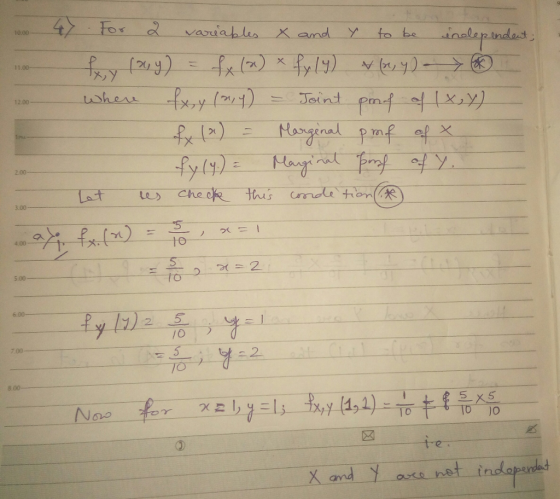
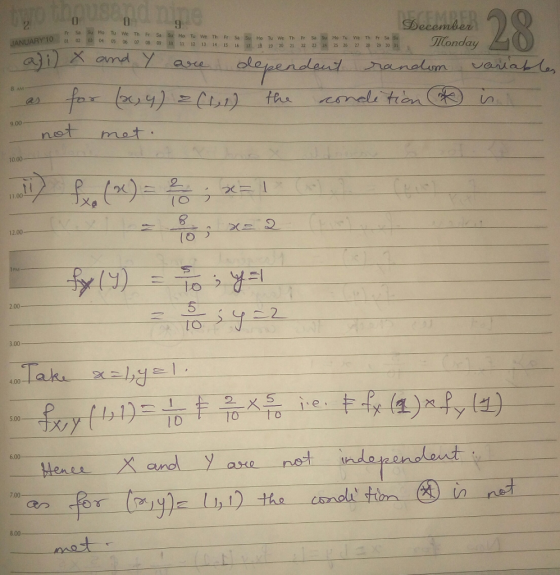
part a is given below:
Add Answer to:
4. For each of the following sets of variables, classify them as independent or dependent. Justify...
Problem 1 Consider a sequence of n+m independent Bernoulli trials with probability of success p in each trial. Let N be the number of successes in the first n trials and let M be the number of suc...
 Problem 1 Consider a sequence of n+m independent Bernoulli trials with probability of success p in each trial. Let N be the number of successes in the first n trials and let M be the number of successes in the remaining m trials. (a) Find the joint PMF of N and M, and the marginal PMFs of N and AM (b) Find the PMF for the total number of successes in the n +m trials.
Problem 1 Consider a sequence...
Problem 1 Consider a sequence of n+m independent Bernoulli trials with probability of success p in each trial. Let N be the number of successes in the first n trials and let M be the number of successes in the remaining m trials. (a) Find the joint PMF of N and M, and the marginal PMFs of N and AM (b) Find the PMF for the total number of successes in the n +m trials.
Problem 1 Consider a sequence...
You perform a sequence of m+n independent Bernoulli trials with success probability p between (0, 1)....
You perform a sequence of m+n independent Bernoulli trials with success probability p between (0, 1). Let X denote the number of successes in the first m trials and Y be the number of successes in the last n trials. Find f(x|z) = P(X = x|X + Y = z). Show that this function of x, which will not depend on p, is a pmf in x with integer values in [max(0, z - n), min(z,m)]. Hint: the intersection of...
Suppose that total 5 independent trials having a common probability of success 1/3 are performed. If...
 Suppose that total 5 independent trials having a common probability of success 1/3 are performed. If X is the number of successes in the first2 trials, and Y is the number of successes in the final 3 trials, then X and Y are independent, since knowing the number of successes in the first 2 trials does not affect the distribution of the number of successes in the final 3 trials (by the assumption of independent trials). Find the joint p.d.f....
(5) Suppose we conduct five independent Bernoulli trials, each with a 60% probability of success. (a)...
(5) Suppose we conduct five independent Bernoulli trials, each with a 60% probability of success. (a) Find the probability of each: • 0 successes • 1 success • 2 successes • 3 successes • 4 successes • 5 successes (b) Plot the probability mass function (pmf) and the cumulative probability distribution (cdf) for the number of successes in the five trials (using your findings from part a).
Classify the following sets of samples as Independent or Dependent, by writing Independent or Dependent by...
Classify the following sets of samples as Independent or Dependent, by writing Independent or Dependent by the appropriate set of samples. (a) Sample 1: The fastest running times of 53 track runners. Sample 2: The fastest running times of the same 53 track runners after completing a new training program. (b) Sample 1: The average salary earned by 102 industry workers in Pittsburgh, PA. Sample 2: The average salary earned by 102 industry workers in Erie, PA.
2. Suppose 4 Bernoulli trials, each with success probability p, are con ducted such that the...
 2. Suppose 4 Bernoulli trials, each with success probability p, are con ducted such that the outcomes of the 4 experiments pendent. Let the random variable X be the total number of successes over the 4 Bernoulli trials are mutually inde- (a) Write down the sample space for the experiment consisting of 4 Bernoulli trials (the sample space is all possible sequences of length 4 of successes and failures you may use the symbols S and F). (b) Give the...
For each Bernoulli process, find the expected number of successes: 1. Number of trials =10, Probability...
For each Bernoulli process, find the expected number of successes: 1. Number of trials =10, Probability of success =0.6 2. Number of trials =210, Probability of success =1/10. 3. Number of trials =43, Probability of success =0.3. 4. Number of trials =23, Probability of failure =0.8. 5. Number of trials =59, Probability of failure =2/7.
13 atoms, each of which decays by emission of an a-particle after an exponentially distributed lifetime...
 13
atoms, each of which decays by emission of an a-particle after an exponentially distributed lifetime with rate 1, independently of the others. Let T, be the time of the first a-particle emission, T, the time of the second. Find: a) the distribution of T: b) the conditional distribution of T2 given T: c) the distribution of T2. 13. Let X and Y be independent random variables, X with uniform distribution on (0,3), Y with Poisson (1) distribution. Find: a)...
13
atoms, each of which decays by emission of an a-particle after an exponentially distributed lifetime with rate 1, independently of the others. Let T, be the time of the first a-particle emission, T, the time of the second. Find: a) the distribution of T: b) the conditional distribution of T2 given T: c) the distribution of T2. 13. Let X and Y be independent random variables, X with uniform distribution on (0,3), Y with Poisson (1) distribution. Find: a)...
1. Suppose X,Y are random variables whose joint pdf is given by f(x, y) = 1/...
1. Suppose X,Y are random variables whose joint pdf is given by f(x, y) = 1/ x , if 0 < x < 1, 0 < y < x f(x, y) =0, otherwise . Find the covariance of the random variables X and Y . 2.Let X1 be a Bernoulli random variable with parameter p1 and X2 be a Bernoulli random variable with parameter p2. Assume X1 and X2 are independent. What is the variance of the random variable Y...
Consider the discrete random variables X and Y with the following joint p.m.f. Pxr(r,y) 1 0.03...
 Consider the discrete random variables X and Y with the following joint p.m.f. Pxr(r,y) 1 0.03 0.100.09 0.08 2 0.050.280.07 0.10 3 0.02 0.120.04 0.02 Find the marginal p.m.F. of X P1 4 Find the marginal p.m.f. of Y Find the conditional p.m.F. of X given Y 3 Find the conditional p.m.f. of X given Y 3. Pae) 2 3 4 . Find the conditional p.m.f. of Y given X 3 .1 . Find the following probabilities Check
 Problem 1 Consider a sequence of n+m independent Bernoulli trials with probability of success p in each trial. Let N be the number of successes in the first n trials and let M be the number of successes in the remaining m trials. (a) Find the joint PMF of N and M, and the marginal PMFs of N and AM (b) Find the PMF for the total number of successes in the n +m trials.
Problem 1 Consider a sequence...
Problem 1 Consider a sequence of n+m independent Bernoulli trials with probability of success p in each trial. Let N be the number of successes in the first n trials and let M be the number of successes in the remaining m trials. (a) Find the joint PMF of N and M, and the marginal PMFs of N and AM (b) Find the PMF for the total number of successes in the n +m trials.
Problem 1 Consider a sequence...
 Suppose that total 5 independent trials having a common probability of success 1/3 are performed. If X is the number of successes in the first2 trials, and Y is the number of successes in the final 3 trials, then X and Y are independent, since knowing the number of successes in the first 2 trials does not affect the distribution of the number of successes in the final 3 trials (by the assumption of independent trials). Find the joint p.d.f....
 2. Suppose 4 Bernoulli trials, each with success probability p, are con ducted such that the outcomes of the 4 experiments pendent. Let the random variable X be the total number of successes over the 4 Bernoulli trials are mutually inde- (a) Write down the sample space for the experiment consisting of 4 Bernoulli trials (the sample space is all possible sequences of length 4 of successes and failures you may use the symbols S and F). (b) Give the...
 13
atoms, each of which decays by emission of an a-particle after an exponentially distributed lifetime with rate 1, independently of the others. Let T, be the time of the first a-particle emission, T, the time of the second. Find: a) the distribution of T: b) the conditional distribution of T2 given T: c) the distribution of T2. 13. Let X and Y be independent random variables, X with uniform distribution on (0,3), Y with Poisson (1) distribution. Find: a)...
13
atoms, each of which decays by emission of an a-particle after an exponentially distributed lifetime with rate 1, independently of the others. Let T, be the time of the first a-particle emission, T, the time of the second. Find: a) the distribution of T: b) the conditional distribution of T2 given T: c) the distribution of T2. 13. Let X and Y be independent random variables, X with uniform distribution on (0,3), Y with Poisson (1) distribution. Find: a)...
 Consider the discrete random variables X and Y with the following joint p.m.f. Pxr(r,y) 1 0.03 0.100.09 0.08 2 0.050.280.07 0.10 3 0.02 0.120.04 0.02 Find the marginal p.m.F. of X P1 4 Find the marginal p.m.f. of Y Find the conditional p.m.F. of X given Y 3 Find the conditional p.m.f. of X given Y 3. Pae) 2 3 4 . Find the conditional p.m.f. of Y given X 3 .1 . Find the following probabilities Check
Most questions answered within 3 hours.
-
Where is the error in this code sequence?
String s1 = "Hello";
String s2 = "ello";...
asked 11 months ago -
Financial data for Joel de Paris, Inc., for last year
follow:
Joel de Paris, Inc.
Balance...
asked 11 months ago -
Consider this reaction:
Al2(SO4)3 (aq)+ BaCl3
(aq) Al2Cl6 (aq)- +
3BaSO4(s) . What is the...
asked 11 months ago -
Suppose that Savneet is considering increasing her
recent random sample from 20 car rentals to 40...
asked 11 months ago -
Trucks arrive at an unloading terminal at an average rate of 120
per hour.
Trucks arrive...
asked 11 months ago -
Why are methanol and ethanol completely soluble in water while
octanol is not very little soluble....
asked 11 months ago -
A facilities manager at a university reads in a research report
that the mean amount of...
asked 11 months ago -
When the CuSO4 is rehydrated by adding water to the anhydrous
compound, is this an endothermic...
asked 11 months ago -
A ray of sunlight is passing from diamond into crown glass; the
angle of incidence is...
asked 11 months ago -
A block of mass 0.249 kg is placed on top of a light, vertical
spring of...
asked 11 months ago -
how do the kidneys compensate in the presences of acidosis
a) trigger hyperventilate
b) reserve acid...
asked 11 months ago -
Question 501 pts
The rental rate of capital to the firm increases. Which of the
following...
asked 11 months ago