Problem 2: Proof of Laws Consider sets ? and ?, and: Prove the associative law ?∩(?∩?)=(?∩?)∩?...
Problem 2: Proof of Laws
Consider sets ? and ?, and:
Prove the associative law ?∩(?∩?)=(?∩?)∩? by membership table.
Homework Answers
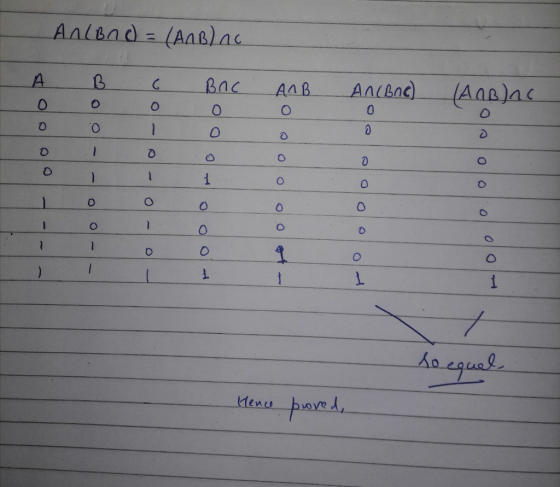
Add Answer to:
Problem 2: Proof of Laws
Consider sets ? and ?, and:
Prove the associative law ?∩(?∩?)=(?∩?)∩?...
Problem 3: Proof of Equalities Consider sets ?, ? and C, and: Prove ((?−?)−?)⊆(?−?) by contradiction.
Problem 3: Proof of Equalities Consider sets ?, ? and C, and: Prove ((?−?)−?)⊆(?−?) by contradiction.
I want to solve it all Q7:- Complete the table a. Commutative law b. Associative law...
 I want to solve it all
Q7:- Complete the table a. Commutative law b. Associative law 2. Laws for matrix multiplication a. Associative law b. Distributive law 3. Inverse of a 2 x 2 matrix 4. Solution of system AX = B (A nonsingular)
I want to solve it all
Q7:- Complete the table a. Commutative law b. Associative law 2. Laws for matrix multiplication a. Associative law b. Distributive law 3. Inverse of a 2 x 2 matrix 4. Solution of system AX = B (A nonsingular)
Prove that and are disjoint sets. PLEASE DO NOT USE AN EXAMPLE AS YOUR PROOF!
 Prove that and
are disjoint sets.
PLEASE DO NOT USE AN EXAMPLE AS YOUR PROOF!
Prove that and
are disjoint sets.
PLEASE DO NOT USE AN EXAMPLE AS YOUR PROOF!
ILULIITUL 10.37 Theorem. (The Generalized Distributive Laws for Sets of Sets.) Let S be a set...
 ILULIITUL 10.37 Theorem. (The Generalized Distributive Laws for Sets of Sets.) Let S be a set and let be a non-empty set of sets. Then: (a) SNU =USNA: AE}. (b) Sund= {SUA:AE). Proof (a) Let = {SNA: AE }. We wish to show that S U = UB. For each 1, we have BESUS iff x S and 2 EU iff xe S and there exists AE such that EA iff there exists AE such that reS and x E...
11. Recall one of De Morgan's laws for families of sets: NACH A = UAEGĀ Equivalently,...
 11. Recall one of De Morgan's laws for families of sets: NACH A = UAEGĀ Equivalently, for all positive integers n: Ain A2 n... An = ALU AU... An Using a proof by induction, prove the latter of the above statements.
11. Recall one of De Morgan's laws for families of sets: NACH A = UAEGĀ Equivalently,...
 11. Recall one of De Morgan's laws for families of sets: NACH A = UAEGĀ Equivalently, for all positive integers n: Ain A2 n... An = ALU AU... An Using a proof by induction, prove the latter of the above statements.
Set Proof: 1. Prove that if S and T are finite sets with |S| = n...
 Set Proof:
1. Prove that if S and T are finite sets with |S| = n and |T| =
m, then |S U T| <= (n + m)
2. Prove that finite set S = T if and only if (iff) (S
Tc) U (Sc T) =
We were unable to transcribe this imageWe were unable to transcribe this imageWe were unable to transcribe this image
Set Proof:
1. Prove that if S and T are finite sets with |S| = n and |T| =
m, then |S U T| <= (n + m)
2. Prove that finite set S = T if and only if (iff) (S
Tc) U (Sc T) =
We were unable to transcribe this imageWe were unable to transcribe this imageWe were unable to transcribe this image
(5) Separate N into two disjoint sets: the evens E, and the odds O. Consider the set of Fibonacci ). Prove (n F and En F are infinite sets,6 numbers {1, 1, 2, 3, 5, 8, 13x13 21x21 8x8 Figure 1.10: An...
 (5) Separate N into two disjoint sets: the evens E, and the odds O. Consider the set of Fibonacci ). Prove (n F and En F are infinite sets,6 numbers {1, 1, 2, 3, 5, 8, 13x13 21x21 8x8 Figure 1.10: An interesting geometric proof could use a patterns of the Fibonacci spiral, although there are simpler proofs. the
(5) Separate N into two disjoint sets: the evens E, and the odds O. Consider the set of Fibonacci ). Prove...
(5) Separate N into two disjoint sets: the evens E, and the odds O. Consider the set of Fibonacci ). Prove (n F and En F are infinite sets,6 numbers {1, 1, 2, 3, 5, 8, 13x13 21x21 8x8 Figure 1.10: An interesting geometric proof could use a patterns of the Fibonacci spiral, although there are simpler proofs. the
(5) Separate N into two disjoint sets: the evens E, and the odds O. Consider the set of Fibonacci ). Prove...
Just question B: Exercise 8.5.2: Proving generalized laws by induction for logical expressions. Prove each of...
 Just question B:
Exercise 8.5.2: Proving generalized laws by induction for logical expressions. Prove each of the following statements using mathematical induction. (a) Prove the following generalized version of DeMorgan's law for logical expressions: For any integer n 22, +(21 A 22A...Axn) = -01 V-32V... Un You can use DeMorgan's law for two variables in your proof: -(21 A32) = -21 V-22 (b) Prove the following generalization of the Distributive law for logical expressions. For any integer n 22 y...
Just question B:
Exercise 8.5.2: Proving generalized laws by induction for logical expressions. Prove each of the following statements using mathematical induction. (a) Prove the following generalized version of DeMorgan's law for logical expressions: For any integer n 22, +(21 A 22A...Axn) = -01 V-32V... Un You can use DeMorgan's law for two variables in your proof: -(21 A32) = -21 V-22 (b) Prove the following generalization of the Distributive law for logical expressions. For any integer n 22 y...
write the proof problem 3 2. Let A, B and C be sets, then Au(Bnc)-(AUB)n (Auc)...
 write the proof problem 3
2. Let A, B and C be sets, then Au(Bnc)-(AUB)n (Auc) 3. Let A and B be sets, then (An B)c-AcUBc.
write the proof problem 3
2. Let A, B and C be sets, then Au(Bnc)-(AUB)n (Auc) 3. Let A and B be sets, then (An B)c-AcUBc.
 I want to solve it all
Q7:- Complete the table a. Commutative law b. Associative law 2. Laws for matrix multiplication a. Associative law b. Distributive law 3. Inverse of a 2 x 2 matrix 4. Solution of system AX = B (A nonsingular)
I want to solve it all
Q7:- Complete the table a. Commutative law b. Associative law 2. Laws for matrix multiplication a. Associative law b. Distributive law 3. Inverse of a 2 x 2 matrix 4. Solution of system AX = B (A nonsingular)
 Prove that and
are disjoint sets.
PLEASE DO NOT USE AN EXAMPLE AS YOUR PROOF!
Prove that and
are disjoint sets.
PLEASE DO NOT USE AN EXAMPLE AS YOUR PROOF!
 ILULIITUL 10.37 Theorem. (The Generalized Distributive Laws for Sets of Sets.) Let S be a set and let be a non-empty set of sets. Then: (a) SNU =USNA: AE}. (b) Sund= {SUA:AE). Proof (a) Let = {SNA: AE }. We wish to show that S U = UB. For each 1, we have BESUS iff x S and 2 EU iff xe S and there exists AE such that EA iff there exists AE such that reS and x E...
 11. Recall one of De Morgan's laws for families of sets: NACH A = UAEGĀ Equivalently, for all positive integers n: Ain A2 n... An = ALU AU... An Using a proof by induction, prove the latter of the above statements.
 11. Recall one of De Morgan's laws for families of sets: NACH A = UAEGĀ Equivalently, for all positive integers n: Ain A2 n... An = ALU AU... An Using a proof by induction, prove the latter of the above statements.
 Set Proof:
1. Prove that if S and T are finite sets with |S| = n and |T| =
m, then |S U T| <= (n + m)
2. Prove that finite set S = T if and only if (iff) (S
Tc) U (Sc T) =
We were unable to transcribe this imageWe were unable to transcribe this imageWe were unable to transcribe this image
Set Proof:
1. Prove that if S and T are finite sets with |S| = n and |T| =
m, then |S U T| <= (n + m)
2. Prove that finite set S = T if and only if (iff) (S
Tc) U (Sc T) =
We were unable to transcribe this imageWe were unable to transcribe this imageWe were unable to transcribe this image
 (5) Separate N into two disjoint sets: the evens E, and the odds O. Consider the set of Fibonacci ). Prove (n F and En F are infinite sets,6 numbers {1, 1, 2, 3, 5, 8, 13x13 21x21 8x8 Figure 1.10: An interesting geometric proof could use a patterns of the Fibonacci spiral, although there are simpler proofs. the
(5) Separate N into two disjoint sets: the evens E, and the odds O. Consider the set of Fibonacci ). Prove...
(5) Separate N into two disjoint sets: the evens E, and the odds O. Consider the set of Fibonacci ). Prove (n F and En F are infinite sets,6 numbers {1, 1, 2, 3, 5, 8, 13x13 21x21 8x8 Figure 1.10: An interesting geometric proof could use a patterns of the Fibonacci spiral, although there are simpler proofs. the
(5) Separate N into two disjoint sets: the evens E, and the odds O. Consider the set of Fibonacci ). Prove...
 Just question B:
Exercise 8.5.2: Proving generalized laws by induction for logical expressions. Prove each of the following statements using mathematical induction. (a) Prove the following generalized version of DeMorgan's law for logical expressions: For any integer n 22, +(21 A 22A...Axn) = -01 V-32V... Un You can use DeMorgan's law for two variables in your proof: -(21 A32) = -21 V-22 (b) Prove the following generalization of the Distributive law for logical expressions. For any integer n 22 y...
Just question B:
Exercise 8.5.2: Proving generalized laws by induction for logical expressions. Prove each of the following statements using mathematical induction. (a) Prove the following generalized version of DeMorgan's law for logical expressions: For any integer n 22, +(21 A 22A...Axn) = -01 V-32V... Un You can use DeMorgan's law for two variables in your proof: -(21 A32) = -21 V-22 (b) Prove the following generalization of the Distributive law for logical expressions. For any integer n 22 y...
 write the proof problem 3
2. Let A, B and C be sets, then Au(Bnc)-(AUB)n (Auc) 3. Let A and B be sets, then (An B)c-AcUBc.
write the proof problem 3
2. Let A, B and C be sets, then Au(Bnc)-(AUB)n (Auc) 3. Let A and B be sets, then (An B)c-AcUBc.
Most questions answered within 3 hours.
-
Where is the error in this code sequence?
String s1 = "Hello";
String s2 = "ello";...
asked 10 months ago -
Financial data for Joel de Paris, Inc., for last year
follow:
Joel de Paris, Inc.
Balance...
asked 10 months ago -
Consider this reaction:
Al2(SO4)3 (aq)+ BaCl3
(aq) Al2Cl6 (aq)- +
3BaSO4(s) . What is the...
asked 10 months ago -
Suppose that Savneet is considering increasing her
recent random sample from 20 car rentals to 40...
asked 10 months ago -
Trucks arrive at an unloading terminal at an average rate of 120
per hour.
Trucks arrive...
asked 10 months ago -
Why are methanol and ethanol completely soluble in water while
octanol is not very little soluble....
asked 10 months ago -
A facilities manager at a university reads in a research report
that the mean amount of...
asked 10 months ago -
When the CuSO4 is rehydrated by adding water to the anhydrous
compound, is this an endothermic...
asked 10 months ago -
A ray of sunlight is passing from diamond into crown glass; the
angle of incidence is...
asked 10 months ago -
A block of mass 0.249 kg is placed on top of a light, vertical
spring of...
asked 10 months ago -
how do the kidneys compensate in the presences of acidosis
a) trigger hyperventilate
b) reserve acid...
asked 10 months ago -
Question 501 pts
The rental rate of capital to the firm increases. Which of the
following...
asked 10 months ago