

Homework Answers
Hi,
As per the problem statement, Please find the solution below with in-lined comments:
Note: included zoom feature , As no mentioned like specific zoom requirements , basic zoom on implemented on both plots
Program1: Describes the Plot for Time Vs Modulation Signal as follows:
ModulationSignalPlot.m
|
% Plot for time Vs 2-bit modulation signal as follows
% no of bits % Finding the Modulating signal as follows %Plot Time Vs Modulating signal xlabel('Time (sec)'); |
Please find the output below:

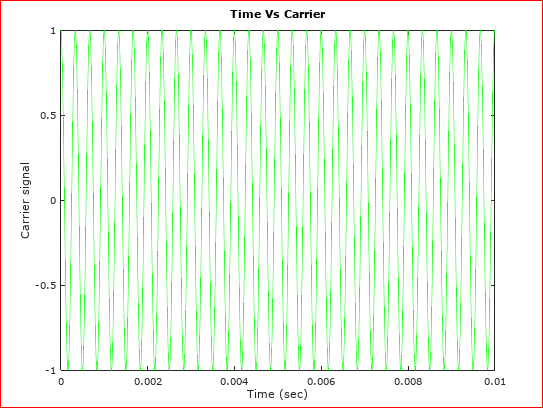
Program2: Plot from Time Vs Carrier Signal as follows:
CarrierSignalPlot.m
|
% Plot Time Vs Carrier Signal as follows % Given frequency in MHz so converting into
Hz % Given constant % Given Carrier Signal function %Plot Time Vs Modulating signal xlabel('Time (sec)'); |
Please find the output below:
Please find the ASK_Modulating_signal.m for reference:
| function [mt] = ASK_Modulating_signal(n,t) Amp_level = 0:1/(n-1):1; mt = zeros(1,length(t)); lm = round(10000*rand(1, length(Amp_level))); Idmx = round(length(t)*rand(1, length(Amp_level))); for i=1:length(lm) if Idmx(i) < lm(i) lm(i) = round(Idmx(i)/3); end if Idmx(i)+lm(i)/2 > length(t) mt(1,Idmx(i)-round(lm(i)/2):length(t)) = Amp_level(i); else mt(1,Idmx(i)-round(lm(i)/2):Idmx(i)+round(lm(i)/2)) = Amp_level(i); end end end |
Thanks
Add Answer to:
Help solve in MATLAB
1. Let m(t) be the 2-bit modulating signal and s(t) cos(at) be...
Problems: 1. Consider the system shown below. Let the input signal to the Ideal Sampler to be: s(...
 just looking for #2, 3, and 4
Problems: 1. Consider the system shown below. Let the input signal to the Ideal Sampler to be: s(t) = 2 cos(2m50t) + 4cos(2m100t) a. (10 points) Determine S(f) and plot it b. (20 points) Let the sampling rate to be: fs 300 samples/sec. Plot the spectrum of the Ideal sample, that is plot S8(f) c. Let the sampling rate to be: fs 175 samples/sec. i. (30 points) Plot S8(f) ii. (10 points) Let...
just looking for #2, 3, and 4
Problems: 1. Consider the system shown below. Let the input signal to the Ideal Sampler to be: s(t) = 2 cos(2m50t) + 4cos(2m100t) a. (10 points) Determine S(f) and plot it b. (20 points) Let the sampling rate to be: fs 300 samples/sec. Plot the spectrum of the Ideal sample, that is plot S8(f) c. Let the sampling rate to be: fs 175 samples/sec. i. (30 points) Plot S8(f) ii. (10 points) Let...
1. A modulating signal m(t) is given by m(t) = (cos(20nt) – cos(40nt)) a. Find and...
 1. A modulating signal m(t) is given by m(t) = (cos(20nt) – cos(40nt)) a. Find and sketch the spectrum of DSB-SC signal 2m(t)cos (100nt) b. Verify that the DSB-SC modulated signal can be recovered using coherent detection
1. A modulating signal m(t) is given by m(t) = (cos(20nt) – cos(40ſt)) a. Find and...
 1. A modulating signal m(t) is given by m(t) = (cos(20nt) – cos(40ſt)) a. Find and sketch the spectrum of DSB-SC signal 2m(t)cos (100nt) b. Verify that the DSB-SC modulated signal can be recovered using coherent detection. 15 nts
1. A modulating signal m(t) is given by m(t) = 5 (cos(20nt) – cos(40nt)) a. Find...
 1. A modulating signal m(t) is given by m(t) = 5 (cos(20nt) – cos(40nt)) a. Find and sketch the spectrum of DSB-SC signal 2m(t)cos (100nt) b. Verify that the DSB-SC modulated signal can be recovered using coherent detection.
Consider the message signal m(t):
 Consider the message signal m(t):a. Sketch the AM signal u(t)=[ A + m(t) ] Cos(wct) for modulation indexes μ = 0.5 and μ = 2.0 by assuming the carrier frequency to be much higher than the bandwidth of m(t) b. Determine the efficiency percentage (η = ps/pt) for μ = 0.5. Herein, Ps and Pt are sideband and total powers respectively, and Pt= Ps + Pc , in which Pc is the carrier power. Hint : Take into account the Parseval's property. c. If the AM waveforms corresponding...
Hello, I have questions on Matlab. Let's say that I have an equation. Signal x(t)= cos(2*pi*10*t)...
Hello, I have questions on Matlab. Let's say that I have an equation. Signal x(t)= cos(2*pi*10*t) is sampled at sampling frequency of Fs=100 Hz. How do I both Upsample and downsample this frequency by a factor of 2 in Matlab? I need to see the code and how the graphs look. Thank you for the help.
need matlab code Exercise: Use MATLAB to generate a low frequency signal: xy(t) = 3 cos(1400)...
 need matlab code
Exercise: Use MATLAB to generate a low frequency signal: xy(t) = 3 cos(1400) And a higher frequency signal: xz(t) = 2 cos(10,000st) Now add these two signals together to generate the dual-component signal: y(t) = 3 cos(14007a)+ 2 cos(10,000) Points to be addressed: Again, manually calculate the theoretical magnitude spectra of y(t) and show this in your report (use Microsoft Visio or similar for your diagram). Clearly label all axes! Contrast this working to what you see...
need matlab code
Exercise: Use MATLAB to generate a low frequency signal: xy(t) = 3 cos(1400) And a higher frequency signal: xz(t) = 2 cos(10,000st) Now add these two signals together to generate the dual-component signal: y(t) = 3 cos(14007a)+ 2 cos(10,000) Points to be addressed: Again, manually calculate the theoretical magnitude spectra of y(t) and show this in your report (use Microsoft Visio or similar for your diagram). Clearly label all axes! Contrast this working to what you see...
The signal m)811 + cos(20rt) cos(1o0t)] (t is in seconds) is sa using an ideal sampling...
 The signal m)811 + cos(20rt) cos(1o0t)] (t is in seconds) is sa using an ideal sampling function at the rate of 150 samples/sec. Ea is encoded using a 16-level quantizer. ch sample a. Calculate the bandwidth of the signal m(). (2 Points) b. Is sampling done at, below or above Nyquist rate? Show your work (2 Points) (2 Points) c. Determine the rate of transmission (in bps). (3 Points) d. Find the signal-to-quantization noise ratio (SNR).
4. [20 points] A modulating signal m(t) is given by m(t)-cos(100nt)cos(500nt): 1) [5 points] Sketch the...
 4. [20 points] A modulating signal m(t) is given by m(t)-cos(100nt)cos(500nt): 1) [5 points] Sketch the spectrum of m(t). 2) [5 points] Find and sketch the spectrum of the DSB-SC signal 2m(t)cos(1000t). 3) [5 points] From the spectrum obtained in 2), suppress the LSB to obtain the USB spectrum and sketch it. 4) [5 points] Knowing the USB spectrum in 3), write the expression puse(t) for the USB signal For full credit, label frequencies and magnitudes of the spectra for...
Suppose you wish to sample an amplitude modulated signal x(t)-m(t) cos(Q,t) where m(1) is the message...
 Suppose you wish to sample an amplitude modulated signal x(t)-m(t) cos(Q,t) where m(1) is the message signal and Ω,-2π 10 (rad/sec) is the carrier frequency 8.6 a) If the message is anacusic signal with frequencies in a band of [0, 22] kHz, what would be maximum frequency present in x(t)?
 just looking for #2, 3, and 4
Problems: 1. Consider the system shown below. Let the input signal to the Ideal Sampler to be: s(t) = 2 cos(2m50t) + 4cos(2m100t) a. (10 points) Determine S(f) and plot it b. (20 points) Let the sampling rate to be: fs 300 samples/sec. Plot the spectrum of the Ideal sample, that is plot S8(f) c. Let the sampling rate to be: fs 175 samples/sec. i. (30 points) Plot S8(f) ii. (10 points) Let...
just looking for #2, 3, and 4
Problems: 1. Consider the system shown below. Let the input signal to the Ideal Sampler to be: s(t) = 2 cos(2m50t) + 4cos(2m100t) a. (10 points) Determine S(f) and plot it b. (20 points) Let the sampling rate to be: fs 300 samples/sec. Plot the spectrum of the Ideal sample, that is plot S8(f) c. Let the sampling rate to be: fs 175 samples/sec. i. (30 points) Plot S8(f) ii. (10 points) Let...
 1. A modulating signal m(t) is given by m(t) = (cos(20nt) – cos(40nt)) a. Find and sketch the spectrum of DSB-SC signal 2m(t)cos (100nt) b. Verify that the DSB-SC modulated signal can be recovered using coherent detection
 1. A modulating signal m(t) is given by m(t) = (cos(20nt) – cos(40ſt)) a. Find and sketch the spectrum of DSB-SC signal 2m(t)cos (100nt) b. Verify that the DSB-SC modulated signal can be recovered using coherent detection. 15 nts
 1. A modulating signal m(t) is given by m(t) = 5 (cos(20nt) – cos(40nt)) a. Find and sketch the spectrum of DSB-SC signal 2m(t)cos (100nt) b. Verify that the DSB-SC modulated signal can be recovered using coherent detection.
 need matlab code
Exercise: Use MATLAB to generate a low frequency signal: xy(t) = 3 cos(1400) And a higher frequency signal: xz(t) = 2 cos(10,000st) Now add these two signals together to generate the dual-component signal: y(t) = 3 cos(14007a)+ 2 cos(10,000) Points to be addressed: Again, manually calculate the theoretical magnitude spectra of y(t) and show this in your report (use Microsoft Visio or similar for your diagram). Clearly label all axes! Contrast this working to what you see...
need matlab code
Exercise: Use MATLAB to generate a low frequency signal: xy(t) = 3 cos(1400) And a higher frequency signal: xz(t) = 2 cos(10,000st) Now add these two signals together to generate the dual-component signal: y(t) = 3 cos(14007a)+ 2 cos(10,000) Points to be addressed: Again, manually calculate the theoretical magnitude spectra of y(t) and show this in your report (use Microsoft Visio or similar for your diagram). Clearly label all axes! Contrast this working to what you see...
 The signal m)811 + cos(20rt) cos(1o0t)] (t is in seconds) is sa using an ideal sampling function at the rate of 150 samples/sec. Ea is encoded using a 16-level quantizer. ch sample a. Calculate the bandwidth of the signal m(). (2 Points) b. Is sampling done at, below or above Nyquist rate? Show your work (2 Points) (2 Points) c. Determine the rate of transmission (in bps). (3 Points) d. Find the signal-to-quantization noise ratio (SNR).
 4. [20 points] A modulating signal m(t) is given by m(t)-cos(100nt)cos(500nt): 1) [5 points] Sketch the spectrum of m(t). 2) [5 points] Find and sketch the spectrum of the DSB-SC signal 2m(t)cos(1000t). 3) [5 points] From the spectrum obtained in 2), suppress the LSB to obtain the USB spectrum and sketch it. 4) [5 points] Knowing the USB spectrum in 3), write the expression puse(t) for the USB signal For full credit, label frequencies and magnitudes of the spectra for...
 Suppose you wish to sample an amplitude modulated signal x(t)-m(t) cos(Q,t) where m(1) is the message signal and Ω,-2π 10 (rad/sec) is the carrier frequency 8.6 a) If the message is anacusic signal with frequencies in a band of [0, 22] kHz, what would be maximum frequency present in x(t)?
Most questions answered within 3 hours.
-
Where is the error in this code sequence?
String s1 = "Hello";
String s2 = "ello";...
asked 10 months ago -
Financial data for Joel de Paris, Inc., for last year
follow:
Joel de Paris, Inc.
Balance...
asked 10 months ago -
Consider this reaction:
Al2(SO4)3 (aq)+ BaCl3
(aq) Al2Cl6 (aq)- +
3BaSO4(s) . What is the...
asked 10 months ago -
Suppose that Savneet is considering increasing her
recent random sample from 20 car rentals to 40...
asked 10 months ago -
Trucks arrive at an unloading terminal at an average rate of 120
per hour.
Trucks arrive...
asked 10 months ago -
Why are methanol and ethanol completely soluble in water while
octanol is not very little soluble....
asked 10 months ago -
A facilities manager at a university reads in a research report
that the mean amount of...
asked 10 months ago -
When the CuSO4 is rehydrated by adding water to the anhydrous
compound, is this an endothermic...
asked 10 months ago -
A ray of sunlight is passing from diamond into crown glass; the
angle of incidence is...
asked 10 months ago -
A block of mass 0.249 kg is placed on top of a light, vertical
spring of...
asked 10 months ago -
how do the kidneys compensate in the presences of acidosis
a) trigger hyperventilate
b) reserve acid...
asked 10 months ago -
Question 501 pts
The rental rate of capital to the firm increases. Which of the
following...
asked 10 months ago