At Quark’s casino, there is a game called “High Five”, where you paid $1 to roll...
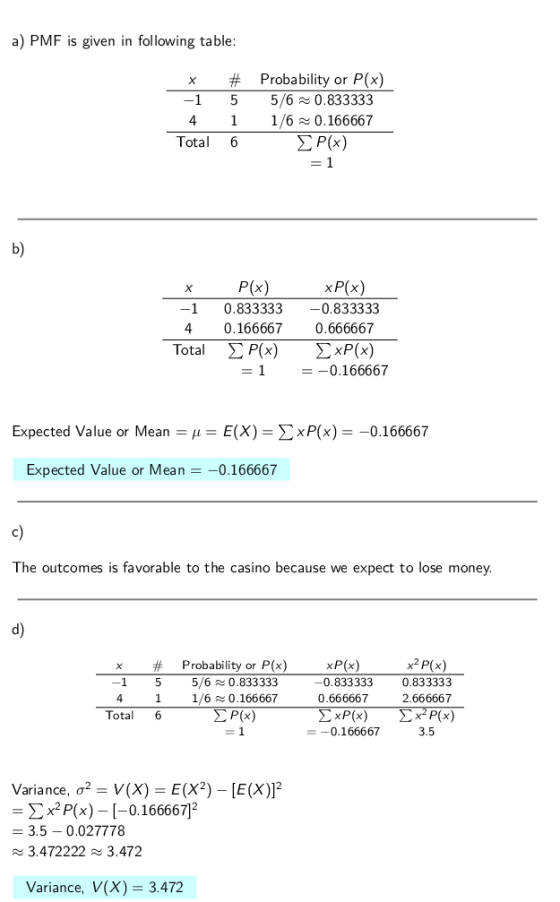
At Quark’s casino, there is a game called “High Five”, where you paid $1 to roll a
fair die once. If a 5 shows up, you get back $5, nothing otherwise.
(a) Let X be the amount of money you WIN by playing this game. Fill in the details in the table below.
|
x |
p (X) = x |
(b) Calculate E(X), the expected amount of money you win by playing this game.
(c) Is the outcome of this game favorable to you or to Quark’s casino?
(d) Calculate Var(X).
Homework Answers
Add Answer to:
At Quark’s casino, there is a game called “High Five”, where you
paid $1 to roll...
In a dice game, you roll a fair die three times, independently. If you don’t roll...
In a dice game, you roll a fair die three times, independently. If you don’t roll any sixes, you lose 1 dollar. If you roll a six exactly once, you win one dollar. If you roll a six exactly twice, you win two dollars. If you roll a six all three times, you win k dollars. (A) Let k = 3. What is the expected value of the amount you would win by playing this game (rounded to the nearest...
What is the expectation (or expected value) of the following: Consider a casino game where the...
What is the expectation (or expected value) of the following: Consider a casino game where the player rolls a 6-sided dice and receive $10 if the roll is 1 or 6, and $0 for any other roll. Let X the amount won after playing the game once. Additionally, what’s the lowest amount the casino can charge to play the game and still make a profit on it over time?
You are playing a gambling game with a 12-sided die. If you roll an odd number,...
You are playing a gambling game with a 12-sided die. If you roll an odd number, then you lose $6. If you roll an even number, then you win that amount in dollars (i.e., you roll a 2, you win $2, etc). What is the Expected average winnings/losings of this game? x = die roll P(x) Payoff(x) P(x)*Payoff(x) 1 2 3 4 5 6 7 8 9 10 11 12 E =
Suppose you pay $2.00 to roll a fair die with the understanding that you will get...
Suppose you pay $2.00 to roll a fair die with the understanding that you will get back $5.00 for rolling a 4 or a 2, nothing otherwise. What is the expected amount to win (or lose)
15. Your friend challenges you to a game. She says that she is going to roll...
 15. Your friend challenges you to a game. She says that she is going to roll 2 6-sided dice. If the first die rolls at least 5, you win if the second die rolls less than 5. If the first die rolls less than 5, you win if the second die rolls at least 5. This seems fair. Is it? (a) What is the probability that you win this game? To incentivize you, your friend says that she will pay...
for a game you pay 2$ to play and roll 1 die. If the number is...
for a game you pay 2$ to play and roll 1 die. If the number is a 1 or 2 you win 9$. If the number is a 6, you win 3$. If the number is anything else, you receive nothing. FInd the expected value (the fair price to charge to play).
In a particular game, a fair die is tossed. If the number of spots showing is...
 In a particular game, a fair die is tossed. If the number of spots showing is a six, you win $6, if the number of spots showing is a five, you win $3, if the number of spots showing is 4, you win $2, and if the number of spots showing is 3, you win $1. If the number of spots showing is 1 or 2, you win nothing. You are going to play the game twice. Let X be...
Consider a game where you roll a six-sided die and a four-sided die, then you subtract...
Consider a game where you roll a six-sided die and a four-sided die, then you subtract the number on the four-sided die from the number on the six-sided die. If the number is positive, you receive that much money (in dollars). If the number is negative, you pay that much money (in dollars). For example, you might roll a 5 on the six-sided die and a 2 on the four-sided die, in which case you would win $3. You might...
Game consists of: • It costs $2 for the player to enter • Each round, the player announces a single number: {1, 2, 3, 4,...
Game consists of: • It costs $2 for the player to enter • Each round, the player announces a single number: {1, 2, 3, 4, 5, 6} • Two fair six-sided dices are rolled • For each die that shows the number announced, the player wins $1. For example, the player pays $2 to enter the game and announces the number 2. If the outcome of the roll is 3, 2, 2, then the player gets back $2. However, if...
Game consists of: • It costs $2 for the player to enter • Each round, the...
Game consists of: • It costs $2 for the player to enter • Each round, the player announces a single number: {1, 2, 3, 4, 5, 6} • Two fair six-sided dices are rolled • For each die that shows the number announced, the player wins $1. For example, the player pays $2 to enter the game and announces the number 2. If the outcome of the roll is 3, 2, 2, then the player gets back $2. However, if...
 15. Your friend challenges you to a game. She says that she is going to roll 2 6-sided dice. If the first die rolls at least 5, you win if the second die rolls less than 5. If the first die rolls less than 5, you win if the second die rolls at least 5. This seems fair. Is it? (a) What is the probability that you win this game? To incentivize you, your friend says that she will pay...
 In a particular game, a fair die is tossed. If the number of spots showing is a six, you win $6, if the number of spots showing is a five, you win $3, if the number of spots showing is 4, you win $2, and if the number of spots showing is 3, you win $1. If the number of spots showing is 1 or 2, you win nothing. You are going to play the game twice. Let X be...
Most questions answered within 3 hours.
-
Where is the error in this code sequence?
String s1 = "Hello";
String s2 = "ello";...
asked 10 months ago -
Financial data for Joel de Paris, Inc., for last year
follow:
Joel de Paris, Inc.
Balance...
asked 10 months ago -
Consider this reaction:
Al2(SO4)3 (aq)+ BaCl3
(aq) Al2Cl6 (aq)- +
3BaSO4(s) . What is the...
asked 10 months ago -
Suppose that Savneet is considering increasing her
recent random sample from 20 car rentals to 40...
asked 10 months ago -
Trucks arrive at an unloading terminal at an average rate of 120
per hour.
Trucks arrive...
asked 10 months ago -
Why are methanol and ethanol completely soluble in water while
octanol is not very little soluble....
asked 10 months ago -
A facilities manager at a university reads in a research report
that the mean amount of...
asked 10 months ago -
When the CuSO4 is rehydrated by adding water to the anhydrous
compound, is this an endothermic...
asked 10 months ago -
A ray of sunlight is passing from diamond into crown glass; the
angle of incidence is...
asked 10 months ago -
A block of mass 0.249 kg is placed on top of a light, vertical
spring of...
asked 10 months ago -
how do the kidneys compensate in the presences of acidosis
a) trigger hyperventilate
b) reserve acid...
asked 10 months ago -
Question 501 pts
The rental rate of capital to the firm increases. Which of the
following...
asked 10 months ago