Consider a classical economy with the following characteristic: Investment function: I = i0 - i1r +...
Consider a classical economy with the following characteristic:
Investment function: I = i0 - i1r + i2IC where IC represents investor confidence and r interest rates.
Consumption function: C = a +b(Y-T) - cr
All model parameters are positive.
Suppose that the investor confidence (IC) has increased. How does this change in investor confidence affect the Classical Model? Be sure to mention what happens to (Y, N, P, r, C, S, Private Saving, Public Saving).
Note: Assume that the change in investment does not impact the capital stock. Written discussion and/or graphs are needed.
Homework Answers
We know that Aggregate Demand and supply functions at equilibrium can be expressed as

So, in the above case we are given consumption and investment functions which we use, to deduce the equilibrium output level.
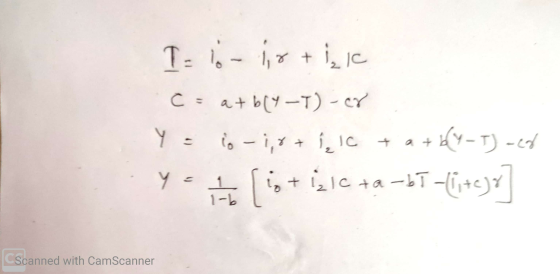
We have,

When Investment confidence increases, the parameter i2 increases. As a result, Output level at equilibrium increases.
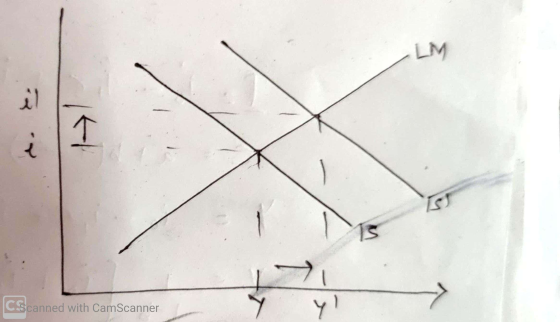
This can also be explained using the IS-LM and AS-AD models.
Increase in investment confidence leads to an upward shift of the IS curve due to increase in Autonomous investmenet expenditure. Due to this shift, more and more investments would occur in many sectors, thereby increasing production capacities. Increased investments also mean increased money demand at a given level of money supply. Hence interest rates also rise. In conclusion, output and interest rate at equilibrium level rises.
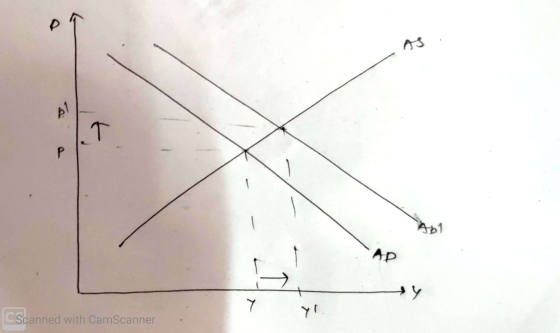
A shift in the IS also causes the Aggregate Demand to shift upwards. As a result Price level also rises at equilibrium.
A rise in investment confidence acts as a stimulator for private savings .Since increased private savings means increased investments, there willbe more and more private firms to cater to the public's demand and competition between them would result in acheiving quality at reasonable price levels. So government starts to withdraw its presence in many sectors where private agencies flourish. As a result, public savings decline.
Add Answer to:
Consider a classical economy with the following
characteristic:
Investment function: I = i0 - i1r +...
11. Suppose there is an increase in autonomous investment . How would this shock impact a...
 11. Suppose there is an increase in autonomous investment . How would this shock impact a standard classical model? Written discussion and graphs are both needed for full credit Be sure to mention what happens to W,Y, N, P,r.C, s, Prs, Pus How would this shock impact a standard Keynesian model with perfectly sticky prices? Show graphs of the Keynesian cross, the Money market, and the IS/LM space. Note: Assume that change in investment does not impact the capital stock....
Consider a closed economy operating according to the Classical model. The production function is: Y =...
 Consider a closed economy operating according to the Classical
model. The production function is: Y = 40K^0:75L^0:25
Problem 1- Use the following information o answer questions 24 29 Consider a closed economy operating acoording to the Classical model. The production function is: 40K0.75し0.25 where K and L are the capital and labor used in the production of output Y The consumption and investment functions are: C 100 +0.8(Y-T) 1 = 1,450-20r where T is the amount of taxes and r...
Consider a closed economy operating according to the Classical
model. The production function is: Y = 40K^0:75L^0:25
Problem 1- Use the following information o answer questions 24 29 Consider a closed economy operating acoording to the Classical model. The production function is: 40K0.75し0.25 where K and L are the capital and labor used in the production of output Y The consumption and investment functions are: C 100 +0.8(Y-T) 1 = 1,450-20r where T is the amount of taxes and r...
11. Consider an economy that abides by the standard classical model specifications. Suppose the economy experiences...
 11. Consider an economy that abides by the standard classical model specifications. Suppose the economy experiences an earthquake that destroys a large amount of capital in the econ- omy (assume the population in unaffected and thus remains constant). Using graphs and written discussion, examine the economy dynamics in the wake of the shock Expectations are as follows: . Capture the timing in your written discussion If a curve shifts, explain why/economic intuition . If a market is in disequilibrium, explain...
A closed economy can be described by the long-run classical model: Y = 2KαL1–α C =...
A closed economy can be described by the long-run classical model: Y = 2KαL1–α C = 18500 + 0.75(Y – T) – 800r I(r) = 11000 – 1200r Note: r represents the real interest rate and is measured in percentage points (for example, if we find r = 10, then r is interpreted as being equal to 10%). Keep your answer to 4 decimal places if needed. Assume that there are two factors of production, capital (K) and labour (L),...
Intermediate Macro Question Consider a small open economy in the classical model, assume the production function...
Intermediate Macro Question Consider a small open economy in the classical model, assume the production function is y=1000(square root KL) K=20 L=5 Government spending is 1000 and taxes are 1000. the consumption function is c=1500+0.5(Y-T) investment equation is 1000-50r=I net export function is 5000-5000e world interest rate is r=r*=10 Solve 1 income 2 consumption 3 National Savings 4. Investments 5. Trade balance 6 Real exchange rate 7. The real world interest rate rises to 20 solve for the new values...
Consider an economy that is described by the following classical model. Y = AxK"XL(1-a). (A =...
 Consider an economy that is described by the following classical
model.
Y = AxK"XL(1-a). (A = 1.355, α = 0.33) C = 10 + 0.55 * (Y-T) 2r K-10, L = 30 (a) In this economy compute the equilib- rium interest rate r (b) Compute the MPC of the consumption function.2 (c) Calculate the equilibrium interest rate when = T-5.5.
Consider an economy that is described by the following classical
model.
Y = AxK"XL(1-a). (A = 1.355, α = 0.33) C = 10 + 0.55 * (Y-T) 2r K-10, L = 30 (a) In this economy compute the equilib- rium interest rate r (b) Compute the MPC of the consumption function.2 (c) Calculate the equilibrium interest rate when = T-5.5.
6. Suppose the economy is characterized by the following behavioral equations: C = 1,500+.6YD I= 2.000...
 6. Suppose the economy is characterized by the following behavioral equations: C = 1,500+.6YD I= 2.000 - 10,000 G= 2,000 T= 2.000 a. At an interest rate of 10%, solve for equilibrium income (Y). disposable income (Y). consumption (C), investment (1), private saving, and public saving. b. What is the marginal propensity to consume in this economy? c. Now suppose that instead of taxes being a fixed quantity, taxes vary with income (as in many countries like the United States)...
2. Effect of Investment Suppose in a closed private economy households are spending 75 cents from...
 2. Effect of Investment Suppose in a closed private economy households are spending 75 cents from each additional dollar that they receive as an income. Moreover, when they do not have any income, they are still spending $100 on their needs. (a) Derive the consumption function and the saving function in this economy. Draw the graphs in the (C-Y) space and in the (S-Y) space. (b) If there is no investment in the economy, what is the equilibrium level of...
21. G increase with algebra. Consider an economy described by the following model. Y = K1/3L2/3...
 21. G increase with algebra. Consider an economy described by the following model. Y = K1/3L2/3 K = 1000; L = 1000 G = 100 T = 100 C = 250 + 0.5(Y-T) 1 = 600 – 100r Calculate the equilibrium real interest rate, national saving, public saving, private saving, consumption, output, and investment. (Hint: you probably don't want to solve for them it in that order.) i.rs ii. national saving = iii. public saving = iv. private saving =...
Consider an economy that is characterized by the Solow Model. The (aggregate) production function is given...
Consider an economy that is characterized by the Solow Model. The (aggregate) production function is given by: Y = 6K1/3L2/3 In this economy, workers consume 80% of income and save the rest. The labour force is growing at 2% per year while the annual rate of capital depreciation is 5.5%. a) Solve for the steady state capital-labour ratio and consumption per worker. The economy is in its steady state as described in part (a). Suppose both the stock of capital...
 11. Suppose there is an increase in autonomous investment . How would this shock impact a standard classical model? Written discussion and graphs are both needed for full credit Be sure to mention what happens to W,Y, N, P,r.C, s, Prs, Pus How would this shock impact a standard Keynesian model with perfectly sticky prices? Show graphs of the Keynesian cross, the Money market, and the IS/LM space. Note: Assume that change in investment does not impact the capital stock....
 Consider a closed economy operating according to the Classical
model. The production function is: Y = 40K^0:75L^0:25
Problem 1- Use the following information o answer questions 24 29 Consider a closed economy operating acoording to the Classical model. The production function is: 40K0.75し0.25 where K and L are the capital and labor used in the production of output Y The consumption and investment functions are: C 100 +0.8(Y-T) 1 = 1,450-20r where T is the amount of taxes and r...
Consider a closed economy operating according to the Classical
model. The production function is: Y = 40K^0:75L^0:25
Problem 1- Use the following information o answer questions 24 29 Consider a closed economy operating acoording to the Classical model. The production function is: 40K0.75し0.25 where K and L are the capital and labor used in the production of output Y The consumption and investment functions are: C 100 +0.8(Y-T) 1 = 1,450-20r where T is the amount of taxes and r...
 11. Consider an economy that abides by the standard classical model specifications. Suppose the economy experiences an earthquake that destroys a large amount of capital in the econ- omy (assume the population in unaffected and thus remains constant). Using graphs and written discussion, examine the economy dynamics in the wake of the shock Expectations are as follows: . Capture the timing in your written discussion If a curve shifts, explain why/economic intuition . If a market is in disequilibrium, explain...
 Consider an economy that is described by the following classical
model.
Y = AxK"XL(1-a). (A = 1.355, α = 0.33) C = 10 + 0.55 * (Y-T) 2r K-10, L = 30 (a) In this economy compute the equilib- rium interest rate r (b) Compute the MPC of the consumption function.2 (c) Calculate the equilibrium interest rate when = T-5.5.
Consider an economy that is described by the following classical
model.
Y = AxK"XL(1-a). (A = 1.355, α = 0.33) C = 10 + 0.55 * (Y-T) 2r K-10, L = 30 (a) In this economy compute the equilib- rium interest rate r (b) Compute the MPC of the consumption function.2 (c) Calculate the equilibrium interest rate when = T-5.5.
 6. Suppose the economy is characterized by the following behavioral equations: C = 1,500+.6YD I= 2.000 - 10,000 G= 2,000 T= 2.000 a. At an interest rate of 10%, solve for equilibrium income (Y). disposable income (Y). consumption (C), investment (1), private saving, and public saving. b. What is the marginal propensity to consume in this economy? c. Now suppose that instead of taxes being a fixed quantity, taxes vary with income (as in many countries like the United States)...
 2. Effect of Investment Suppose in a closed private economy households are spending 75 cents from each additional dollar that they receive as an income. Moreover, when they do not have any income, they are still spending $100 on their needs. (a) Derive the consumption function and the saving function in this economy. Draw the graphs in the (C-Y) space and in the (S-Y) space. (b) If there is no investment in the economy, what is the equilibrium level of...
 21. G increase with algebra. Consider an economy described by the following model. Y = K1/3L2/3 K = 1000; L = 1000 G = 100 T = 100 C = 250 + 0.5(Y-T) 1 = 600 – 100r Calculate the equilibrium real interest rate, national saving, public saving, private saving, consumption, output, and investment. (Hint: you probably don't want to solve for them it in that order.) i.rs ii. national saving = iii. public saving = iv. private saving =...
Most questions answered within 3 hours.
-
Where is the error in this code sequence?
String s1 = "Hello";
String s2 = "ello";...
asked 10 months ago -
Financial data for Joel de Paris, Inc., for last year
follow:
Joel de Paris, Inc.
Balance...
asked 10 months ago -
Consider this reaction:
Al2(SO4)3 (aq)+ BaCl3
(aq) Al2Cl6 (aq)- +
3BaSO4(s) . What is the...
asked 10 months ago -
Suppose that Savneet is considering increasing her
recent random sample from 20 car rentals to 40...
asked 10 months ago -
Trucks arrive at an unloading terminal at an average rate of 120
per hour.
Trucks arrive...
asked 10 months ago -
Why are methanol and ethanol completely soluble in water while
octanol is not very little soluble....
asked 10 months ago -
A facilities manager at a university reads in a research report
that the mean amount of...
asked 10 months ago -
When the CuSO4 is rehydrated by adding water to the anhydrous
compound, is this an endothermic...
asked 10 months ago -
A ray of sunlight is passing from diamond into crown glass; the
angle of incidence is...
asked 10 months ago -
A block of mass 0.249 kg is placed on top of a light, vertical
spring of...
asked 10 months ago -
how do the kidneys compensate in the presences of acidosis
a) trigger hyperventilate
b) reserve acid...
asked 10 months ago -
Question 501 pts
The rental rate of capital to the firm increases. Which of the
following...
asked 10 months ago