
Homework Answers
Add Answer to:
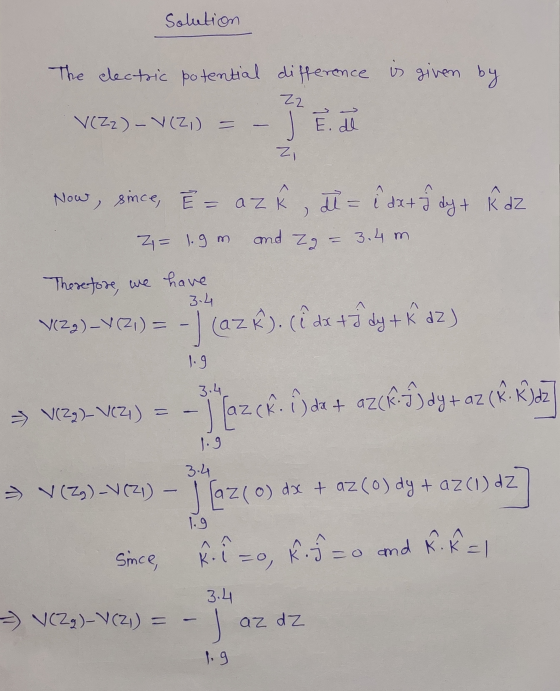
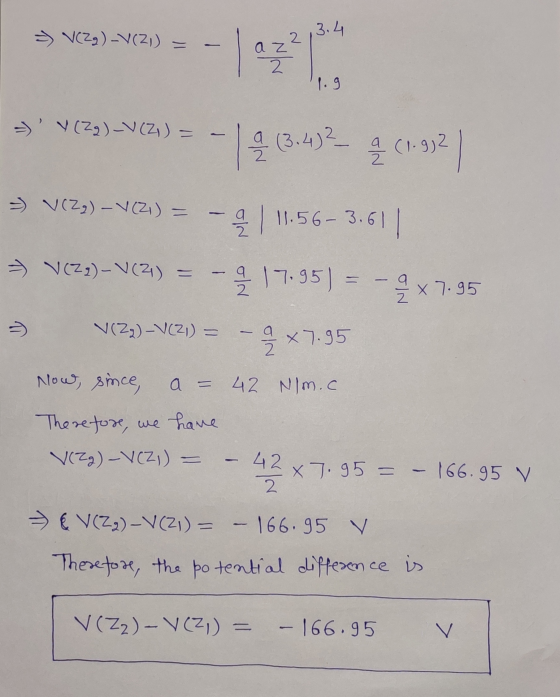
The electric field along the z-axis is given by E = azk where a = 42...
A particular charge distribution produces an electric field along the x-axis of the form, a/x2, where...
A particular charge distribution produces an electric field along the x-axis of the form, a/x2, where a is a positive constant. Find the expression for potential difference, on the x-axis, between x = A and x = B. That is, find V (B) – V (A). What charge distribution produced this?
An electric field of strength E = 4700 N/C is directed along the +x-axis as shown....
 An electric field of strength E = 4700 N/C is directed along the
+x-axis as shown.
An electric field of strength E = 4700 N/C is directed along the +x-axis as shown. What is the magnitude of the potential difference between point B and point A if the distance between these two points is 10 cm? An electron is initially at rest at point B. How much kinetic energy (in electron-Volts, or eV) will the electron gain by moving to...
An electric field of strength E = 4700 N/C is directed along the
+x-axis as shown.
An electric field of strength E = 4700 N/C is directed along the +x-axis as shown. What is the magnitude of the potential difference between point B and point A if the distance between these two points is 10 cm? An electron is initially at rest at point B. How much kinetic energy (in electron-Volts, or eV) will the electron gain by moving to...
1. Find the electric field (in vacuum) as a function of position z along the axis...
 1. Find the electric field (in vacuum) as a function of position z along the axis of a uniformly charged disk of outer radius R with a hole of radius R in its centre. The charge per unit area on the disk is σ. 2, A straight rod, with uniform charge λ per unit length, lies along the z axis from z=11 to z=12-(Thus, the length of the rod is l2-11.) Find the x and y components of the electric...
4. Charges on x-axis produce an electric potential V(x) = 450x2 along the x-axis, where x...
 4. Charges on x-axis produce an electric potential V(x) = 450x2 along the x-axis, where x is in meters and V is in volts. A particle of charge q 60 nC and mass m = - 1.5 g moves in this potential with turning points at +8.0 cm. (a) What is the total energy of the particle in this potential? (b) What is the speed of the particle at x = 3.0 cm? (c) What is the magnitude and direction...
1. Find the electric field (in vacuum) as a function of position z along the axis...
 1. Find the electric field (in vacuum) as a function of position z along the axis of a uniformly charged disk of outer radius R with a hole of radius Ri in its centre. The charge per unit area on the disk is σ. 2. A straight rod, with uniform charge λ per unit length, lies along the z axis from z=11 to z=12. (Thus, the length of the rod is 12-11.) Find the x and y components of the...
1. Find the electric field E(z) of the (infinite) space charge distribution along the -axis -D...
 1. Find the electric field E(z) of the (infinite) space charge distribution along the -axis -D z-d
3. (a) Use Biot-Savart Law to find the magnetic field of wire, along the z-axis, carrying...
 3. (a) Use Biot-Savart Law to find the magnetic field of wire, along the z-axis, carrying a current I (in direction), at a point P a distance r from the wire. Do this for both a finite wire (21 <2<z2), and an infinite wire (-0<z< too). (6) Use the result of part (a) to evaluate the net magnetic field of the wires shown at point P (0,0,2). [15] z P (0,0,2) 22 di 0 B (0,2,0) tec у P(x,y) A...
At what point along the x-axis is the electric field zero?
Two charges, -1.90uC and 4.45uC are placed at x=0cm and x=5.50cm, respectively.1) At what point along the x-axis is the electric field zero?2) At what points along the x-axis is the potential zero? Let V=0 at r=8
The electric field in the xy-plane due to an infinite line of charge along the z-axis...
 The electric field in the xy-plane due to an infinite line of charge along the z-axis is a gradient field with a potential function V(x,y) = c In To 2 + y2 where c> 0 is a constant and ro is a reference distance at which the potential is assumed to be 0. Use this information to answer parts a through c. a. Find the components of the electric field in the x- and y-directions, where E(x,y)= - VV(x,y). Choose...
P (a) (b) +29 ( c) + -Q (d) FIGURE 21-34 Electric field lines for four...
 P (a) (b) +29 ( c) + -Q (d) FIGURE 21-34 Electric field lines for four arrangements of charges. E P R do EXAMPLE 21-12 Uniformly charged disk. Charge is distributed uniformly over a thin circular disk of radius R. The charge per unit area (C/m²) is o. Calculate the electric field at a point P on the axis of the disk, a distance z above its center, Fig. 21-30. APPROACH We can think of the disk as a set...
 An electric field of strength E = 4700 N/C is directed along the
+x-axis as shown.
An electric field of strength E = 4700 N/C is directed along the +x-axis as shown. What is the magnitude of the potential difference between point B and point A if the distance between these two points is 10 cm? An electron is initially at rest at point B. How much kinetic energy (in electron-Volts, or eV) will the electron gain by moving to...
An electric field of strength E = 4700 N/C is directed along the
+x-axis as shown.
An electric field of strength E = 4700 N/C is directed along the +x-axis as shown. What is the magnitude of the potential difference between point B and point A if the distance between these two points is 10 cm? An electron is initially at rest at point B. How much kinetic energy (in electron-Volts, or eV) will the electron gain by moving to...
 1. Find the electric field (in vacuum) as a function of position z along the axis of a uniformly charged disk of outer radius R with a hole of radius R in its centre. The charge per unit area on the disk is σ. 2, A straight rod, with uniform charge λ per unit length, lies along the z axis from z=11 to z=12-(Thus, the length of the rod is l2-11.) Find the x and y components of the electric...
 4. Charges on x-axis produce an electric potential V(x) = 450x2 along the x-axis, where x is in meters and V is in volts. A particle of charge q 60 nC and mass m = - 1.5 g moves in this potential with turning points at +8.0 cm. (a) What is the total energy of the particle in this potential? (b) What is the speed of the particle at x = 3.0 cm? (c) What is the magnitude and direction...
 1. Find the electric field (in vacuum) as a function of position z along the axis of a uniformly charged disk of outer radius R with a hole of radius Ri in its centre. The charge per unit area on the disk is σ. 2. A straight rod, with uniform charge λ per unit length, lies along the z axis from z=11 to z=12. (Thus, the length of the rod is 12-11.) Find the x and y components of the...
 1. Find the electric field E(z) of the (infinite) space charge distribution along the -axis -D z-d
 3. (a) Use Biot-Savart Law to find the magnetic field of wire, along the z-axis, carrying a current I (in direction), at a point P a distance r from the wire. Do this for both a finite wire (21 <2<z2), and an infinite wire (-0<z< too). (6) Use the result of part (a) to evaluate the net magnetic field of the wires shown at point P (0,0,2). [15] z P (0,0,2) 22 di 0 B (0,2,0) tec у P(x,y) A...
 The electric field in the xy-plane due to an infinite line of charge along the z-axis is a gradient field with a potential function V(x,y) = c In To 2 + y2 where c> 0 is a constant and ro is a reference distance at which the potential is assumed to be 0. Use this information to answer parts a through c. a. Find the components of the electric field in the x- and y-directions, where E(x,y)= - VV(x,y). Choose...
 P (a) (b) +29 ( c) + -Q (d) FIGURE 21-34 Electric field lines for four arrangements of charges. E P R do EXAMPLE 21-12 Uniformly charged disk. Charge is distributed uniformly over a thin circular disk of radius R. The charge per unit area (C/m²) is o. Calculate the electric field at a point P on the axis of the disk, a distance z above its center, Fig. 21-30. APPROACH We can think of the disk as a set...
Most questions answered within 3 hours.
-
Where is the error in this code sequence?
String s1 = "Hello";
String s2 = "ello";...
asked 10 months ago -
Financial data for Joel de Paris, Inc., for last year
follow:
Joel de Paris, Inc.
Balance...
asked 10 months ago -
Consider this reaction:
Al2(SO4)3 (aq)+ BaCl3
(aq) Al2Cl6 (aq)- +
3BaSO4(s) . What is the...
asked 10 months ago -
Suppose that Savneet is considering increasing her
recent random sample from 20 car rentals to 40...
asked 10 months ago -
Trucks arrive at an unloading terminal at an average rate of 120
per hour.
Trucks arrive...
asked 10 months ago -
Why are methanol and ethanol completely soluble in water while
octanol is not very little soluble....
asked 10 months ago -
A facilities manager at a university reads in a research report
that the mean amount of...
asked 10 months ago -
When the CuSO4 is rehydrated by adding water to the anhydrous
compound, is this an endothermic...
asked 10 months ago -
A ray of sunlight is passing from diamond into crown glass; the
angle of incidence is...
asked 10 months ago -
A block of mass 0.249 kg is placed on top of a light, vertical
spring of...
asked 10 months ago -
how do the kidneys compensate in the presences of acidosis
a) trigger hyperventilate
b) reserve acid...
asked 10 months ago -
Question 501 pts
The rental rate of capital to the firm increases. Which of the
following...
asked 10 months ago