
Homework Answers
Add Answer to:
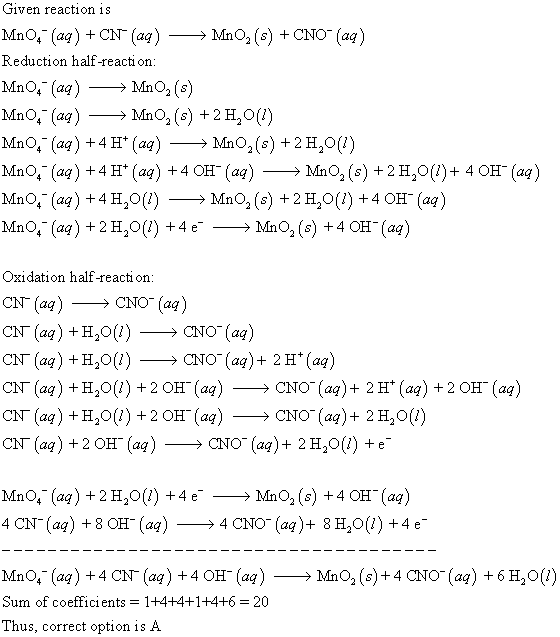
When the reaction MnO_4^-(aq) + CN^-(aq) rightarrow MnO_2(s) + CNO^-(aq) is balanced in a basic medium,...
Use the half-reaction method to balance the following equation in basic solution: CN^- + MnO_4^- Right...
 Use the half-reaction method to balance the following equation in basic solution: CN^- + MnO_4^- Right arrow CNO^- + MnO_2
Please Help! When 0.1009 g of sodium cyanide is dissolved in solution, it takes 19.22 mL...
 Please Help!
When 0.1009 g of sodium cyanide is dissolved in solution, it takes 19.22 mL of a potassium permanganate solution to reach the endpoint of the titration. Using the balanced chemical equation provided, determine the molarity of the potassium permanganate. You will be doing a similar reaction in the laboratory this week. (Remember: the mole ratio of MnO_4^- to KMnO_4 is 1:1 and the mole ratio of CN^- to NaCN is 1:1) H2O (l) + 2 MnO_4^- (aq) +...
Please Help!
When 0.1009 g of sodium cyanide is dissolved in solution, it takes 19.22 mL of a potassium permanganate solution to reach the endpoint of the titration. Using the balanced chemical equation provided, determine the molarity of the potassium permanganate. You will be doing a similar reaction in the laboratory this week. (Remember: the mole ratio of MnO_4^- to KMnO_4 is 1:1 and the mole ratio of CN^- to NaCN is 1:1) H2O (l) + 2 MnO_4^- (aq) +...
Balance the 1/2 reaction using the 1/2 rxn method: MnO_4^- (aq) rightarrow MrvO_2(aq) (basic) Skip 4d...
 Balance the 1/2 reaction using the 1/2 rxn method: MnO_4^- (aq) rightarrow MrvO_2(aq) (basic) Skip 4d Balance the Redox Equat. using, the 1/2 rxn method (acidic conditions): H_2C_2O_4(aq) + MnO_4^-(aq) rightarrow Mn^2+(aq) + CO_2(g)
6. Cu(NH3)4 2+ (aq) + CN - (aq) → CuCN(s) + CNO - (aq)+NH3 (aq) (basic...
6. Cu(NH3)4 2+ (aq) + CN - (aq) → CuCN(s) + CNO - (aq)+NH3 (aq) (basic solution)
6. Cu(NH3)4 2+ (aq) + CN - (aq) → CuCN(s) + CNO - (aq)+NH3 (aq) (basic...
6. Cu(NH3)4 2+ (aq) + CN - (aq) → CuCN(s) + CNO - (aq)+NH3 (aq) (basic solution)
Can you explain or show steps? I'm lost. Thank you!! Balance the reaction and determine which...
 Can you explain or show steps? I'm lost. Thank you!!
Balance the reaction and determine which is the oxidizing and reducing agent in each case. 2. Cr^+ + Sn^4+ rightarrow Cr^3+ + Sn^2+ 3. NaBr + CI_2 rightarrow NaCI + Br_2 4. O_2 + Sb rightarrow H_2O_2 + SbO_2 (basic medium) 5. MnO_4 (aq) H_2O_2 (aq) rightarrow MnO_2(s) + O_2 (g) (basic medium)
Can you explain or show steps? I'm lost. Thank you!!
Balance the reaction and determine which is the oxidizing and reducing agent in each case. 2. Cr^+ + Sn^4+ rightarrow Cr^3+ + Sn^2+ 3. NaBr + CI_2 rightarrow NaCI + Br_2 4. O_2 + Sb rightarrow H_2O_2 + SbO_2 (basic medium) 5. MnO_4 (aq) H_2O_2 (aq) rightarrow MnO_2(s) + O_2 (g) (basic medium)
Balance the following redox reaction occurring in basic solution. Ag(s) + CN- (aq) + O2(g) →...
 Balance the following redox reaction occurring in basic
solution.
Ag(s) + CN- (aq) + O2(g) → Ag(CN), (aq) 2 Ag(s) + 4CN (aq) +202 + H2O(l)(9) + 2 Ag(CN)2 (aq) + 2OH(aq) • 2 Ag(s) + 8 CN (aq) + 402 + 2 H20(1)(g) + 4 Ag(CN)2 (aq) +8 OH(aq) 4 Ag(s) + 2 CN (aq) + O2 + 4H2O(1)(9) + 4 Ag(CN)2 (aq) + 8 OH (aq) 4 Ag(s) + 8 CN (aq) + O2 + 2 H20(1)(9) +...
Balance the following redox reaction occurring in basic
solution.
Ag(s) + CN- (aq) + O2(g) → Ag(CN), (aq) 2 Ag(s) + 4CN (aq) +202 + H2O(l)(9) + 2 Ag(CN)2 (aq) + 2OH(aq) • 2 Ag(s) + 8 CN (aq) + 402 + 2 H20(1)(g) + 4 Ag(CN)2 (aq) +8 OH(aq) 4 Ag(s) + 2 CN (aq) + O2 + 4H2O(1)(9) + 4 Ag(CN)2 (aq) + 8 OH (aq) 4 Ag(s) + 8 CN (aq) + O2 + 2 H20(1)(9) +...
part A: When the redox equation shown below is balanced in a basic solution using the...
part A: When the redox equation shown below is balanced in a basic solution using the smallest set of whole number coefficients, what is the sum of all of the coefficents? BrO3−(aq) + MnO2 (s) ⇌ Br−(aq) + MnO4−(aq) Part B: When the redox equation shown below is balanced in a basic solution using the smallest set of whole number coefficients, what is the coefficent for H2O? H2O2 (aq) + ClO2 (aq) ⇌ ClO2−(aq) + O2 (g)
When the following equation is balanced properly under basic conditions, what are the coefficients of the...
 When the following equation is balanced properly under basic conditions, what are the coefficients of the species shown? S^2- + Cl_2 rightarrow s + Cl^- Water appears in the balanced equation as a (reactant, product, neither) with a coefficient of (Enter 0 for neither.) How many electrons are transferred in this reaction?
FeSO_4 (aq) + Mg (s) rightarrow Fe (s) + MgSO_4 (aq) Then, write balanced half-reactions describing...
 FeSO_4 (aq) + Mg (s) rightarrow Fe (s) + MgSO_4 (aq) Then, write balanced half-reactions describing the oxidation and reduction that happen in this reaction.
 Use the half-reaction method to balance the following equation in basic solution: CN^- + MnO_4^- Right arrow CNO^- + MnO_2
 Please Help!
When 0.1009 g of sodium cyanide is dissolved in solution, it takes 19.22 mL of a potassium permanganate solution to reach the endpoint of the titration. Using the balanced chemical equation provided, determine the molarity of the potassium permanganate. You will be doing a similar reaction in the laboratory this week. (Remember: the mole ratio of MnO_4^- to KMnO_4 is 1:1 and the mole ratio of CN^- to NaCN is 1:1) H2O (l) + 2 MnO_4^- (aq) +...
Please Help!
When 0.1009 g of sodium cyanide is dissolved in solution, it takes 19.22 mL of a potassium permanganate solution to reach the endpoint of the titration. Using the balanced chemical equation provided, determine the molarity of the potassium permanganate. You will be doing a similar reaction in the laboratory this week. (Remember: the mole ratio of MnO_4^- to KMnO_4 is 1:1 and the mole ratio of CN^- to NaCN is 1:1) H2O (l) + 2 MnO_4^- (aq) +...
 Balance the 1/2 reaction using the 1/2 rxn method: MnO_4^- (aq) rightarrow MrvO_2(aq) (basic) Skip 4d Balance the Redox Equat. using, the 1/2 rxn method (acidic conditions): H_2C_2O_4(aq) + MnO_4^-(aq) rightarrow Mn^2+(aq) + CO_2(g)
 Can you explain or show steps? I'm lost. Thank you!!
Balance the reaction and determine which is the oxidizing and reducing agent in each case. 2. Cr^+ + Sn^4+ rightarrow Cr^3+ + Sn^2+ 3. NaBr + CI_2 rightarrow NaCI + Br_2 4. O_2 + Sb rightarrow H_2O_2 + SbO_2 (basic medium) 5. MnO_4 (aq) H_2O_2 (aq) rightarrow MnO_2(s) + O_2 (g) (basic medium)
Can you explain or show steps? I'm lost. Thank you!!
Balance the reaction and determine which is the oxidizing and reducing agent in each case. 2. Cr^+ + Sn^4+ rightarrow Cr^3+ + Sn^2+ 3. NaBr + CI_2 rightarrow NaCI + Br_2 4. O_2 + Sb rightarrow H_2O_2 + SbO_2 (basic medium) 5. MnO_4 (aq) H_2O_2 (aq) rightarrow MnO_2(s) + O_2 (g) (basic medium)
 Balance the following redox reaction occurring in basic
solution.
Ag(s) + CN- (aq) + O2(g) → Ag(CN), (aq) 2 Ag(s) + 4CN (aq) +202 + H2O(l)(9) + 2 Ag(CN)2 (aq) + 2OH(aq) • 2 Ag(s) + 8 CN (aq) + 402 + 2 H20(1)(g) + 4 Ag(CN)2 (aq) +8 OH(aq) 4 Ag(s) + 2 CN (aq) + O2 + 4H2O(1)(9) + 4 Ag(CN)2 (aq) + 8 OH (aq) 4 Ag(s) + 8 CN (aq) + O2 + 2 H20(1)(9) +...
Balance the following redox reaction occurring in basic
solution.
Ag(s) + CN- (aq) + O2(g) → Ag(CN), (aq) 2 Ag(s) + 4CN (aq) +202 + H2O(l)(9) + 2 Ag(CN)2 (aq) + 2OH(aq) • 2 Ag(s) + 8 CN (aq) + 402 + 2 H20(1)(g) + 4 Ag(CN)2 (aq) +8 OH(aq) 4 Ag(s) + 2 CN (aq) + O2 + 4H2O(1)(9) + 4 Ag(CN)2 (aq) + 8 OH (aq) 4 Ag(s) + 8 CN (aq) + O2 + 2 H20(1)(9) +...
 When the following equation is balanced properly under basic conditions, what are the coefficients of the species shown? S^2- + Cl_2 rightarrow s + Cl^- Water appears in the balanced equation as a (reactant, product, neither) with a coefficient of (Enter 0 for neither.) How many electrons are transferred in this reaction?
 FeSO_4 (aq) + Mg (s) rightarrow Fe (s) + MgSO_4 (aq) Then, write balanced half-reactions describing the oxidation and reduction that happen in this reaction.
Most questions answered within 3 hours.
-
Where is the error in this code sequence?
String s1 = "Hello";
String s2 = "ello";...
asked 10 months ago -
Financial data for Joel de Paris, Inc., for last year
follow:
Joel de Paris, Inc.
Balance...
asked 10 months ago -
Consider this reaction:
Al2(SO4)3 (aq)+ BaCl3
(aq) Al2Cl6 (aq)- +
3BaSO4(s) . What is the...
asked 10 months ago -
Suppose that Savneet is considering increasing her
recent random sample from 20 car rentals to 40...
asked 10 months ago -
Trucks arrive at an unloading terminal at an average rate of 120
per hour.
Trucks arrive...
asked 10 months ago -
Why are methanol and ethanol completely soluble in water while
octanol is not very little soluble....
asked 10 months ago -
A facilities manager at a university reads in a research report
that the mean amount of...
asked 10 months ago -
When the CuSO4 is rehydrated by adding water to the anhydrous
compound, is this an endothermic...
asked 10 months ago -
A ray of sunlight is passing from diamond into crown glass; the
angle of incidence is...
asked 10 months ago -
A block of mass 0.249 kg is placed on top of a light, vertical
spring of...
asked 10 months ago -
how do the kidneys compensate in the presences of acidosis
a) trigger hyperventilate
b) reserve acid...
asked 10 months ago -
Question 501 pts
The rental rate of capital to the firm increases. Which of the
following...
asked 10 months ago