 Can someone carefully solve questions 1, 2
and 3 in detail, please!!!
Can someone carefully solve questions 1, 2
and 3 in detail, please!!!
Thank you!!!
Homework Answers
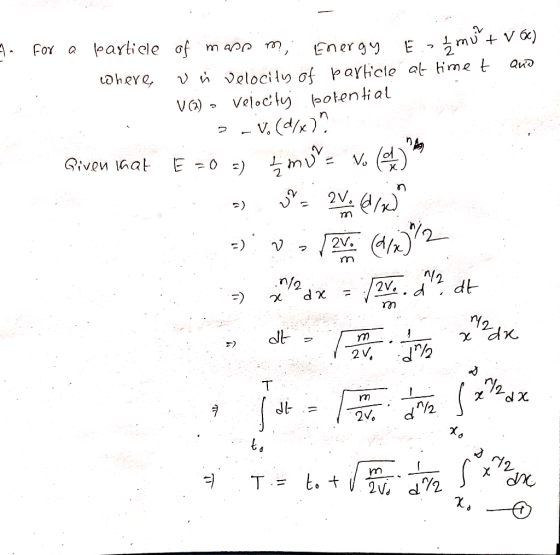
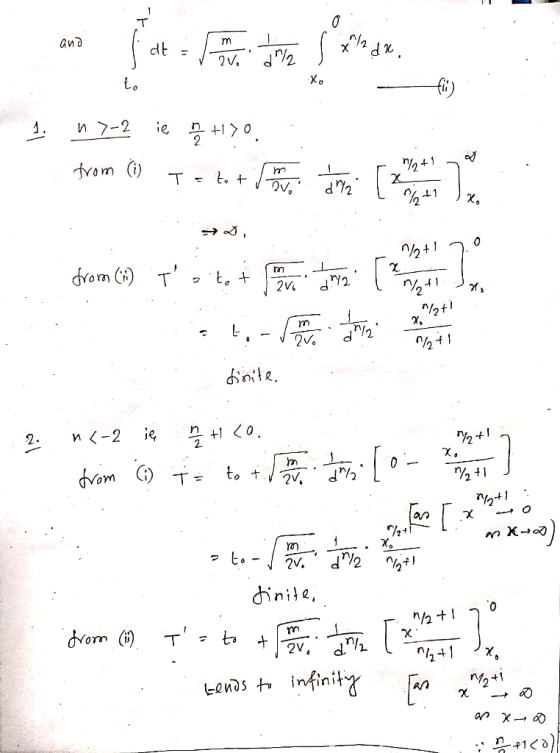
![3 n=-2 from (i) To to treat see more o to the need [logz]. 2 . from (1) To to a mal da into Immid [logx7 . 2.2.](http://img.homeworklib.com/questions/055e4c40-d39a-11ea-9137-4de4dca4c6dd.png?x-oss-process=image/resize,w_560) l
l
Add Answer to:
Can someone carefully solve questions 1, 2
and 3 in detail, please!!!
Thank you!!!
A. Consider...
A. Consider motion of a particle of mass m and energy E = 0 in the...
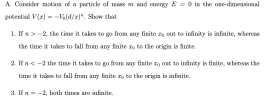 A. Consider motion of a particle of mass m and energy E = 0 in the one-dimensional potential V(x) = -V.(d/x)". Show that 1. If n > —2, the time it takes to go from any finite co out to infinity is infinite, whereas the time it takes to fall from any finite čo to the origin is finite. 2. If n < -2 the time it takes to go from any finite xo out to infinity is finite, whereas...
Please include every step in detail so I can understand. Thank you Preview File Edit View...
 Please include every step in detail so I can understand. Thank
you
Preview File Edit View Go Tools window Help 크 Scanned from a husky station.pdf v Q Search For any eigenfunction ψ, of the infinite square well, show that (x)- L/2 and that 2(nT)의 where L is the well dimension 18
Please include every step in detail so I can understand. Thank
you
Preview File Edit View Go Tools window Help 크 Scanned from a husky station.pdf v Q Search For any eigenfunction ψ, of the infinite square well, show that (x)- L/2 and that 2(nT)의 where L is the well dimension 18
Can someone carefully explain and answer questions 1, 2, 3, 4 and 5 in detail, please!!!...
 Can someone carefully explain and answer questions 1, 2, 3, 4
and 5 in detail, please!!!
Multiplication can be thought of as repeated addition. Three times four is 4 added to itself 3 times. 1) Create an assembly program that multiplies two 8 bit integers (2's complement) together in your PIC, using the repeated summation technique 2) Add a feature to your program that detects if the answer is too big to hold in 8 bit 2's complement notation 3)...
Can someone carefully explain and answer questions 1, 2, 3, 4
and 5 in detail, please!!!
Multiplication can be thought of as repeated addition. Three times four is 4 added to itself 3 times. 1) Create an assembly program that multiplies two 8 bit integers (2's complement) together in your PIC, using the repeated summation technique 2) Add a feature to your program that detects if the answer is too big to hold in 8 bit 2's complement notation 3)...
can someone help me with these problems, if you could detail your answer I would be...
 can someone help me with these problems, if you could detail
your answer I would be grateful :D
Problem 1
a) A 1.5 m long conductor is 6.5x10 ^ 25 electrons / m3. In this
medium the electrons move at 4x10 ^ (- 4) m / s How many electrons
per second pass through the 1.5 mm ^ 2 section?
b) If at a temperature of 20C the conductor resistivity is
3.7x10 ^ (- 3) ohm * m the electric...
can someone help me with these problems, if you could detail
your answer I would be grateful :D
Problem 1
a) A 1.5 m long conductor is 6.5x10 ^ 25 electrons / m3. In this
medium the electrons move at 4x10 ^ (- 4) m / s How many electrons
per second pass through the 1.5 mm ^ 2 section?
b) If at a temperature of 20C the conductor resistivity is
3.7x10 ^ (- 3) ohm * m the electric...
Can someone carefully explain question A and B in detail, please? 5.2 A uniform linear charge density λ is placed on an infinitely long wire. The wire is parallel to an infinite grounded plane, and a...
 Can someone carefully explain question A and B in detail,
please?
5.2 A uniform linear charge density λ is placed on an infinitely long wire. The wire is parallel to an infinite grounded plane, and a distance b above that plane. To make things specific, the points on the wire are described as (x, 0, b), and the conducting plane is z 0. A. Find the potential V(O, y, z) for z > 0. B. Find the induced charge density...
Can someone carefully explain question A and B in detail,
please?
5.2 A uniform linear charge density λ is placed on an infinitely long wire. The wire is parallel to an infinite grounded plane, and a distance b above that plane. To make things specific, the points on the wire are described as (x, 0, b), and the conducting plane is z 0. A. Find the potential V(O, y, z) for z > 0. B. Find the induced charge density...
Question 8 please 5. We start with Schrodinger's Equation in 2(x,t) = H¥(x,t). We can write...
 Question 8 please
5. We start with Schrodinger's Equation in 2(x,t) = H¥(x,t). We can write the time derivative as 2.4(x, t) = V(x,+) - (xt), where At is a sufficiently small increment of time. Plug the algebraic form of the derivative into Schrodinger's Eq. and solve for '(x,t+At). b. Put your answer in the form (x,t+At) = T '(x,t). c. What physically does the operator T do to the function '(x,t)? d. Deduce an expression for '(x,t+24t), in terms...
Question 8 please
5. We start with Schrodinger's Equation in 2(x,t) = H¥(x,t). We can write the time derivative as 2.4(x, t) = V(x,+) - (xt), where At is a sufficiently small increment of time. Plug the algebraic form of the derivative into Schrodinger's Eq. and solve for '(x,t+At). b. Put your answer in the form (x,t+At) = T '(x,t). c. What physically does the operator T do to the function '(x,t)? d. Deduce an expression for '(x,t+24t), in terms...
Please help! :) Discussion #3 1. Consider the motion of an object that can be treated...
 Please help! :)
Discussion #3 1. Consider the motion of an object that can be treated as a point particle and is traveling counter-clockwise in a circle of radius R. This motion can (and will for the purposes of these discussion activities) be described and analyzed using a Cartesian (x-y) coordinate system with a spatial origin at the center of the particle's circular trajectory (the physical path its motion traces out in space). (a) Draw a diagram of the position...
Please help! :)
Discussion #3 1. Consider the motion of an object that can be treated as a point particle and is traveling counter-clockwise in a circle of radius R. This motion can (and will for the purposes of these discussion activities) be described and analyzed using a Cartesian (x-y) coordinate system with a spatial origin at the center of the particle's circular trajectory (the physical path its motion traces out in space). (a) Draw a diagram of the position...
Hello, can you please help me understand this problem? Thank you! 3. Let V be finite...
 Hello, can you please help me understand this problem? Thank
you!
3. Let V be finite dimensional vector space. T is a linear transformation from V into W and E is a subspace of V and F is a subspace of W. Define T-(F) = {u € V|T(u) € F} and T(E) = {WE Ww= T(u) for someu e E}. (a) Prove that T-(F) is a subspace of V and dim(T-(F)) = dim(Ker(T)) + dim(F n Im(T)) (b) Prove that...
Hello, can you please help me understand this problem? Thank
you!
3. Let V be finite dimensional vector space. T is a linear transformation from V into W and E is a subspace of V and F is a subspace of W. Define T-(F) = {u € V|T(u) € F} and T(E) = {WE Ww= T(u) for someu e E}. (a) Prove that T-(F) is a subspace of V and dim(T-(F)) = dim(Ker(T)) + dim(F n Im(T)) (b) Prove that...
i am very confused with these questions. can someone help me solve? and can you explain...
 i am very confused with these questions. can someone help me
solve? and can you explain neatly and clearly? will rate, thank
you.
1. In this experiment, you will be generating time measurements that have both random uncertainty (Stran) and systematic uncertainty (dtsys). Using Eq. 4 as a starting point, write down an equation that will allow you to calculate &t from Stran and otsys 2. The acceleration due to gravity is related to the time, t, it takes the...
i am very confused with these questions. can someone help me
solve? and can you explain neatly and clearly? will rate, thank
you.
1. In this experiment, you will be generating time measurements that have both random uncertainty (Stran) and systematic uncertainty (dtsys). Using Eq. 4 as a starting point, write down an equation that will allow you to calculate &t from Stran and otsys 2. The acceleration due to gravity is related to the time, t, it takes the...
I really need someone to solve and explain the last two questions. Thank you! Exercise 1.5....
 I really need someone to solve and explain the last two
questions. Thank you!
Exercise 1.5. Prove that if A and B are sets satisfying the property that then it must be the case that A - B. Exercise 1.6. Using definition (1.2.5) of the symmetric difference, prove that, for any sets A and B, AAB - (AUB)I(AnB). Exercise 1.7. Verify the second assertion of Theorem 1.3.4, that for any collection of sets {Asher Ai iET iET Exercise 1.8. Prove...
I really need someone to solve and explain the last two
questions. Thank you!
Exercise 1.5. Prove that if A and B are sets satisfying the property that then it must be the case that A - B. Exercise 1.6. Using definition (1.2.5) of the symmetric difference, prove that, for any sets A and B, AAB - (AUB)I(AnB). Exercise 1.7. Verify the second assertion of Theorem 1.3.4, that for any collection of sets {Asher Ai iET iET Exercise 1.8. Prove...
 A. Consider motion of a particle of mass m and energy E = 0 in the one-dimensional potential V(x) = -V.(d/x)". Show that 1. If n > —2, the time it takes to go from any finite co out to infinity is infinite, whereas the time it takes to fall from any finite čo to the origin is finite. 2. If n < -2 the time it takes to go from any finite xo out to infinity is finite, whereas...
 Please include every step in detail so I can understand. Thank
you
Preview File Edit View Go Tools window Help 크 Scanned from a husky station.pdf v Q Search For any eigenfunction ψ, of the infinite square well, show that (x)- L/2 and that 2(nT)의 where L is the well dimension 18
Please include every step in detail so I can understand. Thank
you
Preview File Edit View Go Tools window Help 크 Scanned from a husky station.pdf v Q Search For any eigenfunction ψ, of the infinite square well, show that (x)- L/2 and that 2(nT)의 where L is the well dimension 18
 Can someone carefully explain and answer questions 1, 2, 3, 4
and 5 in detail, please!!!
Multiplication can be thought of as repeated addition. Three times four is 4 added to itself 3 times. 1) Create an assembly program that multiplies two 8 bit integers (2's complement) together in your PIC, using the repeated summation technique 2) Add a feature to your program that detects if the answer is too big to hold in 8 bit 2's complement notation 3)...
Can someone carefully explain and answer questions 1, 2, 3, 4
and 5 in detail, please!!!
Multiplication can be thought of as repeated addition. Three times four is 4 added to itself 3 times. 1) Create an assembly program that multiplies two 8 bit integers (2's complement) together in your PIC, using the repeated summation technique 2) Add a feature to your program that detects if the answer is too big to hold in 8 bit 2's complement notation 3)...
 can someone help me with these problems, if you could detail
your answer I would be grateful :D
Problem 1
a) A 1.5 m long conductor is 6.5x10 ^ 25 electrons / m3. In this
medium the electrons move at 4x10 ^ (- 4) m / s How many electrons
per second pass through the 1.5 mm ^ 2 section?
b) If at a temperature of 20C the conductor resistivity is
3.7x10 ^ (- 3) ohm * m the electric...
can someone help me with these problems, if you could detail
your answer I would be grateful :D
Problem 1
a) A 1.5 m long conductor is 6.5x10 ^ 25 electrons / m3. In this
medium the electrons move at 4x10 ^ (- 4) m / s How many electrons
per second pass through the 1.5 mm ^ 2 section?
b) If at a temperature of 20C the conductor resistivity is
3.7x10 ^ (- 3) ohm * m the electric...
 Can someone carefully explain question A and B in detail,
please?
5.2 A uniform linear charge density λ is placed on an infinitely long wire. The wire is parallel to an infinite grounded plane, and a distance b above that plane. To make things specific, the points on the wire are described as (x, 0, b), and the conducting plane is z 0. A. Find the potential V(O, y, z) for z > 0. B. Find the induced charge density...
Can someone carefully explain question A and B in detail,
please?
5.2 A uniform linear charge density λ is placed on an infinitely long wire. The wire is parallel to an infinite grounded plane, and a distance b above that plane. To make things specific, the points on the wire are described as (x, 0, b), and the conducting plane is z 0. A. Find the potential V(O, y, z) for z > 0. B. Find the induced charge density...
 Question 8 please
5. We start with Schrodinger's Equation in 2(x,t) = H¥(x,t). We can write the time derivative as 2.4(x, t) = V(x,+) - (xt), where At is a sufficiently small increment of time. Plug the algebraic form of the derivative into Schrodinger's Eq. and solve for '(x,t+At). b. Put your answer in the form (x,t+At) = T '(x,t). c. What physically does the operator T do to the function '(x,t)? d. Deduce an expression for '(x,t+24t), in terms...
Question 8 please
5. We start with Schrodinger's Equation in 2(x,t) = H¥(x,t). We can write the time derivative as 2.4(x, t) = V(x,+) - (xt), where At is a sufficiently small increment of time. Plug the algebraic form of the derivative into Schrodinger's Eq. and solve for '(x,t+At). b. Put your answer in the form (x,t+At) = T '(x,t). c. What physically does the operator T do to the function '(x,t)? d. Deduce an expression for '(x,t+24t), in terms...
 Please help! :)
Discussion #3 1. Consider the motion of an object that can be treated as a point particle and is traveling counter-clockwise in a circle of radius R. This motion can (and will for the purposes of these discussion activities) be described and analyzed using a Cartesian (x-y) coordinate system with a spatial origin at the center of the particle's circular trajectory (the physical path its motion traces out in space). (a) Draw a diagram of the position...
Please help! :)
Discussion #3 1. Consider the motion of an object that can be treated as a point particle and is traveling counter-clockwise in a circle of radius R. This motion can (and will for the purposes of these discussion activities) be described and analyzed using a Cartesian (x-y) coordinate system with a spatial origin at the center of the particle's circular trajectory (the physical path its motion traces out in space). (a) Draw a diagram of the position...
 Hello, can you please help me understand this problem? Thank
you!
3. Let V be finite dimensional vector space. T is a linear transformation from V into W and E is a subspace of V and F is a subspace of W. Define T-(F) = {u € V|T(u) € F} and T(E) = {WE Ww= T(u) for someu e E}. (a) Prove that T-(F) is a subspace of V and dim(T-(F)) = dim(Ker(T)) + dim(F n Im(T)) (b) Prove that...
Hello, can you please help me understand this problem? Thank
you!
3. Let V be finite dimensional vector space. T is a linear transformation from V into W and E is a subspace of V and F is a subspace of W. Define T-(F) = {u € V|T(u) € F} and T(E) = {WE Ww= T(u) for someu e E}. (a) Prove that T-(F) is a subspace of V and dim(T-(F)) = dim(Ker(T)) + dim(F n Im(T)) (b) Prove that...
 i am very confused with these questions. can someone help me
solve? and can you explain neatly and clearly? will rate, thank
you.
1. In this experiment, you will be generating time measurements that have both random uncertainty (Stran) and systematic uncertainty (dtsys). Using Eq. 4 as a starting point, write down an equation that will allow you to calculate &t from Stran and otsys 2. The acceleration due to gravity is related to the time, t, it takes the...
i am very confused with these questions. can someone help me
solve? and can you explain neatly and clearly? will rate, thank
you.
1. In this experiment, you will be generating time measurements that have both random uncertainty (Stran) and systematic uncertainty (dtsys). Using Eq. 4 as a starting point, write down an equation that will allow you to calculate &t from Stran and otsys 2. The acceleration due to gravity is related to the time, t, it takes the...
 I really need someone to solve and explain the last two
questions. Thank you!
Exercise 1.5. Prove that if A and B are sets satisfying the property that then it must be the case that A - B. Exercise 1.6. Using definition (1.2.5) of the symmetric difference, prove that, for any sets A and B, AAB - (AUB)I(AnB). Exercise 1.7. Verify the second assertion of Theorem 1.3.4, that for any collection of sets {Asher Ai iET iET Exercise 1.8. Prove...
I really need someone to solve and explain the last two
questions. Thank you!
Exercise 1.5. Prove that if A and B are sets satisfying the property that then it must be the case that A - B. Exercise 1.6. Using definition (1.2.5) of the symmetric difference, prove that, for any sets A and B, AAB - (AUB)I(AnB). Exercise 1.7. Verify the second assertion of Theorem 1.3.4, that for any collection of sets {Asher Ai iET iET Exercise 1.8. Prove...
Most questions answered within 3 hours.
-
Where is the error in this code sequence?
String s1 = "Hello";
String s2 = "ello";...
asked 10 months ago -
Financial data for Joel de Paris, Inc., for last year
follow:
Joel de Paris, Inc.
Balance...
asked 10 months ago -
Consider this reaction:
Al2(SO4)3 (aq)+ BaCl3
(aq) Al2Cl6 (aq)- +
3BaSO4(s) . What is the...
asked 10 months ago -
Suppose that Savneet is considering increasing her
recent random sample from 20 car rentals to 40...
asked 10 months ago -
Trucks arrive at an unloading terminal at an average rate of 120
per hour.
Trucks arrive...
asked 10 months ago -
Why are methanol and ethanol completely soluble in water while
octanol is not very little soluble....
asked 10 months ago -
A facilities manager at a university reads in a research report
that the mean amount of...
asked 10 months ago -
When the CuSO4 is rehydrated by adding water to the anhydrous
compound, is this an endothermic...
asked 10 months ago -
A ray of sunlight is passing from diamond into crown glass; the
angle of incidence is...
asked 10 months ago -
A block of mass 0.249 kg is placed on top of a light, vertical
spring of...
asked 10 months ago -
how do the kidneys compensate in the presences of acidosis
a) trigger hyperventilate
b) reserve acid...
asked 10 months ago -
Question 501 pts
The rental rate of capital to the firm increases. Which of the
following...
asked 10 months ago