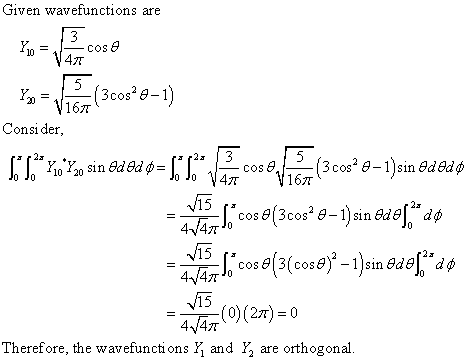
Show that the two wavefunctions: Are orthogonal
Homework Answers
Show that the wavefunctions , where n ≠ m, are orthogonal for a particle confined to...
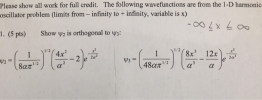 Show that the wavefunctions , where n ≠ m, are orthogonal for a
particle confined to the region -infinity ≤x ≤ infinity
Please show all work for full credit. The following wavefunctions are from the 1-D harmonic oscillator problem (imits from - infinity to + infinity, variable is x) I. (5 pts) Show V2 is orthogonal to vs. 1a
Show that the wavefunctions , where n ≠ m, are orthogonal for a
particle confined to the region -infinity ≤x ≤ infinity
Please show all work for full credit. The following wavefunctions are from the 1-D harmonic oscillator problem (imits from - infinity to + infinity, variable is x) I. (5 pts) Show V2 is orthogonal to vs. 1a
Demonstrate that all 1-D PIB wavefunctions are orthogonal.
Demonstrate that all 1-D PIB wavefunctions are orthogonal.
3) Show that the u(2,1,1) and u(2,0,0) wavefunctions are orthogonal. AY 1 (2,1, 1)= Z ge...
 3) Show that the u(2,1,1) and u(2,0,0) wavefunctions are orthogonal. AY 1 (2,1, 1)= Z ge h sin 0e tip (64T) ао 3/ 1 Z (2,0,0) (2-о)e % (32л)* (а,
Show that the wafunctions sin "/C and cos "2* are orthogonal over the interval 0sxsa. n...
 Show that the wafunctions sin "/C and cos "2* are orthogonal over the interval 0sxsa. n is an integer and cOS_ are
Problem 5 (a) Two (unnormalized) excited state wavefunctions of the H atom are (1) 4 =...
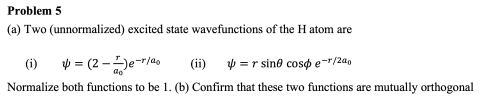 Problem 5 (a) Two (unnormalized) excited state wavefunctions of the H atom are (1) 4 = (2-)e-r/ao (ii) W = r sinô coso e-r/220 Normalize both functions to be 1. (b) Confirm that these two functions are mutually orthogonal
Determine whether the given matrix is orthogonal. If it is, find its inverse. cos sin cos...
 Determine whether the given matrix is orthogonal. If it is, find its inverse. cos sin cos sin A = [ cose sin e sin e 0 cos e - cos ]
show that 9- a) A is orthogonal if and only if A' is orthogonal b) A is orthogonal if and only if A is orthogonal c) A& B are orthogonal then AB is orthogonal d) A is orthogonal then det(A)=1...
 show that
9- a) A is orthogonal if and only if A' is orthogonal b) A is orthogonal if and only if A is orthogonal c) A& B are orthogonal then AB is orthogonal d) A is orthogonal then det(A)=1 or det(A)=-1
9- a) A is orthogonal if and only if A' is orthogonal b) A is orthogonal if and only if A is orthogonal c) A& B are orthogonal then AB is orthogonal d) A is orthogonal then det(A)=1...
show that
9- a) A is orthogonal if and only if A' is orthogonal b) A is orthogonal if and only if A is orthogonal c) A& B are orthogonal then AB is orthogonal d) A is orthogonal then det(A)=1 or det(A)=-1
9- a) A is orthogonal if and only if A' is orthogonal b) A is orthogonal if and only if A is orthogonal c) A& B are orthogonal then AB is orthogonal d) A is orthogonal then det(A)=1...
6.2(a) Complex functions of the form eikx can be used to model the wavefunctions of particles...
6.2(a) Complex functions of the form eikx can be used to model the wavefunctions of particles in a linear accelerator. Show that any linear combination of the complex functions e2ix and e−2ix is an eigenfunction of the operator d2/dx2 and identify its eigenvalue. 6.2(b) Functions of the form sin nx can be used to model the wavefunctions of electrons in a carbon nanotube. Show that any linear combination of the functions sin 3x and cos 3x is an eigenfunction of...
Show that if A and B are orthogonal matrices, then A B is an orthogonal matrix.
Show that if A and B are orthogonal matrices, then A B is an orthogonal matrix.
4. We saw in class that if A is an orthogonal matrix, then ||AX|| = ||X||....
 4. We saw in class that if A is an orthogonal matrix, then ||AX|| = ||X||. One matrix for which we know this is true is the rotation matrix, A = [cos – sin 0] sin cos a. (2 pts) Show that A is an orthogonal matrix. b. (2 pts) Since A is an orthogonal matrix, A-1 = AT. Show that AT can be written as cos 0 – sino w does the angle o relate to the angle ?...
 Show that the wavefunctions , where n ≠ m, are orthogonal for a
particle confined to the region -infinity ≤x ≤ infinity
Please show all work for full credit. The following wavefunctions are from the 1-D harmonic oscillator problem (imits from - infinity to + infinity, variable is x) I. (5 pts) Show V2 is orthogonal to vs. 1a
Show that the wavefunctions , where n ≠ m, are orthogonal for a
particle confined to the region -infinity ≤x ≤ infinity
Please show all work for full credit. The following wavefunctions are from the 1-D harmonic oscillator problem (imits from - infinity to + infinity, variable is x) I. (5 pts) Show V2 is orthogonal to vs. 1a
 3) Show that the u(2,1,1) and u(2,0,0) wavefunctions are orthogonal. AY 1 (2,1, 1)= Z ge h sin 0e tip (64T) ао 3/ 1 Z (2,0,0) (2-о)e % (32л)* (а,
 Show that the wafunctions sin "/C and cos "2* are orthogonal over the interval 0sxsa. n is an integer and cOS_ are
 Problem 5 (a) Two (unnormalized) excited state wavefunctions of the H atom are (1) 4 = (2-)e-r/ao (ii) W = r sinô coso e-r/220 Normalize both functions to be 1. (b) Confirm that these two functions are mutually orthogonal
 Determine whether the given matrix is orthogonal. If it is, find its inverse. cos sin cos sin A = [ cose sin e sin e 0 cos e - cos ]
 show that
9- a) A is orthogonal if and only if A' is orthogonal b) A is orthogonal if and only if A is orthogonal c) A& B are orthogonal then AB is orthogonal d) A is orthogonal then det(A)=1 or det(A)=-1
9- a) A is orthogonal if and only if A' is orthogonal b) A is orthogonal if and only if A is orthogonal c) A& B are orthogonal then AB is orthogonal d) A is orthogonal then det(A)=1...
show that
9- a) A is orthogonal if and only if A' is orthogonal b) A is orthogonal if and only if A is orthogonal c) A& B are orthogonal then AB is orthogonal d) A is orthogonal then det(A)=1 or det(A)=-1
9- a) A is orthogonal if and only if A' is orthogonal b) A is orthogonal if and only if A is orthogonal c) A& B are orthogonal then AB is orthogonal d) A is orthogonal then det(A)=1...
 4. We saw in class that if A is an orthogonal matrix, then ||AX|| = ||X||. One matrix for which we know this is true is the rotation matrix, A = [cos – sin 0] sin cos a. (2 pts) Show that A is an orthogonal matrix. b. (2 pts) Since A is an orthogonal matrix, A-1 = AT. Show that AT can be written as cos 0 – sino w does the angle o relate to the angle ?...
Most questions answered within 3 hours.
-
Where is the error in this code sequence?
String s1 = "Hello";
String s2 = "ello";...
asked 10 months ago -
Financial data for Joel de Paris, Inc., for last year
follow:
Joel de Paris, Inc.
Balance...
asked 10 months ago -
Consider this reaction:
Al2(SO4)3 (aq)+ BaCl3
(aq) Al2Cl6 (aq)- +
3BaSO4(s) . What is the...
asked 10 months ago -
Suppose that Savneet is considering increasing her
recent random sample from 20 car rentals to 40...
asked 10 months ago -
Trucks arrive at an unloading terminal at an average rate of 120
per hour.
Trucks arrive...
asked 10 months ago -
Why are methanol and ethanol completely soluble in water while
octanol is not very little soluble....
asked 10 months ago -
A facilities manager at a university reads in a research report
that the mean amount of...
asked 10 months ago -
When the CuSO4 is rehydrated by adding water to the anhydrous
compound, is this an endothermic...
asked 10 months ago -
A ray of sunlight is passing from diamond into crown glass; the
angle of incidence is...
asked 10 months ago -
A block of mass 0.249 kg is placed on top of a light, vertical
spring of...
asked 10 months ago -
how do the kidneys compensate in the presences of acidosis
a) trigger hyperventilate
b) reserve acid...
asked 10 months ago -
Question 501 pts
The rental rate of capital to the firm increases. Which of the
following...
asked 10 months ago