9. Regulating a natural monopoly Consider the local cable company, a natural monopoly. The following graph...
9. Regulating a natural monopoly
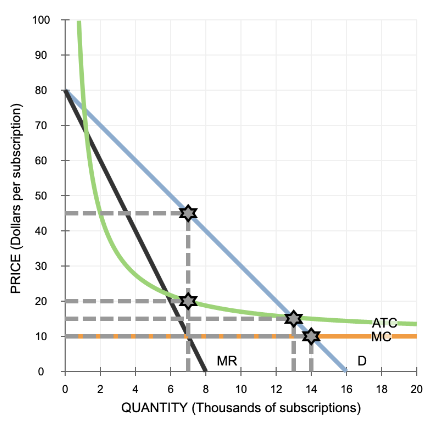
Consider the local cable company, a natural monopoly. The following graph shows the monthly demand curve for cable services and the company's marginal revenue (MR), marginal cost (MC), and average total cost (ATC) curves.
Suppose that the government has decided not to regulate this industry, and the firm is free to maximize profits, without constraints.
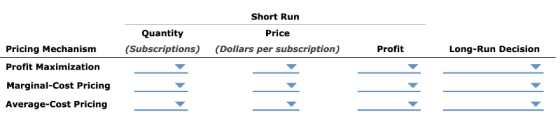
Complete the first row of the following table.
Suppose that the government forces the monopolist to set the price equal to marginal cost.
Complete the second row of the previous table
Suppose that the government forces the monopolist to set the price equal to average total cost.
Complete the third row of the previous table.
True or False: Over time, the cable company has a very strong incentive to lower costs when subject to average-cost pricing regulations.
True
False
Homework Answers
The first strategy (profit maximization):
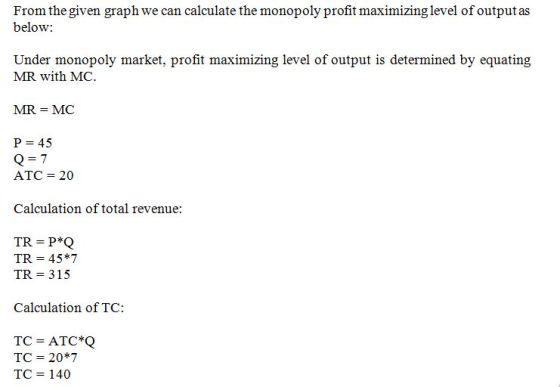
Under this, the monopolist produces the output level where the marginal revenue is equal to the marginal cost of production. Thus, the monopolist must produce 7,000 units and charges \(\$ 45\) per unit.
Profit is the excess of revenue over cost. The calculation is as follows:
\(\pi=(P-A T C)\) Quantity
\(=(\$ 45-\$ 20) 7,000\)
\(=\$ 175,000\)
Thus, the profit earned by the monopolist is \(\$ 175,000 .\). Since the monopolist is making positive profits, it will STAY in the long run.
The second strategy (marginal cost pricing):
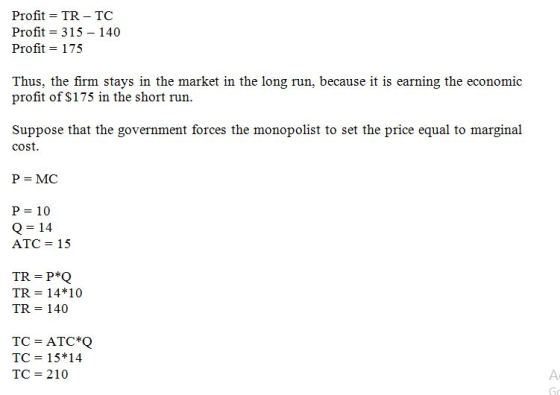
Under this, the monopolist produces the output level where the price (demand curve) equals the marginal cost of production. Thus, the monopolist must produce 14,000 units and charges \(\$ 10\) per unit.
Profit is the excess of revenue over cost. The calculation is as follows:
\(\pi=(P-A T C) Q\) quantity
\(=(\$ 10-\$ 15) 14,000\)
\(=-\$ 70,000\)
Thus, the profit earned by the monopolist is -\$70,000 (negative sign denotes loss). Since the monopolist is incurring losses, it will EXIT in the long run.
Third strategy (average cost pricing):
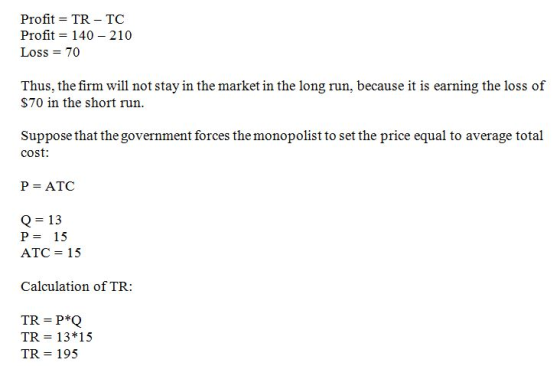
Under this, the monopolist produces the output level where the price (demand curve) is equal to the average total cost of production. Thus, the monopolist must produce 13,000 units and charges \(\$ 15\) per unit.
Profit is the excess of revenue over cost. The calculation is as follows:
\(\pi=(P-A T C)\) Quantity
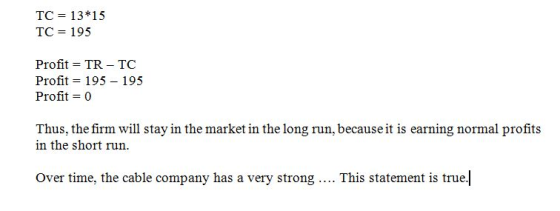
\(=(\$ 15-\$ 15) 13,000\)
\(=0\)
Thus, the profit earned by the monopolist is 0 (neither profit nor loss situation). Thus, in the long run, the firm may STAY or EXIT.
Under average cost pricing policy, the natural monopoly doesn't have any incentive to cut costs. As the firm scuts down its costs, the optimal production will also change, leading to zero profits for the natural monopolist.
Thus, the given statement is TRUE; the firm has NO incentive to cut costs.
Add Answer to:
9. Regulating a natural monopoly Consider the local cable company, a natural monopoly. The following graph...
Most questions answered within 3 hours.
-
Where is the error in this code sequence?
String s1 = "Hello";
String s2 = "ello";...
asked 10 months ago -
Financial data for Joel de Paris, Inc., for last year
follow:
Joel de Paris, Inc.
Balance...
asked 10 months ago -
Consider this reaction:
Al2(SO4)3 (aq)+ BaCl3
(aq) Al2Cl6 (aq)- +
3BaSO4(s) . What is the...
asked 10 months ago -
Suppose that Savneet is considering increasing her
recent random sample from 20 car rentals to 40...
asked 10 months ago -
Trucks arrive at an unloading terminal at an average rate of 120
per hour.
Trucks arrive...
asked 10 months ago -
Why are methanol and ethanol completely soluble in water while
octanol is not very little soluble....
asked 10 months ago -
A facilities manager at a university reads in a research report
that the mean amount of...
asked 10 months ago -
When the CuSO4 is rehydrated by adding water to the anhydrous
compound, is this an endothermic...
asked 10 months ago -
A ray of sunlight is passing from diamond into crown glass; the
angle of incidence is...
asked 10 months ago -
A block of mass 0.249 kg is placed on top of a light, vertical
spring of...
asked 10 months ago -
how do the kidneys compensate in the presences of acidosis
a) trigger hyperventilate
b) reserve acid...
asked 10 months ago -
Question 501 pts
The rental rate of capital to the firm increases. Which of the
following...
asked 10 months ago