What is the critical F value for a between-subjects design with 3 conditions and a total...
What is the critical F value for a between-subjects design with 3 conditions and a total of 49 participants?
| 2.81 |
| 3.20 |
|
3.21 2.80 |
Homework Answers

Add Answer to:
What is the critical F value for a between-subjects design with
3 conditions and a total...
What is the critical value of t for a study with a directional H1, a between-subjects...
What is the critical value of t for a study with a directional H1, a between-subjects design, and N=26? a. 1.708 b. 2.060 c. 1.711 d. 2.064
What are the corresponding degrees of freedom and critical value for a within-subjects ANOVA with 2...
 What are the corresponding degrees of freedom and critical value for a within-subjects ANOVA with 2 conditions, 6 subjects in each condition, and a = 0.01? a) BG: b) BS: C) Error: d) Total: e) critical value: Submit Answer
An advantage of a within-subjects design as compared to a between-subjects design is... a. All of...
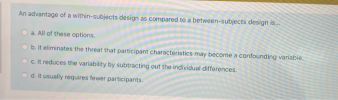 An advantage of a within-subjects design as compared to a between-subjects design is... a. All of these options. b. it eliminates the threat that participant characteristics may become a confounding variable. c. it reduces the variability by subtracting out the individual differences. d. it usually requires fewer participants.
Dr. Can-Adian will be conducting an experiment comparing 4 treatment conditions. If she uses a between-subjects...
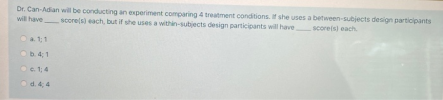 Dr. Can-Adian will be conducting an experiment comparing 4 treatment conditions. If she uses a between-subjects design participants will have score(s) each, but if she uses a within-subjects design participants will have score(s) each. a. 1; 1 b. 4; 1 c. 1: 4 d. 4; 4
6. Typically, when comparing a within-subjects design to a between-groups design which of the following describe...
 6. Typically, when comparing a within-subjects design to a between-groups design which of the following describe their differences in error variance? a. Within-subjects designs results in less error variance than between-groups. b. A within-subjects design results in more error variance than a between-groups design. C. A within-subjects design results in the same amount of error variance as a between-groups design d. There is no error variance in a within-subjects design, whereas a between- groups design does present some error variance....
What are the corresponding degrees of freedom and critical value for a one-way ANOVA with 3...
What are the corresponding degrees of freedom and critical value for a one-way ANOVA with 3 conditions, 5 subjects in each condition, and α = 0.01? BG: ______________________ WG: ______________________ Total: ______________________ critical value: ______________________
What is the df and critical value of F for each situation below? a) K=6,...
What is the df and critical value of F for each situation below? a) K=6, n=7 (between-subject design) _______________________________ b) K=4, n=11(between-subject design) _______________________________ c) K=3, n=5(between-subject design) _______________________________
. propose a between-subjects experimental design to test the relationship. The IV and DV are already...
 . propose a between-subjects experimental design to test the relationship. The IV and DV are already identified for you. Please explain how you would investigate the relationship by including: (1) your hypothesis (.e., what do you expect to happen), (2) an operational definition for your dependent variable (i.e., how will you test the variable), (3) the population (who do you want to recruit and why), (4) the levels of the IV (how many, what they are, and why), and (5)...
A researcher finds F(5,26) = 1.76. What is the associated p-value? round to two digits A...
A researcher finds F(5,26) = 1.76. What is the associated p-value? round to two digits A repeated measures design has n= 7 subjects, and k = 3 conditions. What is the degrees of freedom for the error term in the denominator of the F-value? A repeated measures design has n= 7 subjects, and k = 3 conditions. What is the degrees of freedom for the error term in the denominator of the F-value?
What are the corresponding degrees of freedom and critical value for a one-way ANOVA with 4...
What are the corresponding degrees of freedom and critical value for a one-way ANOVA with 4 conditions, 6 subjects in each condition, and α = 0.05? BG: WG: Total: critical value:
 What are the corresponding degrees of freedom and critical value for a within-subjects ANOVA with 2 conditions, 6 subjects in each condition, and a = 0.01? a) BG: b) BS: C) Error: d) Total: e) critical value: Submit Answer
 An advantage of a within-subjects design as compared to a between-subjects design is... a. All of these options. b. it eliminates the threat that participant characteristics may become a confounding variable. c. it reduces the variability by subtracting out the individual differences. d. it usually requires fewer participants.
 Dr. Can-Adian will be conducting an experiment comparing 4 treatment conditions. If she uses a between-subjects design participants will have score(s) each, but if she uses a within-subjects design participants will have score(s) each. a. 1; 1 b. 4; 1 c. 1: 4 d. 4; 4
 6. Typically, when comparing a within-subjects design to a between-groups design which of the following describe their differences in error variance? a. Within-subjects designs results in less error variance than between-groups. b. A within-subjects design results in more error variance than a between-groups design. C. A within-subjects design results in the same amount of error variance as a between-groups design d. There is no error variance in a within-subjects design, whereas a between- groups design does present some error variance....
 . propose a between-subjects experimental design to test the relationship. The IV and DV are already identified for you. Please explain how you would investigate the relationship by including: (1) your hypothesis (.e., what do you expect to happen), (2) an operational definition for your dependent variable (i.e., how will you test the variable), (3) the population (who do you want to recruit and why), (4) the levels of the IV (how many, what they are, and why), and (5)...
Most questions answered within 3 hours.
-
Where is the error in this code sequence?
String s1 = "Hello";
String s2 = "ello";...
asked 10 months ago -
Financial data for Joel de Paris, Inc., for last year
follow:
Joel de Paris, Inc.
Balance...
asked 10 months ago -
Consider this reaction:
Al2(SO4)3 (aq)+ BaCl3
(aq) Al2Cl6 (aq)- +
3BaSO4(s) . What is the...
asked 10 months ago -
Suppose that Savneet is considering increasing her
recent random sample from 20 car rentals to 40...
asked 10 months ago -
Trucks arrive at an unloading terminal at an average rate of 120
per hour.
Trucks arrive...
asked 10 months ago -
Why are methanol and ethanol completely soluble in water while
octanol is not very little soluble....
asked 10 months ago -
A facilities manager at a university reads in a research report
that the mean amount of...
asked 10 months ago -
When the CuSO4 is rehydrated by adding water to the anhydrous
compound, is this an endothermic...
asked 10 months ago -
A ray of sunlight is passing from diamond into crown glass; the
angle of incidence is...
asked 10 months ago -
A block of mass 0.249 kg is placed on top of a light, vertical
spring of...
asked 10 months ago -
how do the kidneys compensate in the presences of acidosis
a) trigger hyperventilate
b) reserve acid...
asked 10 months ago -
Question 501 pts
The rental rate of capital to the firm increases. Which of the
following...
asked 10 months ago