


Homework Answers
Question 12. Figure B represent negative negative relationship between two variables X and Y. The reason is that as the value of x increases the value of y is decreasing which shows negative relationship between the two.
Question 13. Figure A and figure D are showing positive relationship between X and Y. The reason is that as the value of x is increasing the value of Y is also increasing.
Question 14. Note that when we are at E both the quantity and the total revenue are increasing. This indicates that the slope is positive and therefore when we are at F, the slope turns negative. The correct answer is slope of the tangent at E is positive and the slope of tangent at F is negative.
Question 15. When two variables are not related to each other the relationship between them can be shown as a straight line which is horizontal or vertical.
Ocean 16. Ceteris paribus means all other things or factors are unchanged while we discuss about bringing a change in one of the factors. Other things remaining the same should be correct.
Add Answer to:
2.86 pts D Question 12 Figure A Figure 8 Figure C Figure D Refer to the...
D Question 5 1 pts Refer to the figure below. A scenario involving "attainable production and...
 D Question 5 1 pts Refer to the figure below. A scenario involving "attainable production and unemployment is! represented graphically by point 15 LA Chairs OHNWAUavo 10 Desks Question 6 1 pts Refer to the figure below. Point Z is currently Chairs ONWAUNO 10 Desks table without cha n ced resources watabi table withom olo with Question 7 1 pts Refer to the figure below. If the economy was operating at full employment and producing 4 desks, it could produce...
D Question 29 3.03 pts Figure 1-3 Price 15 12 Demand 150 210 Quantity Refer to...
 D Question 29 3.03 pts Figure 1-3 Price 15 12 Demand 150 210 Quantity Refer to Figure 1-3. Calculate the area of the trapezoid X O $270 O $720 $810 $2,520
Incorrect Question 4 0/1 pts Supply Rent ceiling Demand Quantity of apartments Refer to the figure...
 Incorrect Question 4 0/1 pts Supply Rent ceiling Demand Quantity of apartments Refer to the figure above. Which surface(s) describe(s) the consumers dead-weight loss, as a result of this price ceiling? O B+C D+E C+E
QUESTION 3 Figure Price Supply P K I P" P B M N Demand Quantity Refer...
 QUESTION 3 Figure Price Supply P K I P" P B M N Demand Quantity Refer to Figure. If the government imposes a tax size of P- P" in the above market then the area L+M+Y represents a. consumer surplus after the tax. producer surplus after the tax. Cconsumer surplus before the tax. producer surplus before the tax. QUESTION 4 4 point Figure Supply Dennd Quantity Q1 02 Q3 Q Qs Refer to Figure. If the government impose a tax...
D Question 15 3.5 pts The figure above shows two separate wave pulses that are approaching...
 D Question 15 3.5 pts The figure above shows two separate wave pulses that are approaching each other, with their centers labeled X and Y. Which of the following figures shows the shape of the resultant pulse when the centers of the pulses are at the same horizontal position? O
Refer to Figure 7. The price paid by buyers after the tax is imposed is a. $8. b. $16. C. $14. d. $12.
 Refer to Figure 7. The price paid by buyers after the tax is imposed is a. $8. b. $16. C. $14. d. $12.Refer to Figure 7. The effective price received by sellers after the tax is imposed is a. $8. b. $16. c. $14. d. $12.Refer to Figure 7. The amount of the tax per unit is a. $4. b. $8. C. $14. d. $10.Refer to Figure 7. The per-unit burden of the tax is a. $2 for buyers and...
Question 1 1 pts Refer to the figure below. The production possibilities curve ABCDE is bowed...
 Question 1 1 pts Refer to the figure below. The production possibilities curve ABCDE is bowed outward (concave) as opposed to bowed inward (convex). This is because Chairs OHNuovo o Desks Society does not value desks society faces no resource scarcity opportunity costs increase as more ticular Ebod is reduced of the law of one price D Question 2 Refer to the figure below. At point A, the cost of one more desk is Chairs ONWONOU Desks O chairs 1...
Refer to the information provided in Figure 12.4 below to answer the question(s) that follow. a....
 Refer to the information provided in Figure 12.4 below to answer the question(s) that follow. a. Industry X Price per unit of X (5) so Units of X b. Industry Y b. Industry Y Price per unit of Y (5) Units of Y Figure 12.4 There are two sectors in the economy, X and Y, and both are in long-run, zero-profit equilibrium at the intersections of sand D. Figure 12.4 There are two sectors in the economy, X and Y,...
(C) Figure C D) Figure D 28. (Figure: Market Changes) Refer to the figures. If these...
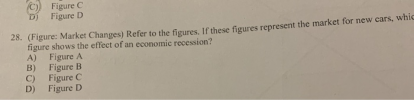 (C) Figure C D) Figure D 28. (Figure: Market Changes) Refer to the figures. If these figures represent the market figure shows the effect of an economic recession? A) Figure A B) Figure B C) Figure C D) Figure D Figure: Market Changes SA Demand Demand Figure A Figure B Supply Supply Figure C Figure D
Question 39 0.5 pts Figure 4-19 Ince 20 18 + 16+ 14 + 12 10 8...
 Question 39 0.5 pts Figure 4-19 Ince 20 18 + 16+ 14 + 12 10 8 6 4 2 D 10 20 30 40 50 60 70 80 90 any 39. Refer to Figure 4-19. In this market, equilibrium price and quantity, respectively, are 0 a $10 and 30 units. b. $10 and 50 units. O c. $10 and 70 units. O d. $4 and 50 units. Question 32 0.5 pts Scenario 26-2. Assume the following information for an imaginary,...
 D Question 5 1 pts Refer to the figure below. A scenario involving "attainable production and unemployment is! represented graphically by point 15 LA Chairs OHNWAUavo 10 Desks Question 6 1 pts Refer to the figure below. Point Z is currently Chairs ONWAUNO 10 Desks table without cha n ced resources watabi table withom olo with Question 7 1 pts Refer to the figure below. If the economy was operating at full employment and producing 4 desks, it could produce...
 D Question 29 3.03 pts Figure 1-3 Price 15 12 Demand 150 210 Quantity Refer to Figure 1-3. Calculate the area of the trapezoid X O $270 O $720 $810 $2,520
 Incorrect Question 4 0/1 pts Supply Rent ceiling Demand Quantity of apartments Refer to the figure above. Which surface(s) describe(s) the consumers dead-weight loss, as a result of this price ceiling? O B+C D+E C+E
 QUESTION 3 Figure Price Supply P K I P" P B M N Demand Quantity Refer to Figure. If the government imposes a tax size of P- P" in the above market then the area L+M+Y represents a. consumer surplus after the tax. producer surplus after the tax. Cconsumer surplus before the tax. producer surplus before the tax. QUESTION 4 4 point Figure Supply Dennd Quantity Q1 02 Q3 Q Qs Refer to Figure. If the government impose a tax...
 D Question 15 3.5 pts The figure above shows two separate wave pulses that are approaching each other, with their centers labeled X and Y. Which of the following figures shows the shape of the resultant pulse when the centers of the pulses are at the same horizontal position? O
 Question 1 1 pts Refer to the figure below. The production possibilities curve ABCDE is bowed outward (concave) as opposed to bowed inward (convex). This is because Chairs OHNuovo o Desks Society does not value desks society faces no resource scarcity opportunity costs increase as more ticular Ebod is reduced of the law of one price D Question 2 Refer to the figure below. At point A, the cost of one more desk is Chairs ONWONOU Desks O chairs 1...
 Refer to the information provided in Figure 12.4 below to answer the question(s) that follow. a. Industry X Price per unit of X (5) so Units of X b. Industry Y b. Industry Y Price per unit of Y (5) Units of Y Figure 12.4 There are two sectors in the economy, X and Y, and both are in long-run, zero-profit equilibrium at the intersections of sand D. Figure 12.4 There are two sectors in the economy, X and Y,...
 (C) Figure C D) Figure D 28. (Figure: Market Changes) Refer to the figures. If these figures represent the market figure shows the effect of an economic recession? A) Figure A B) Figure B C) Figure C D) Figure D Figure: Market Changes SA Demand Demand Figure A Figure B Supply Supply Figure C Figure D
 Question 39 0.5 pts Figure 4-19 Ince 20 18 + 16+ 14 + 12 10 8 6 4 2 D 10 20 30 40 50 60 70 80 90 any 39. Refer to Figure 4-19. In this market, equilibrium price and quantity, respectively, are 0 a $10 and 30 units. b. $10 and 50 units. O c. $10 and 70 units. O d. $4 and 50 units. Question 32 0.5 pts Scenario 26-2. Assume the following information for an imaginary,...
Most questions answered within 3 hours.
-
Where is the error in this code sequence?
String s1 = "Hello";
String s2 = "ello";...
asked 10 months ago -
Financial data for Joel de Paris, Inc., for last year
follow:
Joel de Paris, Inc.
Balance...
asked 10 months ago -
Consider this reaction:
Al2(SO4)3 (aq)+ BaCl3
(aq) Al2Cl6 (aq)- +
3BaSO4(s) . What is the...
asked 10 months ago -
Suppose that Savneet is considering increasing her
recent random sample from 20 car rentals to 40...
asked 10 months ago -
Trucks arrive at an unloading terminal at an average rate of 120
per hour.
Trucks arrive...
asked 10 months ago -
Why are methanol and ethanol completely soluble in water while
octanol is not very little soluble....
asked 10 months ago -
A facilities manager at a university reads in a research report
that the mean amount of...
asked 10 months ago -
When the CuSO4 is rehydrated by adding water to the anhydrous
compound, is this an endothermic...
asked 10 months ago -
A ray of sunlight is passing from diamond into crown glass; the
angle of incidence is...
asked 10 months ago -
A block of mass 0.249 kg is placed on top of a light, vertical
spring of...
asked 10 months ago -
how do the kidneys compensate in the presences of acidosis
a) trigger hyperventilate
b) reserve acid...
asked 10 months ago -
Question 501 pts
The rental rate of capital to the firm increases. Which of the
following...
asked 10 months ago