#1 Create two AVL trees with 7 keys: A, B, C, D, E, F, and G....
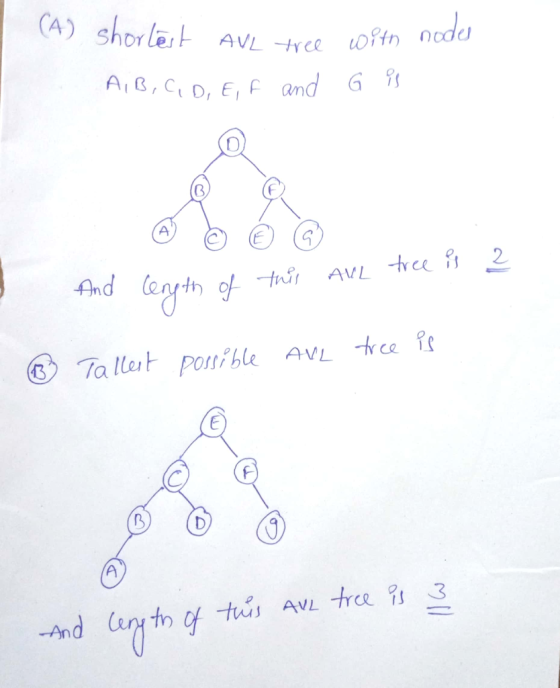
#1 Create two AVL trees with 7 keys: A, B, C, D, E, F, and G. (There are 5,040 different key sequences that produce 429 unique trees. Of those trees, 17 are AVL trees.)
a. Draw the shortest AVL tree containing these 7 keys.
b. Draw one of the tallest possible AVL trees containing these 7 keys.
Homework Answers
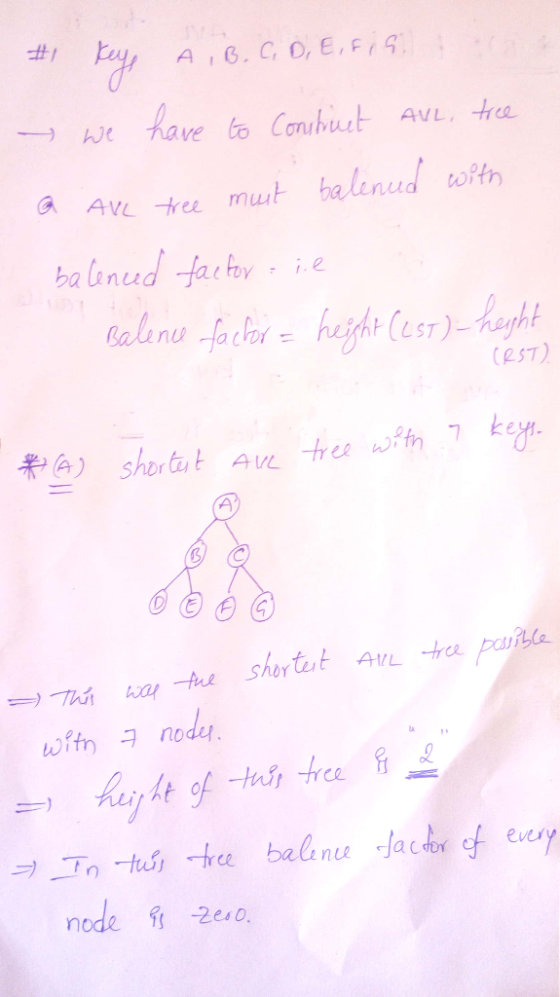
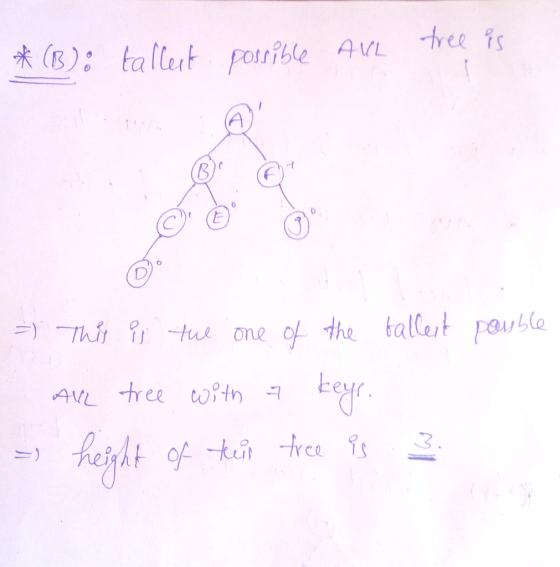
If we consider the ascii values of the nodes then the tree are:
File Edit Format View Help Graphs and trees 4. [6 marks] Using the following graph representation (G(V,E,w)): v a,b,c,d,e,f E fa,b), (a,f),fa,d), (b,e), (b,d), (c,f),(c,d),(d,e),d,f)) W(a,b) 4,...
 File Edit Format View Help Graphs and trees 4. [6 marks] Using the following graph representation (G(V,E,w)): v a,b,c,d,e,f E fa,b), (a,f),fa,d), (b,e), (b,d), (c,f),(c,d),(d,e),d,f)) W(a,b) 4,W(a,f) 9,W(a,d) 10 W(b,e) 12,W(b,d) 7,W(c,d) 3 a) Draw the graph including weights. b) Given the following algorithm for Inding a minimum spanning tree for a graph: Given a graph (G(V,E)) create a new graph (F) with nodes (V) and no edges Add all the edges (E) to a set S and order them...
A long string consists of the six characters A, B, C, D, E, F, G; they...
A long string consists of the six characters A, B, C, D, E, F, G; they appear with frequency 21%, 11%, 8%, 17%, 5%, 23%, and 15%, respectively. (a) Draw the Huffman encoding tree of these six characters. (b) What is the Huffman encoding of these six characters? (c) If this encoding is applied to a string consisting of one million characters with the given frequencies, what is the length of the encoded string in bits?
C. A 2 1. Figure A Figure B When three operational units (OTUS) A, B and...
 C. A 2 1. Figure A Figure B When three operational units (OTUS) A, B and Care concerned, one can make one bifurcating unrooted tree with one node, 1, as shown in figure A. If one more OTU, D, is added to the tree in figure A, one can attach D to any of the three edges (A1, B1, C1), thus one can make three topologically unique unrooted trees with one new node, node 2, as shown In figure B....
Explain ur working 4. [6 marks] Using the following graph representation (G(VE,w)): V a, b,c, d,e, fh E -la, b, [a, fl,la,d, (b,ej, [b,d, c,fl,fc,d],Id,el, sd, f) W(a, b) 4, W(a, f)-9, W(a, d)-10 W(b...
 Explain ur working
4. [6 marks] Using the following graph representation (G(VE,w)): V a, b,c, d,e, fh E -la, b, [a, fl,la,d, (b,ej, [b,d, c,fl,fc,d],Id,el, sd, f) W(a, b) 4, W(a, f)-9, W(a, d)-10 W(b, e) 12, W (b, d)7, W(c,d) 3 a) [3 marks] Draw the graph including weights. b) [2 + 1-3 marks] Given the following algorithm for finding a minimum spanning tree for a graph: Given a graph (G(V,E)) create a new graph (F) vith nodes (V)...
Explain ur working
4. [6 marks] Using the following graph representation (G(VE,w)): V a, b,c, d,e, fh E -la, b, [a, fl,la,d, (b,ej, [b,d, c,fl,fc,d],Id,el, sd, f) W(a, b) 4, W(a, f)-9, W(a, d)-10 W(b, e) 12, W (b, d)7, W(c,d) 3 a) [3 marks] Draw the graph including weights. b) [2 + 1-3 marks] Given the following algorithm for finding a minimum spanning tree for a graph: Given a graph (G(V,E)) create a new graph (F) vith nodes (V)...
C. 7. True/False Questions. (2 points each) a. Applying Horner's Rule, an n-degree polynomial can be...
 C. 7. True/False Questions. (2 points each) a. Applying Horner's Rule, an n-degree polynomial can be evaluated at a given point using only n multiplications and n additions. b. Quick Sort and Merge Sort are comparison-based sorting algorithms. Heap Sort and Distribution Counting Sort are not comparison-based sorting algorithms. An AVL tree applies four types of rotations: RIGHT, LEFT, RIGHT-LEFT, and LEFT-RIGHT. d. When an AVL tree's left sub-tree is left-heavy, a LEFT rotation is needed. e. When an AVL...
5 B A 7 F 2 D 4 E 6 G (10 pts.) Remember that shortestpath...
 5 B A 7 F 2 D 4 E 6 G (10 pts.) Remember that shortestpath () finds shortest paths from a single source to all des- tinations. Use shortestpath() remaining vertices. Generate the paths in an ascending order of length and complete the following table. Again, to obtain the length of the shortest paths from vertex A to all assume that ties are broken by alphabetical order in choose(). Iteration S Vertex Distance selected A B F G E...
Relation = {A, B, C, D, E, F G} a) Find the minimal cover for: A...
Relation = {A, B, C, D, E, F G} a) Find the minimal cover for: A --> C, B --> AEFG, F --> G b) What are the primary keys c) What is the normal form? Please explain with steps :)
Design the optimal (Huffman) code for the alphabet {a, b, c, d, e, f, g, h,...
 Design the optimal (Huffman) code for the alphabet {a, b, c,
d, e, f, g, h, i, j, k, l}, where frequencies are given in the
table below:
Draw the appropriate decoding tree.
a 0.25 g 0.02 b 0.01 h 0.12 c 0.09 i 0.15 d 0.02 j 0.04 e 0.24 k 0.01 f 0.04 l 0.01
Design the optimal (Huffman) code for the alphabet {a, b, c,
d, e, f, g, h, i, j, k, l}, where frequencies are given in the
table below:
Draw the appropriate decoding tree.
a 0.25 g 0.02 b 0.01 h 0.12 c 0.09 i 0.15 d 0.02 j 0.04 e 0.24 k 0.01 f 0.04 l 0.01
We have the attributes: {A, B, C, D, E, F, G}. Consider the following functional dependencies...
We have the attributes: {A, B, C, D, E, F, G}. Consider the following functional dependencies F → C, D E → B B, D, G → C G → B, D B, G → D, E F → E B, E → A, F F, G → C, D The minimal keys are: {G} Determine whether these functional dependencies are in the following normal form(s): Third Normal form or Boyce Codd normal form
Suppose you have a categorical variable X with nine categories: A, B, C, D, E, F, G, H and I. The frequencies corre...
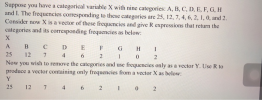 Suppose you have a categorical variable X with nine categories: A, B, C, D, E, F, G, H and I. The frequencies corresponding to these categories are 25, 12, 7, 4, 6, 2, 1, 0, and 2 Consider now X is a vector of these frequencies and give R expressions that return the categories and its corresponding frequencies as below: X A B D E F G I 25 12 7 4 2 1 0 Now you wish to remove...
 File Edit Format View Help Graphs and trees 4. [6 marks] Using the following graph representation (G(V,E,w)): v a,b,c,d,e,f E fa,b), (a,f),fa,d), (b,e), (b,d), (c,f),(c,d),(d,e),d,f)) W(a,b) 4,W(a,f) 9,W(a,d) 10 W(b,e) 12,W(b,d) 7,W(c,d) 3 a) Draw the graph including weights. b) Given the following algorithm for Inding a minimum spanning tree for a graph: Given a graph (G(V,E)) create a new graph (F) with nodes (V) and no edges Add all the edges (E) to a set S and order them...
 C. A 2 1. Figure A Figure B When three operational units (OTUS) A, B and Care concerned, one can make one bifurcating unrooted tree with one node, 1, as shown in figure A. If one more OTU, D, is added to the tree in figure A, one can attach D to any of the three edges (A1, B1, C1), thus one can make three topologically unique unrooted trees with one new node, node 2, as shown In figure B....
 Explain ur working
4. [6 marks] Using the following graph representation (G(VE,w)): V a, b,c, d,e, fh E -la, b, [a, fl,la,d, (b,ej, [b,d, c,fl,fc,d],Id,el, sd, f) W(a, b) 4, W(a, f)-9, W(a, d)-10 W(b, e) 12, W (b, d)7, W(c,d) 3 a) [3 marks] Draw the graph including weights. b) [2 + 1-3 marks] Given the following algorithm for finding a minimum spanning tree for a graph: Given a graph (G(V,E)) create a new graph (F) vith nodes (V)...
Explain ur working
4. [6 marks] Using the following graph representation (G(VE,w)): V a, b,c, d,e, fh E -la, b, [a, fl,la,d, (b,ej, [b,d, c,fl,fc,d],Id,el, sd, f) W(a, b) 4, W(a, f)-9, W(a, d)-10 W(b, e) 12, W (b, d)7, W(c,d) 3 a) [3 marks] Draw the graph including weights. b) [2 + 1-3 marks] Given the following algorithm for finding a minimum spanning tree for a graph: Given a graph (G(V,E)) create a new graph (F) vith nodes (V)...
 C. 7. True/False Questions. (2 points each) a. Applying Horner's Rule, an n-degree polynomial can be evaluated at a given point using only n multiplications and n additions. b. Quick Sort and Merge Sort are comparison-based sorting algorithms. Heap Sort and Distribution Counting Sort are not comparison-based sorting algorithms. An AVL tree applies four types of rotations: RIGHT, LEFT, RIGHT-LEFT, and LEFT-RIGHT. d. When an AVL tree's left sub-tree is left-heavy, a LEFT rotation is needed. e. When an AVL...
 5 B A 7 F 2 D 4 E 6 G (10 pts.) Remember that shortestpath () finds shortest paths from a single source to all des- tinations. Use shortestpath() remaining vertices. Generate the paths in an ascending order of length and complete the following table. Again, to obtain the length of the shortest paths from vertex A to all assume that ties are broken by alphabetical order in choose(). Iteration S Vertex Distance selected A B F G E...
 Design the optimal (Huffman) code for the alphabet {a, b, c,
d, e, f, g, h, i, j, k, l}, where frequencies are given in the
table below:
Draw the appropriate decoding tree.
a 0.25 g 0.02 b 0.01 h 0.12 c 0.09 i 0.15 d 0.02 j 0.04 e 0.24 k 0.01 f 0.04 l 0.01
Design the optimal (Huffman) code for the alphabet {a, b, c,
d, e, f, g, h, i, j, k, l}, where frequencies are given in the
table below:
Draw the appropriate decoding tree.
a 0.25 g 0.02 b 0.01 h 0.12 c 0.09 i 0.15 d 0.02 j 0.04 e 0.24 k 0.01 f 0.04 l 0.01
 Suppose you have a categorical variable X with nine categories: A, B, C, D, E, F, G, H and I. The frequencies corresponding to these categories are 25, 12, 7, 4, 6, 2, 1, 0, and 2 Consider now X is a vector of these frequencies and give R expressions that return the categories and its corresponding frequencies as below: X A B D E F G I 25 12 7 4 2 1 0 Now you wish to remove...
Most questions answered within 3 hours.
-
Where is the error in this code sequence?
String s1 = "Hello";
String s2 = "ello";...
asked 10 months ago -
Financial data for Joel de Paris, Inc., for last year
follow:
Joel de Paris, Inc.
Balance...
asked 10 months ago -
Consider this reaction:
Al2(SO4)3 (aq)+ BaCl3
(aq) Al2Cl6 (aq)- +
3BaSO4(s) . What is the...
asked 10 months ago -
Suppose that Savneet is considering increasing her
recent random sample from 20 car rentals to 40...
asked 10 months ago -
Trucks arrive at an unloading terminal at an average rate of 120
per hour.
Trucks arrive...
asked 10 months ago -
Why are methanol and ethanol completely soluble in water while
octanol is not very little soluble....
asked 10 months ago -
A facilities manager at a university reads in a research report
that the mean amount of...
asked 10 months ago -
When the CuSO4 is rehydrated by adding water to the anhydrous
compound, is this an endothermic...
asked 10 months ago -
A ray of sunlight is passing from diamond into crown glass; the
angle of incidence is...
asked 10 months ago -
A block of mass 0.249 kg is placed on top of a light, vertical
spring of...
asked 10 months ago -
how do the kidneys compensate in the presences of acidosis
a) trigger hyperventilate
b) reserve acid...
asked 10 months ago -
Question 501 pts
The rental rate of capital to the firm increases. Which of the
following...
asked 10 months ago