
Homework Answers
Add Answer to:
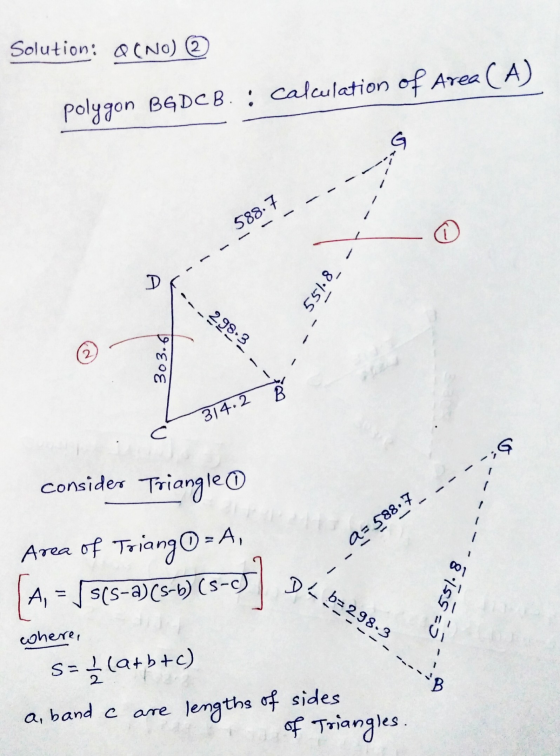
567.6 268.6 ZX 69 H 19.1 588.7 256.1 D 551.8 12574jk 303.6 298.3 610.5 314.2 536.6...
solve #6 1. Balance the following interior angles (angles to the right) of five sided closed...
 solve #6
1. Balance the following interior angles (angles to the right) of five sided closed polygon traverse. If the azimuth of side AB is fixed at 218 59 30, calculate the azimuths of the remaining sides. A-132°47 06, B-108"46 18, C= 107。19 37, D-81.50 36. E-109.16 18, (Note: Line BC bears SE) Compute departure and latitudes, linear misclosure and relative precision for the traverse of problem above, if the length of the side (in feet) are as follows: AB...
solve #6
1. Balance the following interior angles (angles to the right) of five sided closed polygon traverse. If the azimuth of side AB is fixed at 218 59 30, calculate the azimuths of the remaining sides. A-132°47 06, B-108"46 18, C= 107。19 37, D-81.50 36. E-109.16 18, (Note: Line BC bears SE) Compute departure and latitudes, linear misclosure and relative precision for the traverse of problem above, if the length of the side (in feet) are as follows: AB...
A)Compute the area between a lake and a straight line AG, from which offsets are taken at irregul...
 A)Compute the area between a lake and a straight line AG, from
which offsets are taken at irregular intervals as shown in the
table above (all distances in feet).
Circle and express your answer to four significant figures
and include appropriate units.
PARTB
A) Consider a polygon traverse.
The azimuth of side AB is fixed at 35∘09′32′′. A=57∘00′50′′,
B=88∘24′45′′, C=126∘36′58′′, D=46∘03′25′′,E=221∘53′52′′. (Note:
Line BC bears NW.)
The lengths of the sides (in meters) are as follows: AB=383.808,
BC=360.209, CD=342.204, DE=336.210,and...
A)Compute the area between a lake and a straight line AG, from
which offsets are taken at irregular intervals as shown in the
table above (all distances in feet).
Circle and express your answer to four significant figures
and include appropriate units.
PARTB
A) Consider a polygon traverse.
The azimuth of side AB is fixed at 35∘09′32′′. A=57∘00′50′′,
B=88∘24′45′′, C=126∘36′58′′, D=46∘03′25′′,E=221∘53′52′′. (Note:
Line BC bears NW.)
The lengths of the sides (in meters) are as follows: AB=383.808,
BC=360.209, CD=342.204, DE=336.210,and...
1) An observer fails to check the bubble of a level and it is off two...
1) An observer fails to check the bubble of a level and it is off two divisions on a 100-m sight. If the sensitivity of the bubble is 20-sec, what error would there be in the reading? 2 ) The following azimuths are from the north: 329°20’, 180°35’, 48°32’, 170°30’, 145°25’, 319°35’, 350°45’, 95°49’, 11°30’, 235°45’. Express these directions as (a) azimuth from the south, (b) back azimuths, (c) bearings. 8) 6.7 The following azimuths are reckoned from the north:...
1) An observer fails to check the bubble of a level and it is off two...
1) An observer fails to check the bubble of a level and it is off two divisions on a 100-m sight. If the sensitivity of the bubble is 20-sec, what error would there be in the reading? 2 ) The following azimuths are from the north: 329°20’, 180°35’, 48°32’, 170°30’, 145°25’, 319°35’, 350°45’, 95°49’, 11°30’, 235°45’. Express these directions as (a) azimuth from the south, (b) back azimuths, (c) bearings. 8) 6.7 The following azimuths are reckoned from the north:...
Consider a cylindrical capacitor like that shown in Fig. 24.6. Let d = rb − ra...
 Consider a cylindrical capacitor like that shown in Fig. 24.6. Let d = rb − ra be the spacing between the inner and outer conductors. (a) Let the radii of the two conductors be only slightly different, so that d << ra. Show that the result derived in Example 24.4 (Section 24.1) for the capacitance of a cylindrical capacitor then reduces to Eq. (24.2), the equation for the capacitance of a parallel-plate capacitor, with A being the surface area of...
 solve #6
1. Balance the following interior angles (angles to the right) of five sided closed polygon traverse. If the azimuth of side AB is fixed at 218 59 30, calculate the azimuths of the remaining sides. A-132°47 06, B-108"46 18, C= 107。19 37, D-81.50 36. E-109.16 18, (Note: Line BC bears SE) Compute departure and latitudes, linear misclosure and relative precision for the traverse of problem above, if the length of the side (in feet) are as follows: AB...
solve #6
1. Balance the following interior angles (angles to the right) of five sided closed polygon traverse. If the azimuth of side AB is fixed at 218 59 30, calculate the azimuths of the remaining sides. A-132°47 06, B-108"46 18, C= 107。19 37, D-81.50 36. E-109.16 18, (Note: Line BC bears SE) Compute departure and latitudes, linear misclosure and relative precision for the traverse of problem above, if the length of the side (in feet) are as follows: AB...
 A)Compute the area between a lake and a straight line AG, from
which offsets are taken at irregular intervals as shown in the
table above (all distances in feet).
Circle and express your answer to four significant figures
and include appropriate units.
PARTB
A) Consider a polygon traverse.
The azimuth of side AB is fixed at 35∘09′32′′. A=57∘00′50′′,
B=88∘24′45′′, C=126∘36′58′′, D=46∘03′25′′,E=221∘53′52′′. (Note:
Line BC bears NW.)
The lengths of the sides (in meters) are as follows: AB=383.808,
BC=360.209, CD=342.204, DE=336.210,and...
A)Compute the area between a lake and a straight line AG, from
which offsets are taken at irregular intervals as shown in the
table above (all distances in feet).
Circle and express your answer to four significant figures
and include appropriate units.
PARTB
A) Consider a polygon traverse.
The azimuth of side AB is fixed at 35∘09′32′′. A=57∘00′50′′,
B=88∘24′45′′, C=126∘36′58′′, D=46∘03′25′′,E=221∘53′52′′. (Note:
Line BC bears NW.)
The lengths of the sides (in meters) are as follows: AB=383.808,
BC=360.209, CD=342.204, DE=336.210,and...
 Consider a cylindrical capacitor like that shown in Fig. 24.6. Let d = rb − ra be the spacing between the inner and outer conductors. (a) Let the radii of the two conductors be only slightly different, so that d << ra. Show that the result derived in Example 24.4 (Section 24.1) for the capacitance of a cylindrical capacitor then reduces to Eq. (24.2), the equation for the capacitance of a parallel-plate capacitor, with A being the surface area of...
Most questions answered within 3 hours.
-
Where is the error in this code sequence?
String s1 = "Hello";
String s2 = "ello";...
asked 11 months ago -
Financial data for Joel de Paris, Inc., for last year
follow:
Joel de Paris, Inc.
Balance...
asked 11 months ago -
Consider this reaction:
Al2(SO4)3 (aq)+ BaCl3
(aq) Al2Cl6 (aq)- +
3BaSO4(s) . What is the...
asked 11 months ago -
Suppose that Savneet is considering increasing her
recent random sample from 20 car rentals to 40...
asked 11 months ago -
Trucks arrive at an unloading terminal at an average rate of 120
per hour.
Trucks arrive...
asked 11 months ago -
Why are methanol and ethanol completely soluble in water while
octanol is not very little soluble....
asked 11 months ago -
A facilities manager at a university reads in a research report
that the mean amount of...
asked 11 months ago -
When the CuSO4 is rehydrated by adding water to the anhydrous
compound, is this an endothermic...
asked 11 months ago -
A ray of sunlight is passing from diamond into crown glass; the
angle of incidence is...
asked 11 months ago -
A block of mass 0.249 kg is placed on top of a light, vertical
spring of...
asked 11 months ago -
how do the kidneys compensate in the presences of acidosis
a) trigger hyperventilate
b) reserve acid...
asked 11 months ago -
Question 501 pts
The rental rate of capital to the firm increases. Which of the
following...
asked 11 months ago