
Homework Answers
Add Answer to:
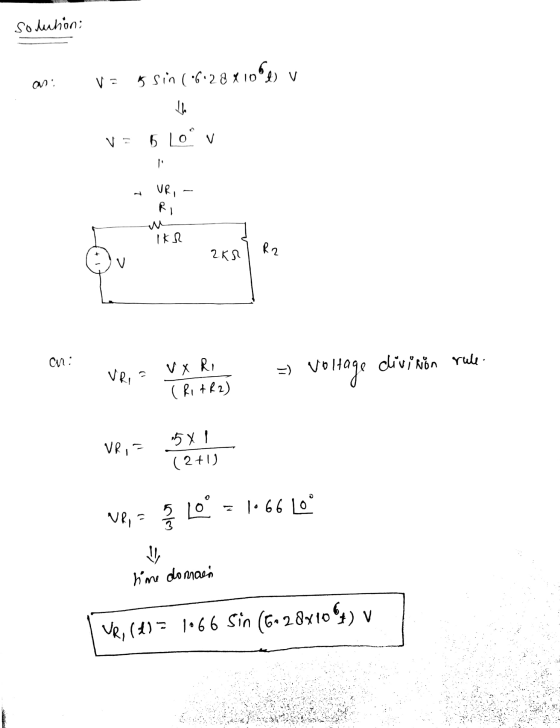
4. Construct the following circuit: V1 5 V 1MHz ODeg Set up your function generator to...
1. Set up the following circuit. (20pts) 5 Vp-p R2 Vo Use the function generator to set up signal (5 Vpp sinusoidal...
 1. Set up the following circuit. (20pts) 5 Vp-p R2 Vo Use the function generator to set up signal (5 Vpp sinusoidal with a 5 V DC offset) as the input voltage (Vin) and take the output voltage (Vo) across R Sketch and label the input voltage (Vin) and actual output voltage (Vo) displayed on the Oscilloscope and compare actual Vo to your calculated output Vo. (Show your all work for your calculation to get a full credit.) You should...
Settings for the 5.2A function generator: • AC Sine Wave • f = 30 Hz • Phase Shift = 50° • Offset...
 Settings for the 5.2A function generator: • AC Sine Wave • f =
30 Hz • Phase Shift = 50° • Offset = 0 V • Amplitude = 2 V
B. Simulate the circuit seen in Figure 5.2. Use the same function generator settings as 5.2A. Record three to four cycles of both the input and output. Using the cursors on the oscilloscope, measuring the time shift between the maxima of the two waves, Δ, and use it to calculate...
Settings for the 5.2A function generator: • AC Sine Wave • f =
30 Hz • Phase Shift = 50° • Offset = 0 V • Amplitude = 2 V
B. Simulate the circuit seen in Figure 5.2. Use the same function generator settings as 5.2A. Record three to four cycles of both the input and output. Using the cursors on the oscilloscope, measuring the time shift between the maxima of the two waves, Δ, and use it to calculate...
3.2 14 marks] You are required to design, set up and physically measure the voltage gain of a BJT...
 3.2 14 marks] You are required to design, set up and physically measure the voltage gain of a BJT based CE amplifier with (Emitter resistance bypassed) with Emitter Stabilized Bias scheme with an external load resistance RL (This question is independent, do not mix with question 3.1) a) Draw the schematic diagram of the set up you are contemplating for this experiment. b) To set up the experiment, what all the components (such as resistors etc.) and lab equipment are...
k solve CET 3615L Practical Final Exam Name Spring 2019 1. Set up the following circuit....
 k
solve
CET 3615L Practical Final Exam Name Spring 2019 1. Set up the following circuit. (20pts) Vin: 5 Vp-p Vo Use the function generator to set up signal (5 Vep sinusoidal with a 5 V DC offset) as the input voltage (Vn) and take the output voltage (Vo) across R Sketch and label the input voltage (Vi) and actual output voltage (Ve) displayed on the Oscilloscope and compare actual Vo to your calculated output Vo. (Show your all work...
k
solve
CET 3615L Practical Final Exam Name Spring 2019 1. Set up the following circuit. (20pts) Vin: 5 Vp-p Vo Use the function generator to set up signal (5 Vep sinusoidal with a 5 V DC offset) as the input voltage (Vn) and take the output voltage (Vo) across R Sketch and label the input voltage (Vi) and actual output voltage (Ve) displayed on the Oscilloscope and compare actual Vo to your calculated output Vo. (Show your all work...
LAB TEST 1 (set 1) PMENT REQUIRED 2 Power Supply 3. Function Generator PROCEDURE 1. Connect a circuit as shown in Figur...
 LAB TEST 1 (set 1) PMENT REQUIRED 2 Power Supply 3. Function Generator PROCEDURE 1. Connect a circuit as shown in Figure 1 2. Measure the output voltage at Ri. Ra for the given frequency range oscilloscope. Ri 1.6 kW 10 Vpp, 5 kHz 100 nF R 24 KW Figure 1 RESULTS Vpp Vpo at R Freq (kHz) Vou (Vop at Ra) 10 10 03.5t 20 10 30 10 10 50 10 60 70 10 80 10 100 10 ....
Please answer questions 4 and 5 if you can, thank you in advance!! 1. Build the...
 Please answer questions 4 and 5 if you can, thank you in
advance!!
1. Build the circuit shown below V. 2 V. 5900-RC 1 k2 1Vin t Vin(t) Function Generator 5900-RC 2. Set the Function Generator such that Vin(t) is a 3 V peak-peak sinusoidal signal at a frequency of 1 kHz. You can do this by varying the amplitude of the function generator when the generator is connected directly into the "input" of the oscilloscope. To test your ability...
Please answer questions 4 and 5 if you can, thank you in
advance!!
1. Build the circuit shown below V. 2 V. 5900-RC 1 k2 1Vin t Vin(t) Function Generator 5900-RC 2. Set the Function Generator such that Vin(t) is a 3 V peak-peak sinusoidal signal at a frequency of 1 kHz. You can do this by varying the amplitude of the function generator when the generator is connected directly into the "input" of the oscilloscope. To test your ability...
Please help me all steps. 1- Set up the circuit as shown in figure (7). Then...
 Please help me all steps.
1- Set up the circuit as shown in figure (7). Then 330 resistor is to limit the maximum current reached. Then 100 resistor is to display the current waveform on the oscilloscope. 0.033k Chi (Voltage) 10mH Ch2 (Current) 0.01K common Figure (7) 2- Adjust the wave generator to give a peak voltage of 10 V square wave at 250Hz (Period is 4msec and Pulse Width is 2msec). Set the OSC as follows: Time base: 1...
Please help me all steps.
1- Set up the circuit as shown in figure (7). Then 330 resistor is to limit the maximum current reached. Then 100 resistor is to display the current waveform on the oscilloscope. 0.033k Chi (Voltage) 10mH Ch2 (Current) 0.01K common Figure (7) 2- Adjust the wave generator to give a peak voltage of 10 V square wave at 250Hz (Period is 4msec and Pulse Width is 2msec). Set the OSC as follows: Time base: 1...
What are the Equilibrium voltages of the capacitor and the resistor when the function generator v...
 What are the Equilibrium voltages of the capacitor and the
resistor when the function generator voltage is +v0? Is this what
you observe on your oscilloscope sketches?
what are the equilibrium voltages of the capacitor and the resistor when the function generator voltage is ± you observe on your oscilloscope sketches? ? Is this what An RC circuit consists of a resistor connected to a capacitor. There may also be a fixed power supply, depending on whether the capacitor is...
What are the Equilibrium voltages of the capacitor and the
resistor when the function generator voltage is +v0? Is this what
you observe on your oscilloscope sketches?
what are the equilibrium voltages of the capacitor and the resistor when the function generator voltage is ± you observe on your oscilloscope sketches? ? Is this what An RC circuit consists of a resistor connected to a capacitor. There may also be a fixed power supply, depending on whether the capacitor is...
Answer for part b is R=247 and V=16v 50. (8 points) You set up the circuit...
 Answer for part b is R=247
and V=16v
50. (8 points) You set up the circuit shown below, C = 5.00 uF. At the time t = 0, you close the switch and then measure the charge q on the capacitor a function of the current i through the resistor. A graph of your results is also shown below. 60.00 50.00 q=-1.2475*1 + 79.9 R2 = 0.9999 40.00 Switch closed 30.00 20.00 10.00 60 i VA +q - 0.00 0...
Answer for part b is R=247
and V=16v
50. (8 points) You set up the circuit shown below, C = 5.00 uF. At the time t = 0, you close the switch and then measure the charge q on the capacitor a function of the current i through the resistor. A graph of your results is also shown below. 60.00 50.00 q=-1.2475*1 + 79.9 R2 = 0.9999 40.00 Switch closed 30.00 20.00 10.00 60 i VA +q - 0.00 0...
Lab Procedure: Part 1: Source Free RC Circuit V(t) ilts C3 (R3 21ko 1uF IC=10V a)...
 Lab Procedure: Part 1: Source Free RC Circuit V(t) ilts C3 (R3 21ko 1uF IC=10V a) For the circuit shown above, provide the equation and calculate the following: 1. The source free equation for V(t) for V(O)= 10 volts 2. The equation for it) 3. V(t) and i(t) for t = t (one time constant) b) Now, enter the circuit using Multisim Schematic Capture. c) Simulate using Transient mode with a graphical output and verify graphical results with your calculations....
 1. Set up the following circuit. (20pts) 5 Vp-p R2 Vo Use the function generator to set up signal (5 Vpp sinusoidal with a 5 V DC offset) as the input voltage (Vin) and take the output voltage (Vo) across R Sketch and label the input voltage (Vin) and actual output voltage (Vo) displayed on the Oscilloscope and compare actual Vo to your calculated output Vo. (Show your all work for your calculation to get a full credit.) You should...
 Settings for the 5.2A function generator: • AC Sine Wave • f =
30 Hz • Phase Shift = 50° • Offset = 0 V • Amplitude = 2 V
B. Simulate the circuit seen in Figure 5.2. Use the same function generator settings as 5.2A. Record three to four cycles of both the input and output. Using the cursors on the oscilloscope, measuring the time shift between the maxima of the two waves, Δ, and use it to calculate...
Settings for the 5.2A function generator: • AC Sine Wave • f =
30 Hz • Phase Shift = 50° • Offset = 0 V • Amplitude = 2 V
B. Simulate the circuit seen in Figure 5.2. Use the same function generator settings as 5.2A. Record three to four cycles of both the input and output. Using the cursors on the oscilloscope, measuring the time shift between the maxima of the two waves, Δ, and use it to calculate...
 3.2 14 marks] You are required to design, set up and physically measure the voltage gain of a BJT based CE amplifier with (Emitter resistance bypassed) with Emitter Stabilized Bias scheme with an external load resistance RL (This question is independent, do not mix with question 3.1) a) Draw the schematic diagram of the set up you are contemplating for this experiment. b) To set up the experiment, what all the components (such as resistors etc.) and lab equipment are...
 k
solve
CET 3615L Practical Final Exam Name Spring 2019 1. Set up the following circuit. (20pts) Vin: 5 Vp-p Vo Use the function generator to set up signal (5 Vep sinusoidal with a 5 V DC offset) as the input voltage (Vn) and take the output voltage (Vo) across R Sketch and label the input voltage (Vi) and actual output voltage (Ve) displayed on the Oscilloscope and compare actual Vo to your calculated output Vo. (Show your all work...
k
solve
CET 3615L Practical Final Exam Name Spring 2019 1. Set up the following circuit. (20pts) Vin: 5 Vp-p Vo Use the function generator to set up signal (5 Vep sinusoidal with a 5 V DC offset) as the input voltage (Vn) and take the output voltage (Vo) across R Sketch and label the input voltage (Vi) and actual output voltage (Ve) displayed on the Oscilloscope and compare actual Vo to your calculated output Vo. (Show your all work...
 LAB TEST 1 (set 1) PMENT REQUIRED 2 Power Supply 3. Function Generator PROCEDURE 1. Connect a circuit as shown in Figure 1 2. Measure the output voltage at Ri. Ra for the given frequency range oscilloscope. Ri 1.6 kW 10 Vpp, 5 kHz 100 nF R 24 KW Figure 1 RESULTS Vpp Vpo at R Freq (kHz) Vou (Vop at Ra) 10 10 03.5t 20 10 30 10 10 50 10 60 70 10 80 10 100 10 ....
 Please answer questions 4 and 5 if you can, thank you in
advance!!
1. Build the circuit shown below V. 2 V. 5900-RC 1 k2 1Vin t Vin(t) Function Generator 5900-RC 2. Set the Function Generator such that Vin(t) is a 3 V peak-peak sinusoidal signal at a frequency of 1 kHz. You can do this by varying the amplitude of the function generator when the generator is connected directly into the "input" of the oscilloscope. To test your ability...
Please answer questions 4 and 5 if you can, thank you in
advance!!
1. Build the circuit shown below V. 2 V. 5900-RC 1 k2 1Vin t Vin(t) Function Generator 5900-RC 2. Set the Function Generator such that Vin(t) is a 3 V peak-peak sinusoidal signal at a frequency of 1 kHz. You can do this by varying the amplitude of the function generator when the generator is connected directly into the "input" of the oscilloscope. To test your ability...
 Please help me all steps.
1- Set up the circuit as shown in figure (7). Then 330 resistor is to limit the maximum current reached. Then 100 resistor is to display the current waveform on the oscilloscope. 0.033k Chi (Voltage) 10mH Ch2 (Current) 0.01K common Figure (7) 2- Adjust the wave generator to give a peak voltage of 10 V square wave at 250Hz (Period is 4msec and Pulse Width is 2msec). Set the OSC as follows: Time base: 1...
Please help me all steps.
1- Set up the circuit as shown in figure (7). Then 330 resistor is to limit the maximum current reached. Then 100 resistor is to display the current waveform on the oscilloscope. 0.033k Chi (Voltage) 10mH Ch2 (Current) 0.01K common Figure (7) 2- Adjust the wave generator to give a peak voltage of 10 V square wave at 250Hz (Period is 4msec and Pulse Width is 2msec). Set the OSC as follows: Time base: 1...
 What are the Equilibrium voltages of the capacitor and the
resistor when the function generator voltage is +v0? Is this what
you observe on your oscilloscope sketches?
what are the equilibrium voltages of the capacitor and the resistor when the function generator voltage is ± you observe on your oscilloscope sketches? ? Is this what An RC circuit consists of a resistor connected to a capacitor. There may also be a fixed power supply, depending on whether the capacitor is...
What are the Equilibrium voltages of the capacitor and the
resistor when the function generator voltage is +v0? Is this what
you observe on your oscilloscope sketches?
what are the equilibrium voltages of the capacitor and the resistor when the function generator voltage is ± you observe on your oscilloscope sketches? ? Is this what An RC circuit consists of a resistor connected to a capacitor. There may also be a fixed power supply, depending on whether the capacitor is...
 Answer for part b is R=247
and V=16v
50. (8 points) You set up the circuit shown below, C = 5.00 uF. At the time t = 0, you close the switch and then measure the charge q on the capacitor a function of the current i through the resistor. A graph of your results is also shown below. 60.00 50.00 q=-1.2475*1 + 79.9 R2 = 0.9999 40.00 Switch closed 30.00 20.00 10.00 60 i VA +q - 0.00 0...
Answer for part b is R=247
and V=16v
50. (8 points) You set up the circuit shown below, C = 5.00 uF. At the time t = 0, you close the switch and then measure the charge q on the capacitor a function of the current i through the resistor. A graph of your results is also shown below. 60.00 50.00 q=-1.2475*1 + 79.9 R2 = 0.9999 40.00 Switch closed 30.00 20.00 10.00 60 i VA +q - 0.00 0...
 Lab Procedure: Part 1: Source Free RC Circuit V(t) ilts C3 (R3 21ko 1uF IC=10V a) For the circuit shown above, provide the equation and calculate the following: 1. The source free equation for V(t) for V(O)= 10 volts 2. The equation for it) 3. V(t) and i(t) for t = t (one time constant) b) Now, enter the circuit using Multisim Schematic Capture. c) Simulate using Transient mode with a graphical output and verify graphical results with your calculations....
Most questions answered within 3 hours.
-
Where is the error in this code sequence?
String s1 = "Hello";
String s2 = "ello";...
asked 10 months ago -
Financial data for Joel de Paris, Inc., for last year
follow:
Joel de Paris, Inc.
Balance...
asked 10 months ago -
Consider this reaction:
Al2(SO4)3 (aq)+ BaCl3
(aq) Al2Cl6 (aq)- +
3BaSO4(s) . What is the...
asked 10 months ago -
Suppose that Savneet is considering increasing her
recent random sample from 20 car rentals to 40...
asked 10 months ago -
Trucks arrive at an unloading terminal at an average rate of 120
per hour.
Trucks arrive...
asked 10 months ago -
Why are methanol and ethanol completely soluble in water while
octanol is not very little soluble....
asked 10 months ago -
A facilities manager at a university reads in a research report
that the mean amount of...
asked 10 months ago -
When the CuSO4 is rehydrated by adding water to the anhydrous
compound, is this an endothermic...
asked 10 months ago -
A ray of sunlight is passing from diamond into crown glass; the
angle of incidence is...
asked 10 months ago -
A block of mass 0.249 kg is placed on top of a light, vertical
spring of...
asked 10 months ago -
how do the kidneys compensate in the presences of acidosis
a) trigger hyperventilate
b) reserve acid...
asked 10 months ago -
Question 501 pts
The rental rate of capital to the firm increases. Which of the
following...
asked 10 months ago