 Two Train Whistles from trains
A and B have the same frequency of 180hz......
Two Train Whistles from trains
A and B have the same frequency of 180hz......
Answers should be 3.79m/s and 3.88m/s
Thanks in advance
Homework Answers
The beat frequency equals the absolute value of the difference
between the two source frequency, or :
f(b) = |f₂ - f₁|
This allows for two different frequencies, one for approach and one
for recession. The approach frequency is :
2.00Hz = |180Hz - f₁|
2.00Hz = f₁- 180Hz
f₁= 182Hz
The recession frequency is :
2.00Hz = |180Hz - f₁|
2.00Hz = 180Hz - f₁
f₁= 178Hz
Now, from the Doppler shift equation, the approach velocity is
:
f₀ = f(s)[v / v + v(s)]
v(s) = v[f₀ - f(s)] / f₀
= 345m/s[178Hz – 180Hz] / 180Hz
= 3.79m/s
The velocity of recession is (from the same equation) :
v(s) = 345m/s[178Hz - 180Hz] / 178Hz
= -3.88m/s
Add Answer to:
Two Train Whistles from trains
A and B have the same frequency of 180hz......
Answers should...
Two train whistles have identical frequencies of 1.62 x 10 Hz. When one train is at...
 Two train whistles have identical frequencies of 1.62 x 10 Hz. When one train is at rest in the station and the other is moving nearby, a commuter standing on the station platform hears beats with a frequency of 8.00 beats/s when the whistles operate together. What are the two possible speeds that the moving train can have? m/s moving away from the station m/s moving towards the station
Thinking and Inquiry Two train whistles, A and B each have a frequency of 392Hz. A...
 Thinking and Inquiry Two train whistles, A and B each have a frequency of 392Hz. A is at rest while B is moving at 35m/s [right]. A railway worker moving at 15 m/s[left] is between the two trains. Air temp is 293 K. 14. a) What is the frequency heard by the railway worker from Train A? (3) b) What is the frequency heard by the railway worker by train B? (3) c) What is the beat frequency heard by...
1a) Two trains emit whistles of the same frequency, 410Hz. If one train is at rest and the other is traveling at 100 km/...
1a) Two trains emit whistles of the same frequency, 410Hz. If one train is at rest and the other is traveling at 100 km/hr away from John at rest, what will John detect as the beat frequency?
Two train whistles, A and B , each have a frequency of 396 Hz . A...
 Two train whistles, A and B , each have a
frequency of 396 Hz . A is stationary and B is
moving toward the right (away from A ) at a speed of 35.0
m/s . A listener is between the two whistles and is moving toward
the right with a speed of 15.0 m/s . (See (Figure 1) .)
Part A
What is the frequency from A as heard by the
listener?
Express your answer in hertz
Part B...
Two train whistles, A and B , each have a
frequency of 396 Hz . A is stationary and B is
moving toward the right (away from A ) at a speed of 35.0
m/s . A listener is between the two whistles and is moving toward
the right with a speed of 15.0 m/s . (See (Figure 1) .)
Part A
What is the frequency from A as heard by the
listener?
Express your answer in hertz
Part B...
Two trains of pass through the same intersection at different times. Knowing that Train B accelerates...
 Two trains of pass through the same intersection at different times. Knowing that Train B accelerates from rest at 100 m/min2 and reaches the crossing 10 min after Train A passed through. Determine the relative velocity of Train B with respect to Train A and the distance between the fronts of each train 2 min after Train B passes through the intersection. Express your answer in vector notation. 72 km/h 30° B
Two trains of pass through the same intersection at different times. Knowing that Train B accelerates...
 Two trains of pass through the same intersection at different times. Knowing that Train B accelerates from rest at 100 m/min? and reaches the crossing 10 min after Train A passed through. Determine the relative velocity of Train B with respect to Train A and the distance between the fronts of each train 2 min after Train B passes through the intersection. Express your answer in vector notation. 72 km/h 30
Two trains of pass through the same intersection at different times. Knowing that Train B accelerates...
 Two trains of pass through the same intersection at different times. Knowing that Train B accelerates from rest at 100 m/min? and reaches the crossing 10 min after Train A passed through. Determine the relative velocity of Train B with respect to Train A and the distance between the fronts of each train 2 min after Train B passes through the intersection. Express your answer in vector notation. 72 km/h B 30°
Two trains of pass through the same intersection at different times. Knowing that Train B accelerates...
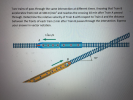 Two trains of pass through the same intersection at different times. Knowing that Train B accelerates from rest at 100 m/minand reaches the crossing 10 min after Train A passed through. Determine the relative velocity of Train B with respect to Train A and the distance between the fronts of each train 2 min after Train B passes through the intersection. Express your answer in vector notation. . dikm/h A 30° B
Two trains of pass through the same intersection at different times. Knowing that Train B accelerates...
 Two trains of pass through the same intersection at different times. Knowing that Train B accelerates from rest at 100 m/min2 and reaches the crossing 10 min after Train A passed through. Determine the relative velocity of Train B with respect to Train A and the distance between the fronts of each train 2 min after Train B passes through the intersection. Express your answer in vector notation. 72 km/h B 30°
Two passenger trains A And B, each 240m long, pass a 50m long railroad in winnepeg....
Two passenger trains A And B, each 240m long, pass a 50m long railroad in winnepeg. the trains are mving in opposite direction at equal speeds of 0.565c with respect to the ground. train A is travling west and all tracks are perfectly straight. the winnepeg stationmaster knowing the speed of train A measures its legth as it passes him by measuring the difference between the arrival times of the front of the train and the rear of the train....
 Two train whistles have identical frequencies of 1.62 x 10 Hz. When one train is at rest in the station and the other is moving nearby, a commuter standing on the station platform hears beats with a frequency of 8.00 beats/s when the whistles operate together. What are the two possible speeds that the moving train can have? m/s moving away from the station m/s moving towards the station
 Thinking and Inquiry Two train whistles, A and B each have a frequency of 392Hz. A is at rest while B is moving at 35m/s [right]. A railway worker moving at 15 m/s[left] is between the two trains. Air temp is 293 K. 14. a) What is the frequency heard by the railway worker from Train A? (3) b) What is the frequency heard by the railway worker by train B? (3) c) What is the beat frequency heard by...
 Two train whistles, A and B , each have a
frequency of 396 Hz . A is stationary and B is
moving toward the right (away from A ) at a speed of 35.0
m/s . A listener is between the two whistles and is moving toward
the right with a speed of 15.0 m/s . (See (Figure 1) .)
Part A
What is the frequency from A as heard by the
listener?
Express your answer in hertz
Part B...
Two train whistles, A and B , each have a
frequency of 396 Hz . A is stationary and B is
moving toward the right (away from A ) at a speed of 35.0
m/s . A listener is between the two whistles and is moving toward
the right with a speed of 15.0 m/s . (See (Figure 1) .)
Part A
What is the frequency from A as heard by the
listener?
Express your answer in hertz
Part B...
 Two trains of pass through the same intersection at different times. Knowing that Train B accelerates from rest at 100 m/min2 and reaches the crossing 10 min after Train A passed through. Determine the relative velocity of Train B with respect to Train A and the distance between the fronts of each train 2 min after Train B passes through the intersection. Express your answer in vector notation. 72 km/h 30° B
 Two trains of pass through the same intersection at different times. Knowing that Train B accelerates from rest at 100 m/min? and reaches the crossing 10 min after Train A passed through. Determine the relative velocity of Train B with respect to Train A and the distance between the fronts of each train 2 min after Train B passes through the intersection. Express your answer in vector notation. 72 km/h 30
 Two trains of pass through the same intersection at different times. Knowing that Train B accelerates from rest at 100 m/min? and reaches the crossing 10 min after Train A passed through. Determine the relative velocity of Train B with respect to Train A and the distance between the fronts of each train 2 min after Train B passes through the intersection. Express your answer in vector notation. 72 km/h B 30°
 Two trains of pass through the same intersection at different times. Knowing that Train B accelerates from rest at 100 m/minand reaches the crossing 10 min after Train A passed through. Determine the relative velocity of Train B with respect to Train A and the distance between the fronts of each train 2 min after Train B passes through the intersection. Express your answer in vector notation. . dikm/h A 30° B
 Two trains of pass through the same intersection at different times. Knowing that Train B accelerates from rest at 100 m/min2 and reaches the crossing 10 min after Train A passed through. Determine the relative velocity of Train B with respect to Train A and the distance between the fronts of each train 2 min after Train B passes through the intersection. Express your answer in vector notation. 72 km/h B 30°
Most questions answered within 3 hours.
-
Where is the error in this code sequence?
String s1 = "Hello";
String s2 = "ello";...
asked 10 months ago -
Financial data for Joel de Paris, Inc., for last year
follow:
Joel de Paris, Inc.
Balance...
asked 10 months ago -
Consider this reaction:
Al2(SO4)3 (aq)+ BaCl3
(aq) Al2Cl6 (aq)- +
3BaSO4(s) . What is the...
asked 10 months ago -
Suppose that Savneet is considering increasing her
recent random sample from 20 car rentals to 40...
asked 10 months ago -
Trucks arrive at an unloading terminal at an average rate of 120
per hour.
Trucks arrive...
asked 10 months ago -
Why are methanol and ethanol completely soluble in water while
octanol is not very little soluble....
asked 10 months ago -
A facilities manager at a university reads in a research report
that the mean amount of...
asked 10 months ago -
When the CuSO4 is rehydrated by adding water to the anhydrous
compound, is this an endothermic...
asked 10 months ago -
A ray of sunlight is passing from diamond into crown glass; the
angle of incidence is...
asked 10 months ago -
A block of mass 0.249 kg is placed on top of a light, vertical
spring of...
asked 10 months ago -
how do the kidneys compensate in the presences of acidosis
a) trigger hyperventilate
b) reserve acid...
asked 10 months ago -
Question 501 pts
The rental rate of capital to the firm increases. Which of the
following...
asked 10 months ago