
Homework Answers

Add Answer to:
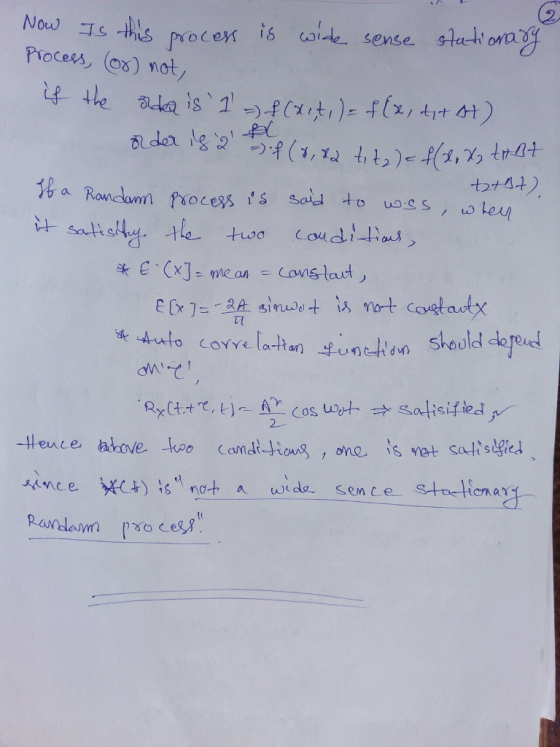
and is X(t) a WSS process?
6.11 Sinusoid with random phase. Consider a random process x(t)-A...
Consider two random processes X(t) and Y(t) defined as X(t)=Acos(wot+z), Y(t)=Bsin(wo+z) where A and B and...
Consider two random processes X(t) and Y(t) defined as X(t)=Acos(wot+z), Y(t)=Bsin(wo+z) where A and B and wo are constants and z is a random variable that is uniformly distributed between 0 and 2pi. find the cross-correlation function of X(t) and Y(t). If both X(t) and Y(t) were wide sense stationary , could they also be jointly wide sense stationary?
2. (30 points) Let X(t) be a wide-sense stationary (WSS) random signal with power spectral density...
 2. (30 points) Let X(t) be a wide-sense stationary (WSS) random signal with power spectral density S(f) = 1011(f/200), and let y(t) be a random process defined by Y(t) = 10 cos(2000nt + 1) where is a uniformly distributed random variable in the interval [ 027]. Assume that X(t) and Y(t) are independent. (a) Derive the mean and autocorrelation function of Y(t). Is Y(t) a WSS process? Why? (b) Define a random signal Z(t) = X(t)Y(t). Determine and sketch the...
2. Consider the random process x(t) defined by x(t) a cos(wt + 6).where w and a...
 2. Consider the random process x(t) defined by x(t) a cos(wt + 6).where w and a are constants, and 0 is a random variable uniformly distributed in the range (-T, ) Sketch the ensemble (sample functions) representing x(t). (2.5 points). a. b. Find the mean and variance of the random variable 0. (2.5 points). Find the mean of x(t), m (t) E(x(t)). (2.5 points). c. d. Find the autocorrelation of x(t), R (t,, t) = E(x, (t)x2 (t)). (5 points)....
Problem # 11: Let Y(t) = (a + a X(t) cos(20 ft+), where a; are constants,...
 Problem # 11: Let Y(t) = (a + a X(t) cos(20 ft+), where a; are constants, 0 is uniform on (0,27], X(t) is a random process independent of 8 at all time instants and is WSS. Determine the mean and the covariance function of the process Y(t). Is Y(t) WSS?
,Two random processes are defined by Y(t)-X(t) cos(wot) where X(t) and Y(t) are jointly wSs. a) I...
 ,Two random processes are defined by Y(t)-X(t) cos(wot) where X(t) and Y(t) are jointly wSs. a) If θ is a constant (non-random), is there any value of θ that will make Yl(t) and Y(t) orthogonal? b) if θ is a uniform r.v., statistically independent of x(t) and Y(t), are there any conditions on θ that will make Yı(t) and Y2(t) orthogonal?
,Two random processes are defined by Y(t)-X(t) cos(wot) where X(t) and Y(t) are jointly wSs. a) If θ is...
,Two random processes are defined by Y(t)-X(t) cos(wot) where X(t) and Y(t) are jointly wSs. a) If θ is a constant (non-random), is there any value of θ that will make Yl(t) and Y(t) orthogonal? b) if θ is a uniform r.v., statistically independent of x(t) and Y(t), are there any conditions on θ that will make Yı(t) and Y2(t) orthogonal?
,Two random processes are defined by Y(t)-X(t) cos(wot) where X(t) and Y(t) are jointly wSs. a) If θ is...
2. Consider the random process x(t) defined by x(t) a cos(wt 6), where w and 0 are constants, and a is a random variable uniformly distributed in the range (-A, A). a. Sketch the ensemble (sample...
 2. Consider the random process x(t) defined by x(t) a cos(wt 6), where w and 0 are constants, and a is a random variable uniformly distributed in the range (-A, A). a. Sketch the ensemble (sample functions) representing x(t). (2.5 points). b. Find the mean and variance of the random variable a. (5 points). c. Find the mean of x(t), m(t) E((t)). (5 points). d. Find the autocorrelation of x(t), Ra (t1, t2) E(x (t)x2 )). (5 points). Is the...
Problem 5: Noisy Signal A signal generator generates a random sinusoid, X cos (2nt + Θ) whose amplitude is given by a random variable X uniformly distributed between-1 and 1, and phase Θ is an indepe...
 Problem 5: Noisy Signal A signal generator generates a random sinusoid, X cos (2nt + Θ) whose amplitude is given by a random variable X uniformly distributed between-1 and 1, and phase Θ is an independent random variable which takes each of the following values π 0, π with equal prob- ability. This signal's amplitude is additively corrupted by independent noise YN(0, 0.01) The output amplitude is denoted by Z, where Z-X +Y. Assuming that an estimator of X has...
A random process has a sample function of the form: Where: Y and are constants (NOT...
A random process has a sample function of the form: Where: Y and are constants (NOT random variables) and is a random variable that is uniformly distributed between 0 and . Find: the mean value, the mean square value and variance of Show that the random process is wide-sense-stationary (wss) and its auto correlation depends only on which is the difference in time between and foe a give waveform
Problem 1 A Poisson process is a continuous-time discrete-valued random process, X(t), that counts the number of events...
 Problem 1 A Poisson process is a continuous-time discrete-valued random process, X(t), that counts the number of events (think of incoming phone calls, customers entering a bank, car accidents, etc.) that occur up to and including time t where the occurrence times of these events satisfy the following three conditions Events only occur after time 0, i.e., X(t)0 for t0 If N (1, 2], where 0< t t2, denotes the number of events that occur in the time interval (t1,...
A random process X(t) is given by: X(t)= K cos(2 tt) ,t20 w is constant and...
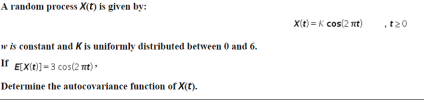 A random process X(t) is given by: X(t)= K cos(2 tt) ,t20 w is constant and K is uniformly distributed between 0 and 6. If E[X(t)]= 3 cos(2 mt) Determine the autocovariance function of X(t).
 2. (30 points) Let X(t) be a wide-sense stationary (WSS) random signal with power spectral density S(f) = 1011(f/200), and let y(t) be a random process defined by Y(t) = 10 cos(2000nt + 1) where is a uniformly distributed random variable in the interval [ 027]. Assume that X(t) and Y(t) are independent. (a) Derive the mean and autocorrelation function of Y(t). Is Y(t) a WSS process? Why? (b) Define a random signal Z(t) = X(t)Y(t). Determine and sketch the...
 2. Consider the random process x(t) defined by x(t) a cos(wt + 6).where w and a are constants, and 0 is a random variable uniformly distributed in the range (-T, ) Sketch the ensemble (sample functions) representing x(t). (2.5 points). a. b. Find the mean and variance of the random variable 0. (2.5 points). Find the mean of x(t), m (t) E(x(t)). (2.5 points). c. d. Find the autocorrelation of x(t), R (t,, t) = E(x, (t)x2 (t)). (5 points)....
 Problem # 11: Let Y(t) = (a + a X(t) cos(20 ft+), where a; are constants, 0 is uniform on (0,27], X(t) is a random process independent of 8 at all time instants and is WSS. Determine the mean and the covariance function of the process Y(t). Is Y(t) WSS?
 ,Two random processes are defined by Y(t)-X(t) cos(wot) where X(t) and Y(t) are jointly wSs. a) If θ is a constant (non-random), is there any value of θ that will make Yl(t) and Y(t) orthogonal? b) if θ is a uniform r.v., statistically independent of x(t) and Y(t), are there any conditions on θ that will make Yı(t) and Y2(t) orthogonal?
,Two random processes are defined by Y(t)-X(t) cos(wot) where X(t) and Y(t) are jointly wSs. a) If θ is...
,Two random processes are defined by Y(t)-X(t) cos(wot) where X(t) and Y(t) are jointly wSs. a) If θ is a constant (non-random), is there any value of θ that will make Yl(t) and Y(t) orthogonal? b) if θ is a uniform r.v., statistically independent of x(t) and Y(t), are there any conditions on θ that will make Yı(t) and Y2(t) orthogonal?
,Two random processes are defined by Y(t)-X(t) cos(wot) where X(t) and Y(t) are jointly wSs. a) If θ is...
 2. Consider the random process x(t) defined by x(t) a cos(wt 6), where w and 0 are constants, and a is a random variable uniformly distributed in the range (-A, A). a. Sketch the ensemble (sample functions) representing x(t). (2.5 points). b. Find the mean and variance of the random variable a. (5 points). c. Find the mean of x(t), m(t) E((t)). (5 points). d. Find the autocorrelation of x(t), Ra (t1, t2) E(x (t)x2 )). (5 points). Is the...
 Problem 5: Noisy Signal A signal generator generates a random sinusoid, X cos (2nt + Θ) whose amplitude is given by a random variable X uniformly distributed between-1 and 1, and phase Θ is an independent random variable which takes each of the following values π 0, π with equal prob- ability. This signal's amplitude is additively corrupted by independent noise YN(0, 0.01) The output amplitude is denoted by Z, where Z-X +Y. Assuming that an estimator of X has...
 Problem 1 A Poisson process is a continuous-time discrete-valued random process, X(t), that counts the number of events (think of incoming phone calls, customers entering a bank, car accidents, etc.) that occur up to and including time t where the occurrence times of these events satisfy the following three conditions Events only occur after time 0, i.e., X(t)0 for t0 If N (1, 2], where 0< t t2, denotes the number of events that occur in the time interval (t1,...
 A random process X(t) is given by: X(t)= K cos(2 tt) ,t20 w is constant and K is uniformly distributed between 0 and 6. If E[X(t)]= 3 cos(2 mt) Determine the autocovariance function of X(t).
Most questions answered within 3 hours.
-
Where is the error in this code sequence?
String s1 = "Hello";
String s2 = "ello";...
asked 11 months ago -
Financial data for Joel de Paris, Inc., for last year
follow:
Joel de Paris, Inc.
Balance...
asked 11 months ago -
Consider this reaction:
Al2(SO4)3 (aq)+ BaCl3
(aq) Al2Cl6 (aq)- +
3BaSO4(s) . What is the...
asked 11 months ago -
Suppose that Savneet is considering increasing her
recent random sample from 20 car rentals to 40...
asked 11 months ago -
Trucks arrive at an unloading terminal at an average rate of 120
per hour.
Trucks arrive...
asked 11 months ago -
Why are methanol and ethanol completely soluble in water while
octanol is not very little soluble....
asked 11 months ago -
A facilities manager at a university reads in a research report
that the mean amount of...
asked 11 months ago -
When the CuSO4 is rehydrated by adding water to the anhydrous
compound, is this an endothermic...
asked 11 months ago -
A ray of sunlight is passing from diamond into crown glass; the
angle of incidence is...
asked 11 months ago -
A block of mass 0.249 kg is placed on top of a light, vertical
spring of...
asked 11 months ago -
how do the kidneys compensate in the presences of acidosis
a) trigger hyperventilate
b) reserve acid...
asked 11 months ago -
Question 501 pts
The rental rate of capital to the firm increases. Which of the
following...
asked 11 months ago