Discuss thick tail, fat tail, univariate and multivariate statistical distributions
Discuss thick tail, fat tail, univariate and multivariate statistical distributions
Homework Answers

Add Answer to:
Discuss thick tail, fat tail, univariate and multivariate
statistical distributions
1. The use of multivariate statistical techniques has become more commonplace largely due to the increasingly...
 1. The use of multivariate statistical techniques has become more commonplace largely due to the increasingly complex nature of research designs and related research questions. 2. A study appropriate for multivariate statistical analysis is typically defined as one with several dependent variables (DVs). The basic distinction between experimental and nonexperimental research designs is whether the levels of the independent variable(s) have been manipulated by the 3. 4. In nonexperimental research (eg, descriptive, correlational, survey, or causal- comparative designs), the researcher...
Univariate Gaussians or normal distributions have a simple representation in that they can be completely described...
 Univariate Gaussians or normal distributions have a simple representation in that they can be completely described by their mean and variance. These distributions are particularly useful because of the central limit theorem, which posits that when a large number of independent random variables are added, the distribution of their sum is approximated by a normal distribution. In other words, normal distributions can be applied to most problems Recall the probability density function of the Univariate Gaussian with mean and variance...
6. The problem with outliers is that they can distort the results of a statistical test....
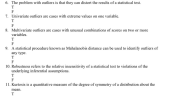 6. The problem with outliers is that they can distort the results of a statistical test. 7. Univariate outliers are cases with extreme values on one variable. Multivariate outliers are cases with unusual combinations of scores on two or more variables. 8. 9. A statistical procedure known as Mahalanobis distance can be used to identify outliers of any type 10. Robustness refers to the relative insensitivity of a statistical test to violations of the underlying inferential assumptions 11. Kurtosis is...
One of the important benefits of multivariate regression over many other statistical tests is that it...
One of the important benefits of multivariate regression over many other statistical tests is that it A. allows you to prevent measurement error. B. allows you to adjust for potentially confounding variables. C. ascertains temporal order that is necessary for causal inference. D. ensures that you are fulfilling all the required assumptions for statistical testing.
briefly discuss the three combinations of variable types that can form univariate data.
briefly discuss the three combinations of variable types that can form univariate data.
In a two tail hypothesis test the value of one tail is 0.041 and α= 0.01, what statistical...
In a two tail hypothesis test the value of one tail is 0.041 and α= 0.01, what statistical decision will you make regarding the null hypothesis you are testing (reject or not reject)?
Discuss examples in which statistical methods are used, or have been used, in chemical analysis. Identify...
Discuss examples in which statistical methods are used, or have been used, in chemical analysis. Identify the statistical methods used, and describe the implementation of these methods as well as the benefits obtained from their use. Explain using f-Test, t-Test, Grub's test, methods in least-squares/linear regression analysis, and multivariate analysis (ANOVA). Do not use methods in principle components analysis (PCA), PCR, Simplex optimization.
MULTIVARIATE DISTRIBUTIONS 3. Suppose that Xi and X2 are independent and each has a uniform distribution...
 MULTIVARIATE DISTRIBUTIONS
3. Suppose that Xi and X2 are independent and each has a uniform distribution on (0,1). Define Y: X1 + X2 and Y2 = X1-X2. Find the marginal probability density functions of Y1 and Y2. . Suppose that X has a standard normal distribution, and that the conditional distribution of Y given X is a normal distribution with mean 2X 3 and variance 12. Find E(Y) and Var(Y)
MULTIVARIATE DISTRIBUTIONS
3. Suppose that Xi and X2 are independent and each has a uniform distribution on (0,1). Define Y: X1 + X2 and Y2 = X1-X2. Find the marginal probability density functions of Y1 and Y2. . Suppose that X has a standard normal distribution, and that the conditional distribution of Y given X is a normal distribution with mean 2X 3 and variance 12. Find E(Y) and Var(Y)
Let X1, X, be iid M μ σ2). Then, find the joint distributions of (i) 2,...
 Let X1, X, be iid M μ σ2). Then, find the joint distributions of (i) 2, , Y, where Y-X,-X,, i = 2, , n; Hint: Use the Definition 4.6.1 for the multivariate normality. FYI: 1) Definition 4.6.1 Ά p(2 1) random vector X-(X1, X is said to have a p-dimensional normal distribution, denoted by N, if and only if each linear function X^ajX, has the univariate normal distribution for all fixed, but arbitrary real numbers a, a,
Provide and discuss some real life example of Multivariate Calculas in around 100 words
Provide and discuss some real life example of Multivariate Calculas in around 100 words
 1. The use of multivariate statistical techniques has become more commonplace largely due to the increasingly complex nature of research designs and related research questions. 2. A study appropriate for multivariate statistical analysis is typically defined as one with several dependent variables (DVs). The basic distinction between experimental and nonexperimental research designs is whether the levels of the independent variable(s) have been manipulated by the 3. 4. In nonexperimental research (eg, descriptive, correlational, survey, or causal- comparative designs), the researcher...
 Univariate Gaussians or normal distributions have a simple representation in that they can be completely described by their mean and variance. These distributions are particularly useful because of the central limit theorem, which posits that when a large number of independent random variables are added, the distribution of their sum is approximated by a normal distribution. In other words, normal distributions can be applied to most problems Recall the probability density function of the Univariate Gaussian with mean and variance...
 6. The problem with outliers is that they can distort the results of a statistical test. 7. Univariate outliers are cases with extreme values on one variable. Multivariate outliers are cases with unusual combinations of scores on two or more variables. 8. 9. A statistical procedure known as Mahalanobis distance can be used to identify outliers of any type 10. Robustness refers to the relative insensitivity of a statistical test to violations of the underlying inferential assumptions 11. Kurtosis is...
 MULTIVARIATE DISTRIBUTIONS
3. Suppose that Xi and X2 are independent and each has a uniform distribution on (0,1). Define Y: X1 + X2 and Y2 = X1-X2. Find the marginal probability density functions of Y1 and Y2. . Suppose that X has a standard normal distribution, and that the conditional distribution of Y given X is a normal distribution with mean 2X 3 and variance 12. Find E(Y) and Var(Y)
MULTIVARIATE DISTRIBUTIONS
3. Suppose that Xi and X2 are independent and each has a uniform distribution on (0,1). Define Y: X1 + X2 and Y2 = X1-X2. Find the marginal probability density functions of Y1 and Y2. . Suppose that X has a standard normal distribution, and that the conditional distribution of Y given X is a normal distribution with mean 2X 3 and variance 12. Find E(Y) and Var(Y)
 Let X1, X, be iid M μ σ2). Then, find the joint distributions of (i) 2, , Y, where Y-X,-X,, i = 2, , n; Hint: Use the Definition 4.6.1 for the multivariate normality. FYI: 1) Definition 4.6.1 Ά p(2 1) random vector X-(X1, X is said to have a p-dimensional normal distribution, denoted by N, if and only if each linear function X^ajX, has the univariate normal distribution for all fixed, but arbitrary real numbers a, a,
Most questions answered within 3 hours.
-
Where is the error in this code sequence?
String s1 = "Hello";
String s2 = "ello";...
asked 10 months ago -
Financial data for Joel de Paris, Inc., for last year
follow:
Joel de Paris, Inc.
Balance...
asked 10 months ago -
Consider this reaction:
Al2(SO4)3 (aq)+ BaCl3
(aq) Al2Cl6 (aq)- +
3BaSO4(s) . What is the...
asked 10 months ago -
Suppose that Savneet is considering increasing her
recent random sample from 20 car rentals to 40...
asked 10 months ago -
Trucks arrive at an unloading terminal at an average rate of 120
per hour.
Trucks arrive...
asked 10 months ago -
Why are methanol and ethanol completely soluble in water while
octanol is not very little soluble....
asked 10 months ago -
A facilities manager at a university reads in a research report
that the mean amount of...
asked 10 months ago -
When the CuSO4 is rehydrated by adding water to the anhydrous
compound, is this an endothermic...
asked 10 months ago -
A ray of sunlight is passing from diamond into crown glass; the
angle of incidence is...
asked 10 months ago -
A block of mass 0.249 kg is placed on top of a light, vertical
spring of...
asked 10 months ago -
how do the kidneys compensate in the presences of acidosis
a) trigger hyperventilate
b) reserve acid...
asked 10 months ago -
Question 501 pts
The rental rate of capital to the firm increases. Which of the
following...
asked 10 months ago