Suppose it takes 100 J of energy to bring two charges to within 1 m of...
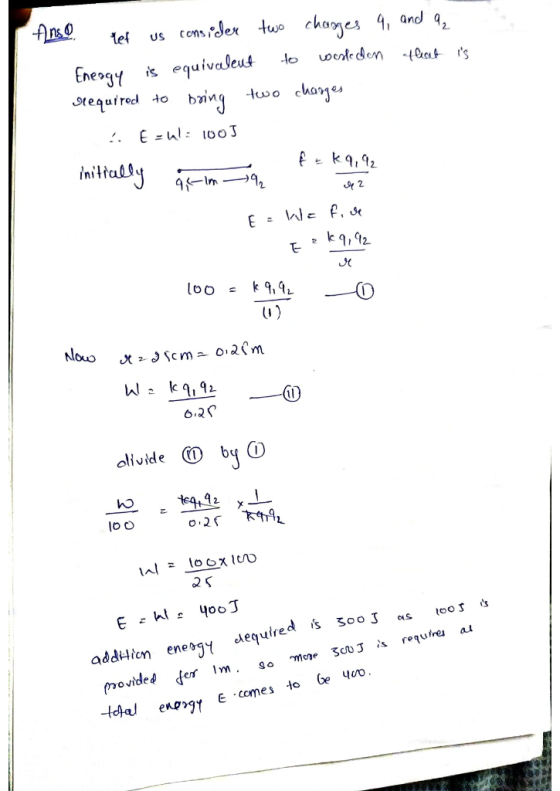
Suppose it takes 100 J of energy to bring two charges to within 1 m of each other. How much additional energy is required to bring them to a separation distance of only 25 cm? Group of answer choices 200 J 300 J 100 J 400 J
Homework Answers
Add Answer to:
Suppose it takes 100 J of energy to bring two charges to within
1 m of...
, Energy of Interaction of Point Charges Coulomb's Law yields an expression for the energy of...
 ,
Energy of Interaction of Point Charges
Coulomb's Law yields an expression for the energy of interaction
for a pair of point charges.
V is the energy (in J) required to bring the two charges from
infinite distance separation to distance r (in nm).
Q1 and Q2 are the charges
in terms of electrons.
(i.e. the constant in the above expression is
2.31×10⁻¹⁹J nm
electrons-2)
For a group of "point" charges (e.g. ions) the total energy of
interaction is the...
,
Energy of Interaction of Point Charges
Coulomb's Law yields an expression for the energy of interaction
for a pair of point charges.
V is the energy (in J) required to bring the two charges from
infinite distance separation to distance r (in nm).
Q1 and Q2 are the charges
in terms of electrons.
(i.e. the constant in the above expression is
2.31×10⁻¹⁹J nm
electrons-2)
For a group of "point" charges (e.g. ions) the total energy of
interaction is the...
Energy of Interaction of Point Charges Coulomb's Law yields an expression for the energy of interaction...
 Energy of Interaction of Point Charges Coulomb's Law yields an expression for the energy of interaction for a pair of point charges. 2.31 x 10⁻¹⁹Q1Q2 V is the energy (in )) required to bring the two charges from infinite distance separation to distance r (in nm). Qi and Q2 are the charges in terms of electrons. (i.e. the constant in the above expression is 2.31x10⁻¹⁹ nm electrons") For a group of "point" charges (e.g. ions) the total energy of interaction...
If it takes 100m to stop a car initially moving at 100 m/s what distance is...
If it takes 100m to stop a car initially moving at 100 m/s what distance is required to stop a car moving at 200 m/s under the same condition? Show work using energy equations only. a. 50m b. 100m c. 200m d. 400m
Q17:-1 . it takes 4.00 J of work to stretch a Hokes-law spring 100 cm fro...
 Q17:-1 . it takes 4.00 J of work to stretch a Hokes-law spring 100 cm fro m its unstressed length, determine the extra work required to stretch it an additional 5.0 cm. (A)6. 24) (B)7.56j (0)2.761 (D)3.84) (E)5.00
You build an electric circuit with a resistance of 10Ω and battery that can supply a...
You build an electric circuit with a resistance of 10Ω and battery that can supply a potential difference of 12 V across the resistor. If you now connect an ammeter between the cell and the resistor, what will be the reading on the ammeter? Group of answer choices 4.8 A 1.2 A 0.83 A 2.2 A Question Which of the following is likely to happen when a conductor is connected between the poles of a cell? Group of answer choices...
When two point charges are a distance R apart, their potential energy is -2.0 J. Part...
 When two point charges are a distance R apart, their potential energy is -2.0 J. Part A How far (in terms of R) should they be from each other so that their potential energy is -8.0 J? Express your answer numerically as a multiple of R. IVO AED ? FA D = R
Two charges, -3.0 μC and 5.0 μC are fixed at a location <1, 1> m and...
Two charges, -3.0 μC and 5.0 μC are fixed at a location <1, 1> m and <-0.25, 0 > m, respectively. (a) What is the net electric field at a point p, located at <0, -0.5> m? (b) How much energy is required to bring these two charges to their fixed locations? Is the energy positive or negative? Interpret what the sign of the energy means. (c) If a free proton is now placed at point p, what would be...
1. Suppose that two point charges, each with a charge of +1 Coulomb are separated by...
1. Suppose that two point charges, each with a charge of +1 Coulomb are separated by a distance of 1 meter. (a) Will they attract or repel? _______________(b) Determine the magnitude of the electrical force between them. 2. Two balloons are charged with an identical quantity and type of charge: -0.0025 C. They are held apart at a separation distance of 8 m. Determine the magnitude of the electrical force of repulsion between them. 3. Two charged boxes are 4...
Two protons arc held at a separation of 2.000 times 10^-10 m. How much electric potential...
 Two protons arc held at a separation of 2.000 times 10^-10 m. How much electric potential energy do they have? (Use k = 9.00 times 10^9 N middot m^2/C^2) 5.760 times 10-9 J 1.152 times 10^-18 J 3.467 times l0^-18 J 3.467 times 10^-18 J 7.200 times 10^10 J The same two protons of question 13 arc now pushed until their separation is 3.000 x 10*12 m. What was the change in potential energy of the protons? (Use it =...
(Only question 21, but you need the information in 20 to answer) 20. ll How much...
(Only question 21, but you need the information in 20 to answer) 20. ll How much work is required to completely separate two charges (each -1.4 micro C) and leave them at rest if they were initially 8.0 mm apart? 2.2 J 21. ll In Exercise 20, if the two charges are released at their initial separation distance, how much kinetic energy would each have when they are very distant from one another?
 Energy of Interaction of Point Charges Coulomb's Law yields an expression for the energy of interaction for a pair of point charges. 2.31 x 10⁻¹⁹Q1Q2 V is the energy (in )) required to bring the two charges from infinite distance separation to distance r (in nm). Qi and Q2 are the charges in terms of electrons. (i.e. the constant in the above expression is 2.31x10⁻¹⁹ nm electrons") For a group of "point" charges (e.g. ions) the total energy of interaction...
 Q17:-1 . it takes 4.00 J of work to stretch a Hokes-law spring 100 cm fro m its unstressed length, determine the extra work required to stretch it an additional 5.0 cm. (A)6. 24) (B)7.56j (0)2.761 (D)3.84) (E)5.00
 When two point charges are a distance R apart, their potential energy is -2.0 J. Part A How far (in terms of R) should they be from each other so that their potential energy is -8.0 J? Express your answer numerically as a multiple of R. IVO AED ? FA D = R
 Two protons arc held at a separation of 2.000 times 10^-10 m. How much electric potential energy do they have? (Use k = 9.00 times 10^9 N middot m^2/C^2) 5.760 times 10-9 J 1.152 times 10^-18 J 3.467 times l0^-18 J 3.467 times 10^-18 J 7.200 times 10^10 J The same two protons of question 13 arc now pushed until their separation is 3.000 x 10*12 m. What was the change in potential energy of the protons? (Use it =...
Most questions answered within 3 hours.
-
Where is the error in this code sequence?
String s1 = "Hello";
String s2 = "ello";...
asked 11 months ago -
Financial data for Joel de Paris, Inc., for last year
follow:
Joel de Paris, Inc.
Balance...
asked 11 months ago -
Consider this reaction:
Al2(SO4)3 (aq)+ BaCl3
(aq) Al2Cl6 (aq)- +
3BaSO4(s) . What is the...
asked 11 months ago -
Suppose that Savneet is considering increasing her
recent random sample from 20 car rentals to 40...
asked 11 months ago -
Trucks arrive at an unloading terminal at an average rate of 120
per hour.
Trucks arrive...
asked 11 months ago -
Why are methanol and ethanol completely soluble in water while
octanol is not very little soluble....
asked 11 months ago -
A facilities manager at a university reads in a research report
that the mean amount of...
asked 11 months ago -
When the CuSO4 is rehydrated by adding water to the anhydrous
compound, is this an endothermic...
asked 11 months ago -
A ray of sunlight is passing from diamond into crown glass; the
angle of incidence is...
asked 11 months ago -
A block of mass 0.249 kg is placed on top of a light, vertical
spring of...
asked 11 months ago -
how do the kidneys compensate in the presences of acidosis
a) trigger hyperventilate
b) reserve acid...
asked 11 months ago -
Question 501 pts
The rental rate of capital to the firm increases. Which of the
following...
asked 11 months ago