
Homework Answers
Add Answer to:
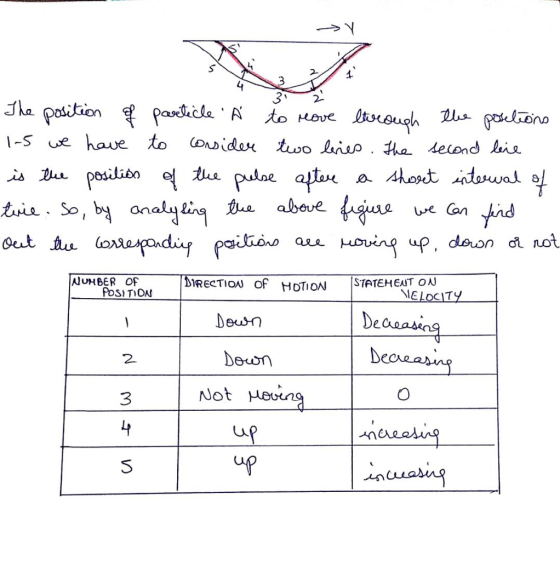
3. b) A pulse of the shape above is moving right toward A (a particle of...
Experiment AM Position and Velocity Comprehension Questions 1. You have worked with graphs for four different...
 Experiment AM Position and Velocity Comprehension Questions 1. You have worked with graphs for four different cart motions at nearly constant velocity for the cart moving slowly and more quickly as well as for the cart moving in the direction of increasing and decreasing z. The next few questions are about the similarities and differences among them. (a) What is the general shape of the position vs. time or r(t) graph for motion at constant velocity? (b) What is the...
Not sure if these are right 2· The e motion of a particle is modelled by the equation s(e) 5+9t-6t2+t3, where s is measured in metres and t is time in seconds. a) When is the particle at rest? (2)...
 Not
sure if these are right
2· The e motion of a particle is modelled by the equation s(e) 5+9t-6t2+t3, where s is measured in metres and t is time in seconds. a) When is the particle at rest? (2) (3) When is the particle moving in a positive direction? b) vct) -124+30 Ct-1 Ct d-9-12t t3t2 ve) c) Draw a diagram to show the motion of the particle with respect to a distance axis, Indicate key time values Determine...
Not
sure if these are right
2· The e motion of a particle is modelled by the equation s(e) 5+9t-6t2+t3, where s is measured in metres and t is time in seconds. a) When is the particle at rest? (2) (3) When is the particle moving in a positive direction? b) vct) -124+30 Ct-1 Ct d-9-12t t3t2 ve) c) Draw a diagram to show the motion of the particle with respect to a distance axis, Indicate key time values Determine...
need help with ANALYZE PART A AND B and FINALIZE EXPLORE A car is moving with constant acceleration along a straight road (A) Determine how the velocity and the displacement of the car vary with t...
 need help with ANALYZE PART A AND B and FINALIZE
EXPLORE A car is moving with constant acceleration along a straight road (A) Determine how the velocity and the displacement of the car vary with time if the car is initialy moving to the right with a speed of 9.0 m/s and has an acceleration to the right of 1.7 m/s (B) Determine the velocity as a function of time when the velocity is instead initially to the right and...
need help with ANALYZE PART A AND B and FINALIZE
EXPLORE A car is moving with constant acceleration along a straight road (A) Determine how the velocity and the displacement of the car vary with time if the car is initialy moving to the right with a speed of 9.0 m/s and has an acceleration to the right of 1.7 m/s (B) Determine the velocity as a function of time when the velocity is instead initially to the right and...
From the previous problem, Problem 2.17, answer the questions below; (20=3+3+4+5+5 points) Does the particle stop...
 From the previous problem, Problem 2.17,
answer the questions below; (20=3+3+4+5+5 points)
Does the particle stop for time t between -4 s and +4
s? If it stops, when? Explain your answer.
Does this particle change direction? Explain your answer.
Describe the motion of the particle for time t between
-4 s and +4 s.
Graph v(t) versus t for -4 s≤ t ≤ 4
s.
[Please use a graph sheet to answer f). You can download and print
it...
From the previous problem, Problem 2.17,
answer the questions below; (20=3+3+4+5+5 points)
Does the particle stop for time t between -4 s and +4
s? If it stops, when? Explain your answer.
Does this particle change direction? Explain your answer.
Describe the motion of the particle for time t between
-4 s and +4 s.
Graph v(t) versus t for -4 s≤ t ≤ 4
s.
[Please use a graph sheet to answer f). You can download and print
it...
2. Consider a charged particle in a magnetic field. Let -e = -1.60 x 10-191C) be...
 2. Consider a charged particle in a magnetic field. Let -e = -1.60 x 10-191C) be an electron, under B=0.1T) of a uniform magnetic field directed out of the page direction (o-direction). At t = 0[sec] the particle is at the origin, and the initial velocity is toward positive y direction. (a) Sketch the initial configuration of this electron (-e at the origin) into (x,y)-plane. Applying the right hand rule, indicate the magnetic force on this moving electron. Note that...
A particle is introduced to a region with a potential described by U(x)--2x2 +x*+1 Joules. 3. a. ...
 A particle is introduced to a region with a potential described by U(x)--2x2 +x*+1 Joules. 3. a. (2 pts) In software, plot the potential U) Set your axis ranges: -2 SxS2 and 0s b. (5 pts) Find the equilibrium positions and determine whether they are stable or c. (8 pts) Describe the motion of the particle for total energy values E-О.0.05. 1.0, 2.0 unstable. Explain how you arrived at your answers. (all in Joules). What I am looking for here...
A charged particle is moving in a uniform, constant magnetic field. Which one of the following...
 A charged particle is moving in a uniform, constant magnetic field. Which one of the following statements concerning the magnetic force exerted on the particle is false It does no work on the particle. It increases the speed of the particle. It changes the velocity of the particle. It can act only on a particle in motion. It does not change the kinetic energy of the particle. A circular current loop with radius of 0.100 m is located in the...
cally up from a moving cart. The position of the balls to raph below shows the...
 cally up from a moving cart. The position of the balls to raph below shows the position of the ball at equal time inter- A ball is fired vertically up from a mo the left of the graph below showst vals, as would be seen by the person on the cart. a. For this person the motion is sym- metric in time so positions on the way down are the same as on the way up, so only one ball...
Instructions: 1. Draw the schematic of the situation described in the wording of the problem. This...
 Instructions: 1. Draw the schematic of the situation described in the wording of the problem. This schematic includes a list of the data given in the wording of the problem, such as initial position (x, yo), initial velocity Ivo, V, Vol, final position (x,y), final velocity (V, V, W) or maximum height (ym). Make a decision on whether you want to use "y" or "h" for the vertical axis and keep it consistent throughout all the problems. Write down the...
3. Fill the blanks and the Proof - J.J. Thomson's experiment to fine the charge-to-mass ratio of the tt) (25 po...
 3. Fill the blanks and the Proof - J.J. Thomson's experiment to fine the charge-to-mass ratio of the tt) (25 points) electron (i.e. e/m; The first is the experiment of Joseph John Thomson, who first demonstrated that atoms are actually composed of aggregates of charged particles. Prior to his work, it was believed that atoms were the fundamental building blocks of matter. The first evidence contrary to this notion came when people began studying the properties of atoms in large...
 Experiment AM Position and Velocity Comprehension Questions 1. You have worked with graphs for four different cart motions at nearly constant velocity for the cart moving slowly and more quickly as well as for the cart moving in the direction of increasing and decreasing z. The next few questions are about the similarities and differences among them. (a) What is the general shape of the position vs. time or r(t) graph for motion at constant velocity? (b) What is the...
 Not
sure if these are right
2· The e motion of a particle is modelled by the equation s(e) 5+9t-6t2+t3, where s is measured in metres and t is time in seconds. a) When is the particle at rest? (2) (3) When is the particle moving in a positive direction? b) vct) -124+30 Ct-1 Ct d-9-12t t3t2 ve) c) Draw a diagram to show the motion of the particle with respect to a distance axis, Indicate key time values Determine...
Not
sure if these are right
2· The e motion of a particle is modelled by the equation s(e) 5+9t-6t2+t3, where s is measured in metres and t is time in seconds. a) When is the particle at rest? (2) (3) When is the particle moving in a positive direction? b) vct) -124+30 Ct-1 Ct d-9-12t t3t2 ve) c) Draw a diagram to show the motion of the particle with respect to a distance axis, Indicate key time values Determine...
 need help with ANALYZE PART A AND B and FINALIZE
EXPLORE A car is moving with constant acceleration along a straight road (A) Determine how the velocity and the displacement of the car vary with time if the car is initialy moving to the right with a speed of 9.0 m/s and has an acceleration to the right of 1.7 m/s (B) Determine the velocity as a function of time when the velocity is instead initially to the right and...
need help with ANALYZE PART A AND B and FINALIZE
EXPLORE A car is moving with constant acceleration along a straight road (A) Determine how the velocity and the displacement of the car vary with time if the car is initialy moving to the right with a speed of 9.0 m/s and has an acceleration to the right of 1.7 m/s (B) Determine the velocity as a function of time when the velocity is instead initially to the right and...
 From the previous problem, Problem 2.17,
answer the questions below; (20=3+3+4+5+5 points)
Does the particle stop for time t between -4 s and +4
s? If it stops, when? Explain your answer.
Does this particle change direction? Explain your answer.
Describe the motion of the particle for time t between
-4 s and +4 s.
Graph v(t) versus t for -4 s≤ t ≤ 4
s.
[Please use a graph sheet to answer f). You can download and print
it...
From the previous problem, Problem 2.17,
answer the questions below; (20=3+3+4+5+5 points)
Does the particle stop for time t between -4 s and +4
s? If it stops, when? Explain your answer.
Does this particle change direction? Explain your answer.
Describe the motion of the particle for time t between
-4 s and +4 s.
Graph v(t) versus t for -4 s≤ t ≤ 4
s.
[Please use a graph sheet to answer f). You can download and print
it...
 2. Consider a charged particle in a magnetic field. Let -e = -1.60 x 10-191C) be an electron, under B=0.1T) of a uniform magnetic field directed out of the page direction (o-direction). At t = 0[sec] the particle is at the origin, and the initial velocity is toward positive y direction. (a) Sketch the initial configuration of this electron (-e at the origin) into (x,y)-plane. Applying the right hand rule, indicate the magnetic force on this moving electron. Note that...
 A particle is introduced to a region with a potential described by U(x)--2x2 +x*+1 Joules. 3. a. (2 pts) In software, plot the potential U) Set your axis ranges: -2 SxS2 and 0s b. (5 pts) Find the equilibrium positions and determine whether they are stable or c. (8 pts) Describe the motion of the particle for total energy values E-О.0.05. 1.0, 2.0 unstable. Explain how you arrived at your answers. (all in Joules). What I am looking for here...
 A charged particle is moving in a uniform, constant magnetic field. Which one of the following statements concerning the magnetic force exerted on the particle is false It does no work on the particle. It increases the speed of the particle. It changes the velocity of the particle. It can act only on a particle in motion. It does not change the kinetic energy of the particle. A circular current loop with radius of 0.100 m is located in the...
 cally up from a moving cart. The position of the balls to raph below shows the position of the ball at equal time inter- A ball is fired vertically up from a mo the left of the graph below showst vals, as would be seen by the person on the cart. a. For this person the motion is sym- metric in time so positions on the way down are the same as on the way up, so only one ball...
 Instructions: 1. Draw the schematic of the situation described in the wording of the problem. This schematic includes a list of the data given in the wording of the problem, such as initial position (x, yo), initial velocity Ivo, V, Vol, final position (x,y), final velocity (V, V, W) or maximum height (ym). Make a decision on whether you want to use "y" or "h" for the vertical axis and keep it consistent throughout all the problems. Write down the...
 3. Fill the blanks and the Proof - J.J. Thomson's experiment to fine the charge-to-mass ratio of the tt) (25 points) electron (i.e. e/m; The first is the experiment of Joseph John Thomson, who first demonstrated that atoms are actually composed of aggregates of charged particles. Prior to his work, it was believed that atoms were the fundamental building blocks of matter. The first evidence contrary to this notion came when people began studying the properties of atoms in large...
Most questions answered within 3 hours.
-
Where is the error in this code sequence?
String s1 = "Hello";
String s2 = "ello";...
asked 11 months ago -
Financial data for Joel de Paris, Inc., for last year
follow:
Joel de Paris, Inc.
Balance...
asked 11 months ago -
Consider this reaction:
Al2(SO4)3 (aq)+ BaCl3
(aq) Al2Cl6 (aq)- +
3BaSO4(s) . What is the...
asked 11 months ago -
Suppose that Savneet is considering increasing her
recent random sample from 20 car rentals to 40...
asked 11 months ago -
Trucks arrive at an unloading terminal at an average rate of 120
per hour.
Trucks arrive...
asked 11 months ago -
Why are methanol and ethanol completely soluble in water while
octanol is not very little soluble....
asked 11 months ago -
A facilities manager at a university reads in a research report
that the mean amount of...
asked 11 months ago -
When the CuSO4 is rehydrated by adding water to the anhydrous
compound, is this an endothermic...
asked 11 months ago -
A ray of sunlight is passing from diamond into crown glass; the
angle of incidence is...
asked 11 months ago -
A block of mass 0.249 kg is placed on top of a light, vertical
spring of...
asked 11 months ago -
how do the kidneys compensate in the presences of acidosis
a) trigger hyperventilate
b) reserve acid...
asked 11 months ago -
Question 501 pts
The rental rate of capital to the firm increases. Which of the
following...
asked 11 months ago