
Homework Answers
T(°C) = (T(°F) - 32) × 5/9
T(°C) = (-25 - 32) × 5/9
T = -31.7 C
Minus 25 degree Farenheit is equal to minus 31.7 degree centigrade.
Add Answer to:
L = L_0 (1 + alpha times delta T). Alpha is the heat expansion coefficient (25...
3. The linear expansion coefficient is defined by AL/L = a AT. Consider a material for...
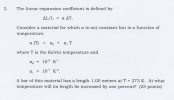 3. The linear expansion coefficient is defined by AL/L = a AT. Consider a material for which a is not constant but is a function of temperature: a (T) = 2o + QT where T is the Kelvin temperature and do = 10-5 K-1 Q = 10-7 K2 A bar of this material has a length 1.00 meters at T = 273 K. At what temperature will its length be increased by one percent? (25 points)
1. If a gas under 5 atmospheres of presssure has a volume of 2 liters and...
1. If a gas under 5 atmospheres of presssure has a volume of 2 liters and a temperature of 10 degree celsius, What will be the new volume if the pressure increases to 7 atmospheres and the temperature rises to 50 degrees celsius? A. 1.6 L b. 3.7 L C neither A nor B 2. 300 g of ice at zero degree centigrade is mixed with 500 g of water at 50 degrees centigrade. What will be the final temperature...
1. If a gas under 5 atmospheres of presssure has a volume of 2 liters...
1. If a gas under 5 atmospheres of presssure has a volume of 2 liters and a temperature of 10 degree celsius, What will be the new volume if the pressure increases to 7 atmospheres and the temperature rises to 50 degrees celsius? A. 1.6 L b. 3.7 L C neither A nor B 2. 300 g of ice at zero degree centigrade is mixed with 500 g of water at 50 degrees centigrade. What will be the final...
The coefficient of linear expansion of steel is 12 × 10-6 K-1. What is the change...
The coefficient of linear expansion of steel is 12 × 10-6 K-1. What is the change in length of a 25-m steel bridge span when it undergoes a temperature change of 40 K from winter to summer?
An aluminum wing on a passenger jet is 40m long when it's temperature is 15 degrees...
An aluminum wing on a passenger jet is 40m long when it's temperature is 15 degrees C. At what temperature would the wing be 3cm (0.03m) shorter? The coefficient of linear expansion for aluminum being used is (25 * 10^-6). I keep plugging this into an equation for thermal expansion, but I am not getting numbers that look right. [change in L (0.03) = (25 * 10^-6)(40)(change in T, T-15)]
An aluminum block of mass 9.0 kg is originally at a temperature of 25°C and 1...
An aluminum block of mass 9.0 kg is originally at a temperature of 25°C and 1 atm. It is then heated to a temperature of 67°C without any change in pressure. The specific heat of aluminum is 900 J/(kg · °C), its density is 2.70 103 kg/m3, and the coefficient of linear expansion is 24 ✕ 10 −6 /°C. (a) Determine the work done by the aluminum block.
One mole of an ideal gas undergoes a reversible adiabatic expansion from T_1, to T_2 while...
 One mole of an ideal gas undergoes a reversible adiabatic expansion from T_1, to T_2 while tripling the volume of the gas. What is the relation between T_1 and T-2? T-2/3 < T_1<T_2 T_2/3 < T_1 < T-2 T_1= T_2 T_2<T_1 T_1 lessthanorequalto T_2/3 One mole of Ar gas undergoes the reversible transformation shown. Assuming Ar behaves ideally, which statement is true for step 2? Delta U= C_p DeltaT DeltaH < Delta U Delat S= c_p ln(T_c/T_B) W = etaRt...
QUESTION 7** On a 1 m square plate is a hole of area A 0.3 m2 at T: 200 K The plate is made of a material whose linear thermal expansion coefficient is α increase AA of the area of the window at T-30...
 QUESTION 7** On a 1 m square plate is a hole of area A 0.3 m2 at T: 200 K The plate is made of a material whose linear thermal expansion coefficient is α increase AA of the area of the window at T-300 K compared with that at T- 200 K? 13 x 10 6 K l what is the ΔΑ: 5.3x10⁻⁴m2 ΔΑ = 7.8 × 10⁻⁴ m2 ΔΑ = 9.3 × 10⁻⁴ m2 ΔΑ =11.2×10⁻⁴ m2 4A =...
Hi I am working on the group work I need help with and a little explanation...
 Hi I am working on the group work I need help with and a
little explanation with it that will help a lot.
Tools View GW1 Ch 16 (Protected View)-Word (P OTECTED VIEW Be careful-files from the Internet can contain viruses. Unless you need to edit, it's safer to stay in Protected V Group Work: Ch. 16 1. A pressure of 10 mm Hg is measured using a constant-volume gas thermometer at a temperature of 50°C. What is the pressure...
Hi I am working on the group work I need help with and a
little explanation with it that will help a lot.
Tools View GW1 Ch 16 (Protected View)-Word (P OTECTED VIEW Be careful-files from the Internet can contain viruses. Unless you need to edit, it's safer to stay in Protected V Group Work: Ch. 16 1. A pressure of 10 mm Hg is measured using a constant-volume gas thermometer at a temperature of 50°C. What is the pressure...
Calculate molar volume of an ideal gas in m^3 at room temperature and pressure (or RTP)....
 Calculate molar volume of an ideal gas in m^3 at room temperature and pressure (or RTP). Id other words, calculate how much volume one mole of an ideal gas at 1.01 times 10^5 Pa and 298 K takes up. Then convert it to liters (l), where 1 t - 0.001 m^3 Measured at 18.00 C, a lead rod has a length of 52.44 cm, and an iron rod has a length of 52.61 cm. Both rods are heated to 86.0...
 3. The linear expansion coefficient is defined by AL/L = a AT. Consider a material for which a is not constant but is a function of temperature: a (T) = 2o + QT where T is the Kelvin temperature and do = 10-5 K-1 Q = 10-7 K2 A bar of this material has a length 1.00 meters at T = 273 K. At what temperature will its length be increased by one percent? (25 points)
 One mole of an ideal gas undergoes a reversible adiabatic expansion from T_1, to T_2 while tripling the volume of the gas. What is the relation between T_1 and T-2? T-2/3 < T_1<T_2 T_2/3 < T_1 < T-2 T_1= T_2 T_2<T_1 T_1 lessthanorequalto T_2/3 One mole of Ar gas undergoes the reversible transformation shown. Assuming Ar behaves ideally, which statement is true for step 2? Delta U= C_p DeltaT DeltaH < Delta U Delat S= c_p ln(T_c/T_B) W = etaRt...
 QUESTION 7** On a 1 m square plate is a hole of area A 0.3 m2 at T: 200 K The plate is made of a material whose linear thermal expansion coefficient is α increase AA of the area of the window at T-300 K compared with that at T- 200 K? 13 x 10 6 K l what is the ΔΑ: 5.3x10⁻⁴m2 ΔΑ = 7.8 × 10⁻⁴ m2 ΔΑ = 9.3 × 10⁻⁴ m2 ΔΑ =11.2×10⁻⁴ m2 4A =...
 Hi I am working on the group work I need help with and a
little explanation with it that will help a lot.
Tools View GW1 Ch 16 (Protected View)-Word (P OTECTED VIEW Be careful-files from the Internet can contain viruses. Unless you need to edit, it's safer to stay in Protected V Group Work: Ch. 16 1. A pressure of 10 mm Hg is measured using a constant-volume gas thermometer at a temperature of 50°C. What is the pressure...
Hi I am working on the group work I need help with and a
little explanation with it that will help a lot.
Tools View GW1 Ch 16 (Protected View)-Word (P OTECTED VIEW Be careful-files from the Internet can contain viruses. Unless you need to edit, it's safer to stay in Protected V Group Work: Ch. 16 1. A pressure of 10 mm Hg is measured using a constant-volume gas thermometer at a temperature of 50°C. What is the pressure...
 Calculate molar volume of an ideal gas in m^3 at room temperature and pressure (or RTP). Id other words, calculate how much volume one mole of an ideal gas at 1.01 times 10^5 Pa and 298 K takes up. Then convert it to liters (l), where 1 t - 0.001 m^3 Measured at 18.00 C, a lead rod has a length of 52.44 cm, and an iron rod has a length of 52.61 cm. Both rods are heated to 86.0...
Most questions answered within 3 hours.
-
Where is the error in this code sequence?
String s1 = "Hello";
String s2 = "ello";...
asked 11 months ago -
Financial data for Joel de Paris, Inc., for last year
follow:
Joel de Paris, Inc.
Balance...
asked 11 months ago -
Consider this reaction:
Al2(SO4)3 (aq)+ BaCl3
(aq) Al2Cl6 (aq)- +
3BaSO4(s) . What is the...
asked 11 months ago -
Suppose that Savneet is considering increasing her
recent random sample from 20 car rentals to 40...
asked 11 months ago -
Trucks arrive at an unloading terminal at an average rate of 120
per hour.
Trucks arrive...
asked 11 months ago -
Why are methanol and ethanol completely soluble in water while
octanol is not very little soluble....
asked 11 months ago -
A facilities manager at a university reads in a research report
that the mean amount of...
asked 11 months ago -
When the CuSO4 is rehydrated by adding water to the anhydrous
compound, is this an endothermic...
asked 11 months ago -
A ray of sunlight is passing from diamond into crown glass; the
angle of incidence is...
asked 11 months ago -
A block of mass 0.249 kg is placed on top of a light, vertical
spring of...
asked 11 months ago -
how do the kidneys compensate in the presences of acidosis
a) trigger hyperventilate
b) reserve acid...
asked 11 months ago -
Question 501 pts
The rental rate of capital to the firm increases. Which of the
following...
asked 11 months ago