
Homework Answers
Add Answer to:
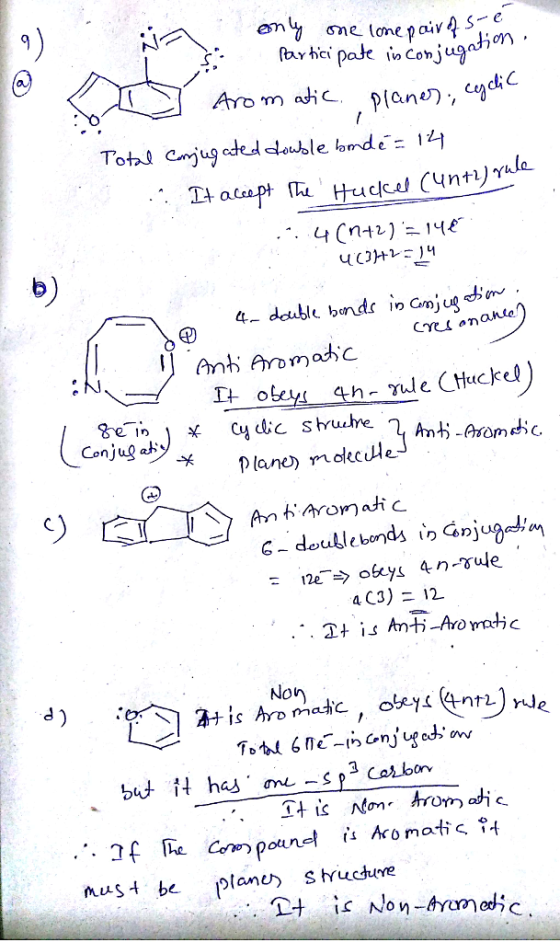
9. Identify each of the following molecules as aromatic, antiaromatic or nonaromatic. (For this problem, you...
Alder Re? 9. Draw the two major products for the following reaction. a. Identify each as...
 Alder Re? 9. Draw the two major products for the following reaction. a. Identify each as either a 1,2 or 1,4 addition product. b. Write either "thermodynamic" or "kinetic" underneath each one. c. Draw the two resonance structures for the intermediate from which both form H-Br ton nroducts for the following reaction. Draw the the major product or products for the following reaction. Drow the resonance structures for the intermediate from which both form Bra/ hv NBS/ peroxides 11. Give...
Show lone pairs on all appropriate atoms and the proper flow of electrons. (1) Mechanism #1:...
 Show lone pairs on all appropriate atoms and the proper flow of electrons. (1) Mechanism #1: • Predict the products of the following reaction under different temperature conditions. • Show the mechanism for how the two products are formed at different temperatures (include resonance structures if appropriate). • Label the kinetic product and the thermodynamic product. (5 points) -80 °C + HBr 40 °C (2) Predict the product and show the complete mechanism for the following reaction. • Make sure...
#4 is asking for a potential path to synthesize from the listed starting material to the...
 #4 is asking for a potential
path to synthesize from the listed starting material to the final
product. Including all reagents used and intermediary steps. The
chapter this was assigned with is enolate anions & amines.
1. Draw all possible products for the base catalyzed reaction of ethanal and propanal. Indicate the new bond formed. (Full: all possible products and correct ID of new bond, partial: 75% of possible products) 2. Draw and label the kinetic and thermodynamic products for...
#4 is asking for a potential
path to synthesize from the listed starting material to the final
product. Including all reagents used and intermediary steps. The
chapter this was assigned with is enolate anions & amines.
1. Draw all possible products for the base catalyzed reaction of ethanal and propanal. Indicate the new bond formed. (Full: all possible products and correct ID of new bond, partial: 75% of possible products) 2. Draw and label the kinetic and thermodynamic products for...
please help with how the flow chart will look like? thank you! Synthesis of n-Butyl Bromide...
 please help with how the flow chart will look like? thank
you!
Synthesis of n-Butyl Bromide Purpose of the Experiment: In this week's experiment you will be synthesizing n-butylbromide (IUPAC 1-bromobutane from 1-butanol and a concentrated acid via a nucleophilie substitution reaction. It is important to know that alcohols dehydrate to form alkenes in the presence of strong inorganic acids, so care must be taken in this experiment not to heat the reaction too vigorously else an elimination reaction may...
please help with how the flow chart will look like? thank
you!
Synthesis of n-Butyl Bromide Purpose of the Experiment: In this week's experiment you will be synthesizing n-butylbromide (IUPAC 1-bromobutane from 1-butanol and a concentrated acid via a nucleophilie substitution reaction. It is important to know that alcohols dehydrate to form alkenes in the presence of strong inorganic acids, so care must be taken in this experiment not to heat the reaction too vigorously else an elimination reaction may...
 Alder Re? 9. Draw the two major products for the following reaction. a. Identify each as either a 1,2 or 1,4 addition product. b. Write either "thermodynamic" or "kinetic" underneath each one. c. Draw the two resonance structures for the intermediate from which both form H-Br ton nroducts for the following reaction. Draw the the major product or products for the following reaction. Drow the resonance structures for the intermediate from which both form Bra/ hv NBS/ peroxides 11. Give...
 Show lone pairs on all appropriate atoms and the proper flow of electrons. (1) Mechanism #1: • Predict the products of the following reaction under different temperature conditions. • Show the mechanism for how the two products are formed at different temperatures (include resonance structures if appropriate). • Label the kinetic product and the thermodynamic product. (5 points) -80 °C + HBr 40 °C (2) Predict the product and show the complete mechanism for the following reaction. • Make sure...
 #4 is asking for a potential
path to synthesize from the listed starting material to the final
product. Including all reagents used and intermediary steps. The
chapter this was assigned with is enolate anions & amines.
1. Draw all possible products for the base catalyzed reaction of ethanal and propanal. Indicate the new bond formed. (Full: all possible products and correct ID of new bond, partial: 75% of possible products) 2. Draw and label the kinetic and thermodynamic products for...
#4 is asking for a potential
path to synthesize from the listed starting material to the final
product. Including all reagents used and intermediary steps. The
chapter this was assigned with is enolate anions & amines.
1. Draw all possible products for the base catalyzed reaction of ethanal and propanal. Indicate the new bond formed. (Full: all possible products and correct ID of new bond, partial: 75% of possible products) 2. Draw and label the kinetic and thermodynamic products for...
 please help with how the flow chart will look like? thank
you!
Synthesis of n-Butyl Bromide Purpose of the Experiment: In this week's experiment you will be synthesizing n-butylbromide (IUPAC 1-bromobutane from 1-butanol and a concentrated acid via a nucleophilie substitution reaction. It is important to know that alcohols dehydrate to form alkenes in the presence of strong inorganic acids, so care must be taken in this experiment not to heat the reaction too vigorously else an elimination reaction may...
please help with how the flow chart will look like? thank
you!
Synthesis of n-Butyl Bromide Purpose of the Experiment: In this week's experiment you will be synthesizing n-butylbromide (IUPAC 1-bromobutane from 1-butanol and a concentrated acid via a nucleophilie substitution reaction. It is important to know that alcohols dehydrate to form alkenes in the presence of strong inorganic acids, so care must be taken in this experiment not to heat the reaction too vigorously else an elimination reaction may...
Most questions answered within 3 hours.
-
Where is the error in this code sequence?
String s1 = "Hello";
String s2 = "ello";...
asked 11 months ago -
Financial data for Joel de Paris, Inc., for last year
follow:
Joel de Paris, Inc.
Balance...
asked 11 months ago -
Consider this reaction:
Al2(SO4)3 (aq)+ BaCl3
(aq) Al2Cl6 (aq)- +
3BaSO4(s) . What is the...
asked 11 months ago -
Suppose that Savneet is considering increasing her
recent random sample from 20 car rentals to 40...
asked 11 months ago -
Trucks arrive at an unloading terminal at an average rate of 120
per hour.
Trucks arrive...
asked 11 months ago -
Why are methanol and ethanol completely soluble in water while
octanol is not very little soluble....
asked 11 months ago -
A facilities manager at a university reads in a research report
that the mean amount of...
asked 11 months ago -
When the CuSO4 is rehydrated by adding water to the anhydrous
compound, is this an endothermic...
asked 11 months ago -
A ray of sunlight is passing from diamond into crown glass; the
angle of incidence is...
asked 11 months ago -
A block of mass 0.249 kg is placed on top of a light, vertical
spring of...
asked 11 months ago -
how do the kidneys compensate in the presences of acidosis
a) trigger hyperventilate
b) reserve acid...
asked 11 months ago -
Question 501 pts
The rental rate of capital to the firm increases. Which of the
following...
asked 11 months ago