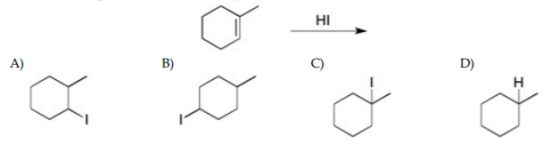
1) Predict the major product of the following reaction.
1) Predict the major product of the following reaction.
2) What synthetic goal is achieved by subjecting an alkene to an oxymercuration-demercuration sequence?
A) syn-hydroxylation
B) Markovnikov addition of H2O wherein skeletal rearrangement is prevented
C) anti-Markovnikov addition of H2O wherein skeletal rearrangement is promoted
D) Markovnikov addition of H2O wherein skeletal rearrangement is promoted
E) anti-Markovnikov addition of H20 wherein skeletal rearrangement is prevented
3) Treatment of 2-methylpropene with which of the following reaction conditions results in an anti-Markovnikov addition product? (circle all that apply)
A) dry gaseous HBr with peroxides present
B) BH3-THF, followed by alkaline H2O2
C) dilute H2SO4 and heat
D) aqueous Hg(OAc)2, followed by alkaline NaBH4
4) What is the structure of compound B obtained in the following reaction sequence?

Homework Answers

10. Provide the reagents necessary to complete the following transformation. 13. Provide the structure of the...
 10.
Provide the reagents necessary to complete the following
transformation. 13. Provide the structure of the major organic
product of the reaction below
10. Provide the reagents necessary to complete the following transformation. A. 1. BH3 THF 2. H202, HO B). H20, H2SO4 C. OsO4. H202 D. CH3CO3H E. 1. CH3CO3H 2. H, H20 11. Which of the following is the best reaction sequence to use if one wants to accomplish a Markovnikov addition of water to an alkene with...
10.
Provide the reagents necessary to complete the following
transformation. 13. Provide the structure of the major organic
product of the reaction below
10. Provide the reagents necessary to complete the following transformation. A. 1. BH3 THF 2. H202, HO B). H20, H2SO4 C. OsO4. H202 D. CH3CO3H E. 1. CH3CO3H 2. H, H20 11. Which of the following is the best reaction sequence to use if one wants to accomplish a Markovnikov addition of water to an alkene with...
Acid Catalyzed Hydration-treatment of alkenes with water in the presence of acid catalyst leads to the...
 Acid Catalyzed Hydration-treatment of alkenes with water in the presence of acid catalyst leads to the formation of alcohols. H2SO4/H2O > 150°C Mechanism Major Product Acid catalyzed dehydration goes through a carbocation intermediate. This means that the Markovnikov product is obtained when carbocation rearrangements do not occur. The need for excessively high temperatures makes this reaction of limited use in laboratory synthesis. Oxymercuration - Oxymercuration involves the addition of Hg to the alkene using mercury (II) acetate Hg(OAc) followed by...
a) There are several reagents that can be used to effect addition to a double bond,...
 a) There are several reagents that can be used to effect
addition to a double bond, including: acid and water,
oxymercuration--demercuration reagents, and
hydroboration--oxidation reagents. Inspect the final product and
select all the reasons why oxymercuration--demercuration was chosen
to effect the following transformation instead of the other
reagents.
b) Complete the mechanism for the reaction by adding curved
arrows. The reagents chosen for the transformation are: 1)
Hg(OAc)2, THF, H2O and 2) NaBH4, OH
a) There are several reagents that can be used to effect
addition to a double bond, including: acid and water,
oxymercuration--demercuration reagents, and
hydroboration--oxidation reagents. Inspect the final product and
select all the reasons why oxymercuration--demercuration was chosen
to effect the following transformation instead of the other
reagents.
b) Complete the mechanism for the reaction by adding curved
arrows. The reagents chosen for the transformation are: 1)
Hg(OAc)2, THF, H2O and 2) NaBH4, OH
15) What synthetic goal is achieved by subjecting an alkene to BH3-THF, followed by oxidative working...
 15) What synthetic goal is achieved by subjecting an alkene to BH3-THF, followed by oxidative working using H2O2 and NaOH? A) Markovnikov addition of water where relative stereochemistry is preserved B) Markovnikov addition of water where relative stereochemistry is scrambled (or destroyed) C) Anti-Markovnikov addition of water where relative stereochemistry is preserved D) Anti-Markovnikov addition of water where relative stereochemistry is scrambled (or destroyed) 16) Which of the following reaction occur by anti-addition to an alkene? A) Br2 B) BH3-THF,...
Testbank Question 34 What is the major product for the following reaction? a. Hg(OAc)2. CH3OH NaB...
 Testbank Question 34 What is the major product for the following reaction? a. Hg(OAc)2. CH3OH NaBH4, NaOH +enanti omer +enanti omer он None of these choices. Testbank Question 39 What is the major product of the following reaction sequence? 1. H2, Pd/CaCO3. quinoline 2a BH3 THF 2b. H202, NaOH но он Гон
Testbank Question 34 What is the major product for the following reaction? a. Hg(OAc)2. CH3OH NaBH4, NaOH +enanti omer +enanti omer он None of these choices.
Testbank Question...
Testbank Question 34 What is the major product for the following reaction? a. Hg(OAc)2. CH3OH NaBH4, NaOH +enanti omer +enanti omer он None of these choices. Testbank Question 39 What is the major product of the following reaction sequence? 1. H2, Pd/CaCO3. quinoline 2a BH3 THF 2b. H202, NaOH но он Гон
Testbank Question 34 What is the major product for the following reaction? a. Hg(OAc)2. CH3OH NaBH4, NaOH +enanti omer +enanti omer он None of these choices.
Testbank Question...
draw the major products for the following transformations and determine whether it is a Markovnikov or...
 draw the major products for the following transformations and
determine whether it is a Markovnikov or anti-Markovnikov(if
applicable) Make sure products are stereochemically correct. (Write
down each reaction and draw products)
1) BH3. THE 2) H2O2, NaOH, H20 1) Hg(OAC)2, EtOH 2) NaBH4, H30+ 1-Ethylcyclohexene Br2, H2O
draw the major products for the following transformations and
determine whether it is a Markovnikov or anti-Markovnikov(if
applicable) Make sure products are stereochemically correct. (Write
down each reaction and draw products)
1) BH3. THE 2) H2O2, NaOH, H20 1) Hg(OAC)2, EtOH 2) NaBH4, H30+ 1-Ethylcyclohexene Br2, H2O
Predict the major organic product in the following reactions and classify the type of addition reaction it is
 1. Predict the major organic product in the following reactions and classify the type of addition reaction it is (syn vs anti, Markovnikov vs anti-Markovnikov, it can be multiple of these). If there is no reaction say NR. If multiple products are possible, please indicate al major organic products. Be sure to indicate the proper stereochemical outcome!2. Fill in the missing components for the following reactions. More than one step may be necessary. If there is no reaction say NR....
a. Provide the major product(s) of its reaction with BH3-THF followed by H2O2 in basic aqueous solution. Include stereo...
 a. Provide the major product(s) of its reaction with BH3-THF followed by H2O2 in basic aqueous solution. Include stereochemistry. In addition, draw the arrow(s) that leads to the initial interaction between alkene and BH3. Draw the structure of that intermediate and label atoms with d+ and d- to show partial charges, Give a BRIEF explanation for the regioselectivity of the step that follows. b. Provide the curved arrow mechanism and the major product(s) of its reaction with Hg(OAc)2 in 1-propanol...
1. Give the major product of the following reactions, write NR. if no reaction happens. Indicate the stereochemistr...
 1. Give the major product of the following reactions, write NR. if no reaction happens. Indicate the stereochemistry if necessary CHCI KOC(CH3). (CH),COH 1. conc. HBr, heat 2. KOBU, HOBU 1. NaOM, MOH CI 2. BICN 1. 1 eq. BH3. THE 2. H2O2, NaOH, H2O 3. Hg(OAC), MeOH 4. NaBH4, NaOH, H2O 1. conc. HCI 2. LDA, THF 3. O. CH,OH 4.(CH), 1. Hg(OAC), THE 2. NaBH, NaOH, H2O > OH (Hint: product has a bicyclic ring)
Alkenes can be converted to alcohols by reaction with mercuric acetate to form a...
Alkenes can be converted to alcohols by reaction with mercuric acetate to form a ?-hydroxyalkylmercury(II) acetate compound, a reaction called oxymercuration. Subsequent reduction with NaBH4 reduces the C?Hg bond to a C?H bond, forming the alkyl alcohol, a reaction called demercuration. Draw the structures of the Hg-containing compound(s) and the final alcohol product(s) formed in the following reaction sequence, omitting, by products. If applicable, draw hydrogen at a chirality center and indicate stereochemistry via wedge-and-dash bonds. Neutral produst (s) of...
 10.
Provide the reagents necessary to complete the following
transformation. 13. Provide the structure of the major organic
product of the reaction below
10. Provide the reagents necessary to complete the following transformation. A. 1. BH3 THF 2. H202, HO B). H20, H2SO4 C. OsO4. H202 D. CH3CO3H E. 1. CH3CO3H 2. H, H20 11. Which of the following is the best reaction sequence to use if one wants to accomplish a Markovnikov addition of water to an alkene with...
10.
Provide the reagents necessary to complete the following
transformation. 13. Provide the structure of the major organic
product of the reaction below
10. Provide the reagents necessary to complete the following transformation. A. 1. BH3 THF 2. H202, HO B). H20, H2SO4 C. OsO4. H202 D. CH3CO3H E. 1. CH3CO3H 2. H, H20 11. Which of the following is the best reaction sequence to use if one wants to accomplish a Markovnikov addition of water to an alkene with...
 Acid Catalyzed Hydration-treatment of alkenes with water in the presence of acid catalyst leads to the formation of alcohols. H2SO4/H2O > 150°C Mechanism Major Product Acid catalyzed dehydration goes through a carbocation intermediate. This means that the Markovnikov product is obtained when carbocation rearrangements do not occur. The need for excessively high temperatures makes this reaction of limited use in laboratory synthesis. Oxymercuration - Oxymercuration involves the addition of Hg to the alkene using mercury (II) acetate Hg(OAc) followed by...
 a) There are several reagents that can be used to effect
addition to a double bond, including: acid and water,
oxymercuration--demercuration reagents, and
hydroboration--oxidation reagents. Inspect the final product and
select all the reasons why oxymercuration--demercuration was chosen
to effect the following transformation instead of the other
reagents.
b) Complete the mechanism for the reaction by adding curved
arrows. The reagents chosen for the transformation are: 1)
Hg(OAc)2, THF, H2O and 2) NaBH4, OH
a) There are several reagents that can be used to effect
addition to a double bond, including: acid and water,
oxymercuration--demercuration reagents, and
hydroboration--oxidation reagents. Inspect the final product and
select all the reasons why oxymercuration--demercuration was chosen
to effect the following transformation instead of the other
reagents.
b) Complete the mechanism for the reaction by adding curved
arrows. The reagents chosen for the transformation are: 1)
Hg(OAc)2, THF, H2O and 2) NaBH4, OH
 15) What synthetic goal is achieved by subjecting an alkene to BH3-THF, followed by oxidative working using H2O2 and NaOH? A) Markovnikov addition of water where relative stereochemistry is preserved B) Markovnikov addition of water where relative stereochemistry is scrambled (or destroyed) C) Anti-Markovnikov addition of water where relative stereochemistry is preserved D) Anti-Markovnikov addition of water where relative stereochemistry is scrambled (or destroyed) 16) Which of the following reaction occur by anti-addition to an alkene? A) Br2 B) BH3-THF,...
 Testbank Question 34 What is the major product for the following reaction? a. Hg(OAc)2. CH3OH NaBH4, NaOH +enanti omer +enanti omer он None of these choices. Testbank Question 39 What is the major product of the following reaction sequence? 1. H2, Pd/CaCO3. quinoline 2a BH3 THF 2b. H202, NaOH но он Гон
Testbank Question 34 What is the major product for the following reaction? a. Hg(OAc)2. CH3OH NaBH4, NaOH +enanti omer +enanti omer он None of these choices.
Testbank Question...
Testbank Question 34 What is the major product for the following reaction? a. Hg(OAc)2. CH3OH NaBH4, NaOH +enanti omer +enanti omer он None of these choices. Testbank Question 39 What is the major product of the following reaction sequence? 1. H2, Pd/CaCO3. quinoline 2a BH3 THF 2b. H202, NaOH но он Гон
Testbank Question 34 What is the major product for the following reaction? a. Hg(OAc)2. CH3OH NaBH4, NaOH +enanti omer +enanti omer он None of these choices.
Testbank Question...
 draw the major products for the following transformations and
determine whether it is a Markovnikov or anti-Markovnikov(if
applicable) Make sure products are stereochemically correct. (Write
down each reaction and draw products)
1) BH3. THE 2) H2O2, NaOH, H20 1) Hg(OAC)2, EtOH 2) NaBH4, H30+ 1-Ethylcyclohexene Br2, H2O
draw the major products for the following transformations and
determine whether it is a Markovnikov or anti-Markovnikov(if
applicable) Make sure products are stereochemically correct. (Write
down each reaction and draw products)
1) BH3. THE 2) H2O2, NaOH, H20 1) Hg(OAC)2, EtOH 2) NaBH4, H30+ 1-Ethylcyclohexene Br2, H2O
 a. Provide the major product(s) of its reaction with BH3-THF followed by H2O2 in basic aqueous solution. Include stereochemistry. In addition, draw the arrow(s) that leads to the initial interaction between alkene and BH3. Draw the structure of that intermediate and label atoms with d+ and d- to show partial charges, Give a BRIEF explanation for the regioselectivity of the step that follows. b. Provide the curved arrow mechanism and the major product(s) of its reaction with Hg(OAc)2 in 1-propanol...
 1. Give the major product of the following reactions, write NR. if no reaction happens. Indicate the stereochemistry if necessary CHCI KOC(CH3). (CH),COH 1. conc. HBr, heat 2. KOBU, HOBU 1. NaOM, MOH CI 2. BICN 1. 1 eq. BH3. THE 2. H2O2, NaOH, H2O 3. Hg(OAC), MeOH 4. NaBH4, NaOH, H2O 1. conc. HCI 2. LDA, THF 3. O. CH,OH 4.(CH), 1. Hg(OAC), THE 2. NaBH, NaOH, H2O > OH (Hint: product has a bicyclic ring)
Most questions answered within 3 hours.
-
Where is the error in this code sequence?
String s1 = "Hello";
String s2 = "ello";...
asked 11 months ago -
Financial data for Joel de Paris, Inc., for last year
follow:
Joel de Paris, Inc.
Balance...
asked 11 months ago -
Consider this reaction:
Al2(SO4)3 (aq)+ BaCl3
(aq) Al2Cl6 (aq)- +
3BaSO4(s) . What is the...
asked 11 months ago -
Suppose that Savneet is considering increasing her
recent random sample from 20 car rentals to 40...
asked 11 months ago -
Trucks arrive at an unloading terminal at an average rate of 120
per hour.
Trucks arrive...
asked 11 months ago -
Why are methanol and ethanol completely soluble in water while
octanol is not very little soluble....
asked 11 months ago -
A facilities manager at a university reads in a research report
that the mean amount of...
asked 11 months ago -
When the CuSO4 is rehydrated by adding water to the anhydrous
compound, is this an endothermic...
asked 11 months ago -
A ray of sunlight is passing from diamond into crown glass; the
angle of incidence is...
asked 11 months ago -
A block of mass 0.249 kg is placed on top of a light, vertical
spring of...
asked 11 months ago -
how do the kidneys compensate in the presences of acidosis
a) trigger hyperventilate
b) reserve acid...
asked 11 months ago -
Question 501 pts
The rental rate of capital to the firm increases. Which of the
following...
asked 11 months ago