
Homework Answers
Request Answer!
We need at least 10 more requests to produce the answer.
0 / 10 have requested this problem solution
The more requests, the faster the answer.
Add Answer to:
31 . Find the CTFT of: j cos(10t-n/2) 32. Find the CTF T of: ( (t/5)-A(t/6))/2
1. Find the CTFT of the following signals 0 otherwise cos(40rt) sin(10Tt = e-10t (b) x(t)...
 1. Find the CTFT of the following signals 0 otherwise cos(40rt) sin(10Tt = e-10t (b) x(t) = ) ( c) x(t) u(t) + e10ta(-t + 1)
Given that: i(t) = 5 cos(10t) v(t) = 5 cos(10t+30o) Determine: p(t) = ? Average power...
Given that: i(t) = 5 cos(10t) v(t) = 5 cos(10t+30o) Determine: p(t) = ? Average power = ?
Given a sinusoid signal u(t)=-5 cos(10t+30°) Find (a) peak value (6) RRMS value (c) average- absolute...
 Given a sinusoid signal u(t)=-5 cos(10t+30°) Find (a) peak value (6) RRMS value (c) average- absolute (AA) value (d) integral square value (e) integral absolute value
8.51. Find the ac steady-state value of iL(t) 4 S2 2 52 22 100 cos 10t...
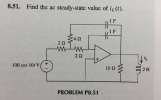 8.51. Find the ac steady-state value of iL(t) 4 S2 2 52 22 100 cos 10t V 10 S2 2 H PROBLEM P8.51 00 T
8.51. Find the ac steady-state value of iL(t) 4 S2 2 52 22 100 cos 10t V 10 S2 2 H PROBLEM P8.51 00 T
8.51. Find the ac steady-state value of iL(t) 4 S2 2 52 22 100 cos 10t V 10 S2 2 H PROBLEM P8.51 00 T
Q. Find and plot the CTFT of the following signal (without using any computer simulation) x(t)cos(2t)...
 Q. Find and plot the CTFT of the following signal (without using any computer simulation) x(t)cos(2t) rect (t) Explain and provide details of the steps.
CLOSED OPEN Page 2 > of 6 ☺ Question 1: (a). The voltage vs(t)= 10 cos(10t...
 CLOSED OPEN Page 2 > of 6 ☺ Question 1: (a). The voltage vs(t)= 10 cos(10t +30°)V is applied to the inverting op amp as shown below. Using phasor, find (i) volt) 100 KS 2 (ii) v(t) 100 k92 20 k 2 M (iii) Zo (impedance) volt) Vs 20 k2 100 uFv 27 Zo 0 - FS 0 + F O FE F7 Home F8 BR F12 F10 F11 $ C ) % 5 * 00 3 - 7 9...
Its related to MATLAB Generate a continuous-time signal z(t)-cos(2π 10t + 5) + cos(2π30t + 5). You may use the part of...
 Its related to MATLAB
Generate a continuous-time signal z(t)-cos(2π 10t + 5) + cos(2π30t + 5). You may use the part of the followings. a >>t0:0.001:1; >plot (t, x_t) b. Generate a discrete-time signal x[n] = (1/4)(u[n]-u[n-4). You may use the part of the followings >>a_n-ones (1, 4) s> b_nzeros (1, 7) >> stem(n, x n)
Generate a continuous-time signal z(t)-cos(2π 10t + 5) + cos(2π30t + 5). You may use the part of the followings. a >>t0:0.001:1; >plot (t,...
Its related to MATLAB
Generate a continuous-time signal z(t)-cos(2π 10t + 5) + cos(2π30t + 5). You may use the part of the followings. a >>t0:0.001:1; >plot (t, x_t) b. Generate a discrete-time signal x[n] = (1/4)(u[n]-u[n-4). You may use the part of the followings >>a_n-ones (1, 4) s> b_nzeros (1, 7) >> stem(n, x n)
Generate a continuous-time signal z(t)-cos(2π 10t + 5) + cos(2π30t + 5). You may use the part of the followings. a >>t0:0.001:1; >plot (t,...
2. Find the CTFT for the following PERIODIC signals: a. xdt) = sin(2t + π/4)) b....
 2. Find the CTFT for the following PERIODIC signals: a. xdt) = sin(2t + π/4)) b. Xb(t) = 2 + cos(2π/3 t) + 4sin(5π/3 t)
2. A dragon is flying around in a pattern given by the parametric curve r(t) (cos(t) cos((sin(t) sin(t) cos(t)j. cos(t) - cos sin(t)-sin(t) cos(t))j (a) Find a formula for the velocity of the dragon...
 2. A dragon is flying around in a pattern given by the parametric curve r(t) (cos(t) cos((sin(t) sin(t) cos(t)j. cos(t) - cos sin(t)-sin(t) cos(t))j (a) Find a formula for the velocity of the dragon at time t (b) Find all the times at which the dragon's speed is zero. Explain your reasoning. c) Does the path of the dragon contain any cusps? Explain your reasoning
2. A dragon is flying around in a pattern given by the parametric curve r(t)...
2. A dragon is flying around in a pattern given by the parametric curve r(t) (cos(t) cos((sin(t) sin(t) cos(t)j. cos(t) - cos sin(t)-sin(t) cos(t))j (a) Find a formula for the velocity of the dragon at time t (b) Find all the times at which the dragon's speed is zero. Explain your reasoning. c) Does the path of the dragon contain any cusps? Explain your reasoning
2. A dragon is flying around in a pattern given by the parametric curve r(t)...
Consider the Fourier Series for the periodic function: x(t) = 4+ 4 cos(5t)+ 6 sin (10t)...
Consider the Fourier Series for the periodic function: x(t) = 4+ 4 cos(5t)+ 6 sin (10t) a.) Find the Fourier coefficients of the exponential form. b.) Find the Fourier Coefficients of the combined trigonometric form. c.) Sketch the one-sided power spectral density
 1. Find the CTFT of the following signals 0 otherwise cos(40rt) sin(10Tt = e-10t (b) x(t) = ) ( c) x(t) u(t) + e10ta(-t + 1)
 Given a sinusoid signal u(t)=-5 cos(10t+30°) Find (a) peak value (6) RRMS value (c) average- absolute (AA) value (d) integral square value (e) integral absolute value
 8.51. Find the ac steady-state value of iL(t) 4 S2 2 52 22 100 cos 10t V 10 S2 2 H PROBLEM P8.51 00 T
8.51. Find the ac steady-state value of iL(t) 4 S2 2 52 22 100 cos 10t V 10 S2 2 H PROBLEM P8.51 00 T
8.51. Find the ac steady-state value of iL(t) 4 S2 2 52 22 100 cos 10t V 10 S2 2 H PROBLEM P8.51 00 T
 Q. Find and plot the CTFT of the following signal (without using any computer simulation) x(t)cos(2t) rect (t) Explain and provide details of the steps.
 CLOSED OPEN Page 2 > of 6 ☺ Question 1: (a). The voltage vs(t)= 10 cos(10t +30°)V is applied to the inverting op amp as shown below. Using phasor, find (i) volt) 100 KS 2 (ii) v(t) 100 k92 20 k 2 M (iii) Zo (impedance) volt) Vs 20 k2 100 uFv 27 Zo 0 - FS 0 + F O FE F7 Home F8 BR F12 F10 F11 $ C ) % 5 * 00 3 - 7 9...
 Its related to MATLAB
Generate a continuous-time signal z(t)-cos(2π 10t + 5) + cos(2π30t + 5). You may use the part of the followings. a >>t0:0.001:1; >plot (t, x_t) b. Generate a discrete-time signal x[n] = (1/4)(u[n]-u[n-4). You may use the part of the followings >>a_n-ones (1, 4) s> b_nzeros (1, 7) >> stem(n, x n)
Generate a continuous-time signal z(t)-cos(2π 10t + 5) + cos(2π30t + 5). You may use the part of the followings. a >>t0:0.001:1; >plot (t,...
Its related to MATLAB
Generate a continuous-time signal z(t)-cos(2π 10t + 5) + cos(2π30t + 5). You may use the part of the followings. a >>t0:0.001:1; >plot (t, x_t) b. Generate a discrete-time signal x[n] = (1/4)(u[n]-u[n-4). You may use the part of the followings >>a_n-ones (1, 4) s> b_nzeros (1, 7) >> stem(n, x n)
Generate a continuous-time signal z(t)-cos(2π 10t + 5) + cos(2π30t + 5). You may use the part of the followings. a >>t0:0.001:1; >plot (t,...
 2. Find the CTFT for the following PERIODIC signals: a. xdt) = sin(2t + π/4)) b. Xb(t) = 2 + cos(2π/3 t) + 4sin(5π/3 t)
 2. A dragon is flying around in a pattern given by the parametric curve r(t) (cos(t) cos((sin(t) sin(t) cos(t)j. cos(t) - cos sin(t)-sin(t) cos(t))j (a) Find a formula for the velocity of the dragon at time t (b) Find all the times at which the dragon's speed is zero. Explain your reasoning. c) Does the path of the dragon contain any cusps? Explain your reasoning
2. A dragon is flying around in a pattern given by the parametric curve r(t)...
2. A dragon is flying around in a pattern given by the parametric curve r(t) (cos(t) cos((sin(t) sin(t) cos(t)j. cos(t) - cos sin(t)-sin(t) cos(t))j (a) Find a formula for the velocity of the dragon at time t (b) Find all the times at which the dragon's speed is zero. Explain your reasoning. c) Does the path of the dragon contain any cusps? Explain your reasoning
2. A dragon is flying around in a pattern given by the parametric curve r(t)...
Most questions answered within 3 hours.
-
Where is the error in this code sequence?
String s1 = "Hello";
String s2 = "ello";...
asked 11 months ago -
Financial data for Joel de Paris, Inc., for last year
follow:
Joel de Paris, Inc.
Balance...
asked 11 months ago -
Consider this reaction:
Al2(SO4)3 (aq)+ BaCl3
(aq) Al2Cl6 (aq)- +
3BaSO4(s) . What is the...
asked 11 months ago -
Suppose that Savneet is considering increasing her
recent random sample from 20 car rentals to 40...
asked 11 months ago -
Trucks arrive at an unloading terminal at an average rate of 120
per hour.
Trucks arrive...
asked 11 months ago -
Why are methanol and ethanol completely soluble in water while
octanol is not very little soluble....
asked 11 months ago -
A facilities manager at a university reads in a research report
that the mean amount of...
asked 11 months ago -
When the CuSO4 is rehydrated by adding water to the anhydrous
compound, is this an endothermic...
asked 11 months ago -
A ray of sunlight is passing from diamond into crown glass; the
angle of incidence is...
asked 11 months ago -
A block of mass 0.249 kg is placed on top of a light, vertical
spring of...
asked 11 months ago -
how do the kidneys compensate in the presences of acidosis
a) trigger hyperventilate
b) reserve acid...
asked 11 months ago -
Question 501 pts
The rental rate of capital to the firm increases. Which of the
following...
asked 11 months ago