
Homework Answers
Add Answer to:
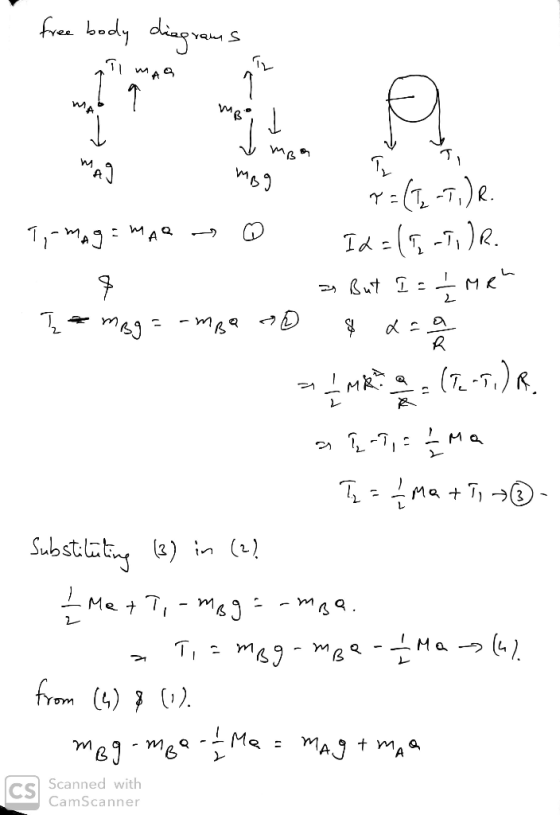
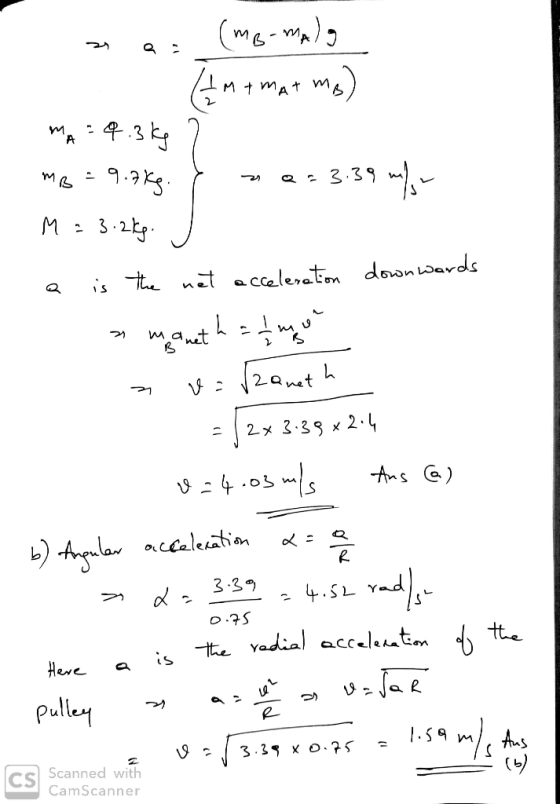
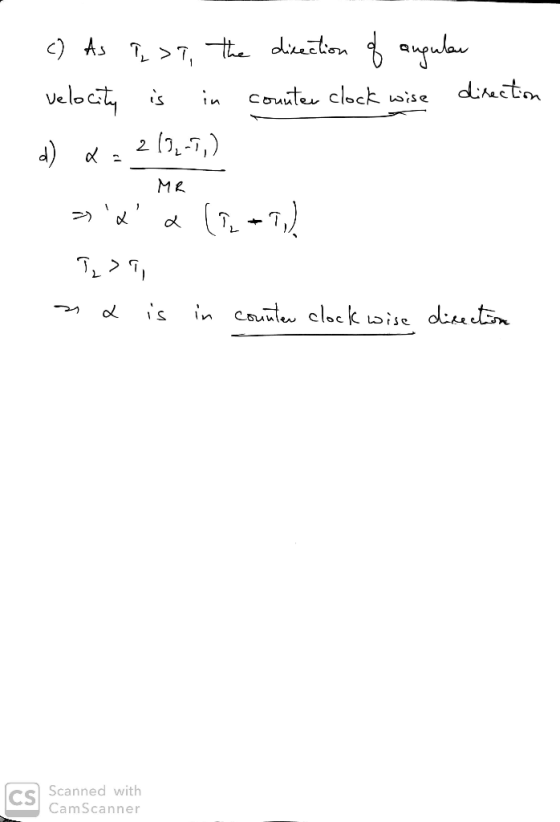
3. An Atwood machine consists of two masses, mA 4.3 kg and mB 9.7 kg, connected...
An Atwood machine consists of two masses, mA= 63 kg and mB = 71 kg ,...
An Atwood machine consists of two masses, mA= 63 kg and mB = 71 kg , connected by a massless inelastic cord that passes over a pulley free to rotate (Figure 1). The pulley is a solid cylinder of radius R = 0.40 mm and mass 5.0 kg. [Hint: The tensions FTA and FTB are not equal.] Acceleration of each mass is 0.57 m/s2 What % error would be made if the moment of inertia of the pulley is ignored?...
Two masses, mA = 34.0 kg and mB = 40.0 kg , are connected by a...
 Two masses, mA = 34.0 kg and mB = 40.0 kg , are connected by a
rope that hangs over a pulley (as in the figure (Figure 1)). The
center of the pulley is hollowed out so that you may assume all the
mass of the pulley is in the rim. The radius of the pulley is 0.381
m and the mass of the pulley is 3.10 kg . Initially mA is on the
ground and mB rests 2.50 m...
Two masses, mA = 34.0 kg and mB = 40.0 kg , are connected by a
rope that hangs over a pulley (as in the figure (Figure 1)). The
center of the pulley is hollowed out so that you may assume all the
mass of the pulley is in the rim. The radius of the pulley is 0.381
m and the mass of the pulley is 3.10 kg . Initially mA is on the
ground and mB rests 2.50 m...
An Atwood machine consists of two masses M_{a} = 7.0 kg and M_{b} = 8.2 kg,...
An Atwood machine consists of two masses M_{a} = 7.0 kg and M_{b} = 8.2 kg, connected by a cord that passes over a pulley free to rotate about a fixed axis. The pulley is a solid cylinder of radius R_{0} = 0.40 m and mass M = 0.80 kg. The moment of inertia of the pulley with respect to an axis around which the pulley is rotating in this problem is I = M R_{0}^{2}/2 Find the acceleration (magnitude...
Two masses, Ma= 35.0kg and Mb = 40.0 kg, are connected by a rope that hangs...
 Two masses, Ma= 35.0kg and Mb =
40.0 kg, are connected by a rope that hangs over a pulley (as in
the figure ). The pulley is a uniform cylinder of radius 0.381m and
mass 3.4kg . Initially Ma is on the ground and Mb rests 2.3m above
the ground.
If the system is released, use conservation of energy to determine
the speed of just before it strikes the ground. Assume the pulley
bearing is frictionless.
Two masses, Ma= 35.0kg and Mb =
40.0 kg, are connected by a rope that hangs over a pulley (as in
the figure ). The pulley is a uniform cylinder of radius 0.381m and
mass 3.4kg . Initially Ma is on the ground and Mb rests 2.3m above
the ground.
If the system is released, use conservation of energy to determine
the speed of just before it strikes the ground. Assume the pulley
bearing is frictionless.
4. A simple Atwood machine consists of two masses m1 and m2 that are connected by...
 4. A simple Atwood machine consists of two masses
m1 and m2 that are
connected by a string wound over a pulley, as seen in the figure
below. Assume m2 is larger than
m1. Motion in the upward direction is positive.
On a piece of paper, draw two free body diagrams; one for each of
the masses, showing all forces acting on each mass. Then answer the
following questions.
Suppose that m2 starts from rest at a height
of 7...
4. A simple Atwood machine consists of two masses
m1 and m2 that are
connected by a string wound over a pulley, as seen in the figure
below. Assume m2 is larger than
m1. Motion in the upward direction is positive.
On a piece of paper, draw two free body diagrams; one for each of
the masses, showing all forces acting on each mass. Then answer the
following questions.
Suppose that m2 starts from rest at a height
of 7...
An Atwood machine consists of a mass of 3.5 kg connected by a light string to...
An Atwood machine consists of a mass of 3.5 kg connected by a light string to a mass of 6.0 kg over a frictionless pulley with a moment of inertia of 0.0352 kg ∙ m2 and a radius of 12.5 cm. If the system is released from rest, what is the speed of the masses after they have moved through 1.25 m if the string does not slip on the pulley? Please note: the professor has told us that the...
Two masses, mA = 29.0 kg and mg = 42.0 kg are connected by a rope...
 Two masses, mA = 29.0 kg and mg = 42.0 kg are connected by a rope that hangs over a pulley (as in the figure). The pulley is a uniform cylinder of radius R. 0.311 m and mass 3.4 kg. Initially, mis on the ground and mp rests 2.5 m above the ground. MA 25 m Part A If the system is now released, use conservation of energy to determine the speed of me just before it strikes the ground....
An Atwood machine consists of two masses connected by a light string of fixed length which...
 An Atwood machine consists of two masses connected by a light string of fixed length which is wrapped around a frictionless bar. One end of the string is connected to a 6 kg mass (mi), while the other end is connected to a 2 kg mass (m2). The 6 kg mass is 2.5 meters above the flat, horizontal floor, while the 2 kg mass starts at rest on the floor. 3. bar mi 2 m2 A) Calculate the speed of...
QUESTION 1 An Atwood Machine consists of two masses connected to a cord which is draped...
QUESTION 1 An Atwood Machine consists of two masses connected to a cord which is draped over a pulley. In our experiment, what will be true about the masses? Mass 1 will vary with Mass 2 held constant. Mass 1 will vary with Mass 2 held constant. The masses will have a constant sum. The masses will have a constant mass difference. 3 points QUESTION 2 You will get a value for acceleration for each trial from a LoggerPro...
The Atwood machine consists of two masses hanging from the ends of a rope that passes...
 The Atwood machine consists of two masses hanging from the ends of a rope that passes over a pulley. The pulley can be approximated by a uniform disk with mass m, = 5.53 kg and radius rp = 0.150 m. The hanging masses are m = 17.1 kg and mp = 12.1 kg. Calculate the magnitude of the masses' acceleration a and the tension in the left and right ends of the rope, T and Tr, respectively. m m/s2 a...
 Two masses, mA = 34.0 kg and mB = 40.0 kg , are connected by a
rope that hangs over a pulley (as in the figure (Figure 1)). The
center of the pulley is hollowed out so that you may assume all the
mass of the pulley is in the rim. The radius of the pulley is 0.381
m and the mass of the pulley is 3.10 kg . Initially mA is on the
ground and mB rests 2.50 m...
Two masses, mA = 34.0 kg and mB = 40.0 kg , are connected by a
rope that hangs over a pulley (as in the figure (Figure 1)). The
center of the pulley is hollowed out so that you may assume all the
mass of the pulley is in the rim. The radius of the pulley is 0.381
m and the mass of the pulley is 3.10 kg . Initially mA is on the
ground and mB rests 2.50 m...
 Two masses, Ma= 35.0kg and Mb =
40.0 kg, are connected by a rope that hangs over a pulley (as in
the figure ). The pulley is a uniform cylinder of radius 0.381m and
mass 3.4kg . Initially Ma is on the ground and Mb rests 2.3m above
the ground.
If the system is released, use conservation of energy to determine
the speed of just before it strikes the ground. Assume the pulley
bearing is frictionless.
Two masses, Ma= 35.0kg and Mb =
40.0 kg, are connected by a rope that hangs over a pulley (as in
the figure ). The pulley is a uniform cylinder of radius 0.381m and
mass 3.4kg . Initially Ma is on the ground and Mb rests 2.3m above
the ground.
If the system is released, use conservation of energy to determine
the speed of just before it strikes the ground. Assume the pulley
bearing is frictionless.
 4. A simple Atwood machine consists of two masses
m1 and m2 that are
connected by a string wound over a pulley, as seen in the figure
below. Assume m2 is larger than
m1. Motion in the upward direction is positive.
On a piece of paper, draw two free body diagrams; one for each of
the masses, showing all forces acting on each mass. Then answer the
following questions.
Suppose that m2 starts from rest at a height
of 7...
4. A simple Atwood machine consists of two masses
m1 and m2 that are
connected by a string wound over a pulley, as seen in the figure
below. Assume m2 is larger than
m1. Motion in the upward direction is positive.
On a piece of paper, draw two free body diagrams; one for each of
the masses, showing all forces acting on each mass. Then answer the
following questions.
Suppose that m2 starts from rest at a height
of 7...
 Two masses, mA = 29.0 kg and mg = 42.0 kg are connected by a rope that hangs over a pulley (as in the figure). The pulley is a uniform cylinder of radius R. 0.311 m and mass 3.4 kg. Initially, mis on the ground and mp rests 2.5 m above the ground. MA 25 m Part A If the system is now released, use conservation of energy to determine the speed of me just before it strikes the ground....
 An Atwood machine consists of two masses connected by a light string of fixed length which is wrapped around a frictionless bar. One end of the string is connected to a 6 kg mass (mi), while the other end is connected to a 2 kg mass (m2). The 6 kg mass is 2.5 meters above the flat, horizontal floor, while the 2 kg mass starts at rest on the floor. 3. bar mi 2 m2 A) Calculate the speed of...
 The Atwood machine consists of two masses hanging from the ends of a rope that passes over a pulley. The pulley can be approximated by a uniform disk with mass m, = 5.53 kg and radius rp = 0.150 m. The hanging masses are m = 17.1 kg and mp = 12.1 kg. Calculate the magnitude of the masses' acceleration a and the tension in the left and right ends of the rope, T and Tr, respectively. m m/s2 a...
Most questions answered within 3 hours.
-
Where is the error in this code sequence?
String s1 = "Hello";
String s2 = "ello";...
asked 11 months ago -
Financial data for Joel de Paris, Inc., for last year
follow:
Joel de Paris, Inc.
Balance...
asked 11 months ago -
Consider this reaction:
Al2(SO4)3 (aq)+ BaCl3
(aq) Al2Cl6 (aq)- +
3BaSO4(s) . What is the...
asked 11 months ago -
Suppose that Savneet is considering increasing her
recent random sample from 20 car rentals to 40...
asked 11 months ago -
Trucks arrive at an unloading terminal at an average rate of 120
per hour.
Trucks arrive...
asked 11 months ago -
Why are methanol and ethanol completely soluble in water while
octanol is not very little soluble....
asked 11 months ago -
A facilities manager at a university reads in a research report
that the mean amount of...
asked 11 months ago -
When the CuSO4 is rehydrated by adding water to the anhydrous
compound, is this an endothermic...
asked 11 months ago -
A ray of sunlight is passing from diamond into crown glass; the
angle of incidence is...
asked 11 months ago -
A block of mass 0.249 kg is placed on top of a light, vertical
spring of...
asked 11 months ago -
how do the kidneys compensate in the presences of acidosis
a) trigger hyperventilate
b) reserve acid...
asked 11 months ago -
Question 501 pts
The rental rate of capital to the firm increases. Which of the
following...
asked 11 months ago