
Homework Answers
Add Answer to:
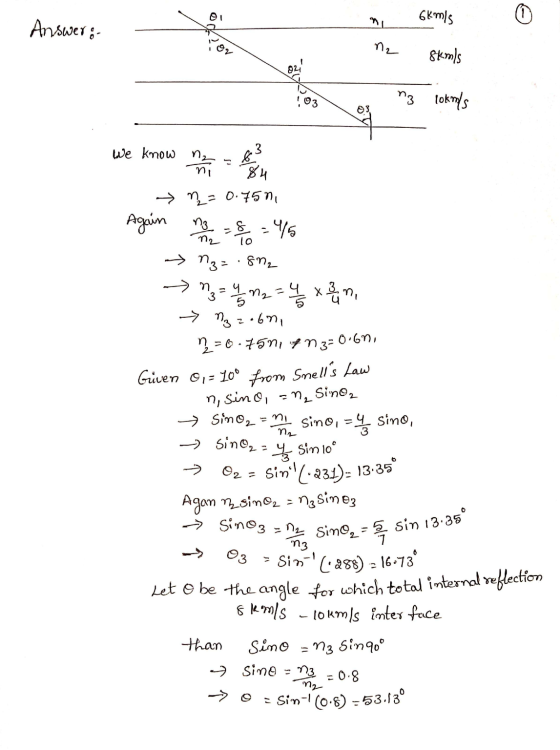
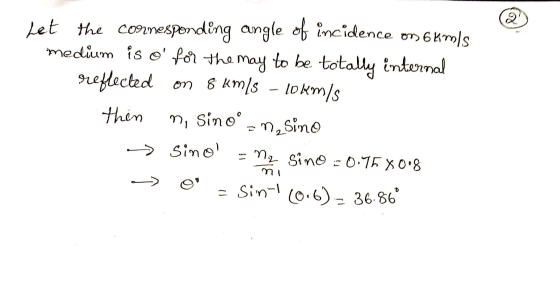
For a medium composed of upper, middle, and lower layers with velocities of 6, 8, and...
A light ray is travelling at 1.33 x 10⁸ m/s through a medium and hits the...
A light ray is travelling at 1.33 x 10⁸ m/s through a medium and hits the interface of a second medium. The critical angle for total internal reflection is 50 degrees for this case. If the mediums were switched, and light was traveling now from the second medium to the first medium (same two mediums, however), what would be the incident angle needed, in degrees, with the respect to the normal, if the refracted angle is 33 degrees?
A light ray is travelling at 2.21 x 10⁸ m/s through a medium and hits the...
A light ray is travelling at 2.21 x 10⁸ m/s through a medium and hits the interface of a second medium. The critical angle for total internal reflection is 54 degrees for this case. If the mediums were switched, and light was traveling now from the second medium to the first medium (same two mediums, however), what would be the incident angle needed, in degrees, with the respect to the normal, if the refracted angle is 32 degrees?
A light ray is travelling at 1.65 x 10⁸ m/s through a medium and hits the...
A light ray is travelling at 1.65 x 10⁸ m/s through a medium and hits the interface of a second medium. The critical angle for total internal reflection is 51 degrees for this case. If the mediums were switched, and light was traveling now from the second medium to the first medium (same two mediums, however), what would be the incident angle needed, in degrees, with the respect to the normal, if the refracted angle is 21 degrees?
2. At the Moho interface of the ocean crust, the velocities change as listed below. (a)...
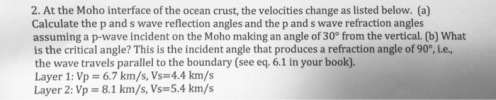 2. At the Moho interface of the ocean crust, the velocities change as listed below. (a) Calculate the p and s wave reflection angles and the p and s wave refraction angles assuming a p-wave incident on the Moho making an angle of 30° from the vertical. (b) What is the critical angle? This is the incident angle that produces a refraction angle of 90°, i.e., the wave travels parallel to the boundary (see eq. 6.1 in your book). Layer...
14) A glass prism with an index of refraction of 1.53 sits on a horizontal surface,...
 14) A glass prism with an index of refraction of 1.53 sits on a horizontal surface, as shown. A ray of light traveling horizontally, enters the prism on its vertical face, as shown. If the labeled angle is O= 470, then will there be total internal reflection when the light ray strikes the slanted face of the prism? Show your work IDENTIFY: Fill in the blanks with "vertical", "horizontal","zero" or "90". The normal to the vertical face of the prism...
3. The following figure shows light travelling from medium 1 to medium 2. Please draw the...
 3. The following figure shows light travelling from medium 1 to medium 2. Please draw the refracted ray for the following two cases: a. Medium 1 has a higher refractive index than medium 2 b. Medium 1 has a lower refractive index than medium 2 c. In which case is it possible to get total internal reflection? d. If the angle of incidence is 37°, the refractive indices of the two mediums are, n = 1.2 and n2 = 1.35,...
can you please answer these question Question 3 0/5 pts In the figure below, a light...
 can you please answer these question
Question 3 0/5 pts In the figure below, a light ray enters a glass slab (whose index of refraction, nglass = 1.594) at point A and then undergoes total internal reflection at point B. Find the initial angle of incidence, 0; in degrees, for which total internal reflection can take place. The medium that surrounds the glass slab is a liquid whose index of refraction, niquid= 1.291. Please round your answer to the nearest...
can you please answer these question
Question 3 0/5 pts In the figure below, a light ray enters a glass slab (whose index of refraction, nglass = 1.594) at point A and then undergoes total internal reflection at point B. Find the initial angle of incidence, 0; in degrees, for which total internal reflection can take place. The medium that surrounds the glass slab is a liquid whose index of refraction, niquid= 1.291. Please round your answer to the nearest...
water interface (the surface of the lake), it is partly reflected back into the air and...
 water interface (the surface of the lake), it is partly
reflected back into the air and partly refracted
or transmitted into the water. This explains why on the surface of
a lake sometimes you see the reflection of the surrounding
landscape and other times the underwater vegetation.
These effects on light propagation occur because light travels at
different speeds depending on the medium. The index of refraction
of a material, denoted by n, gives an indication of the speed of...
water interface (the surface of the lake), it is partly
reflected back into the air and partly refracted
or transmitted into the water. This explains why on the surface of
a lake sometimes you see the reflection of the surrounding
landscape and other times the underwater vegetation.
These effects on light propagation occur because light travels at
different speeds depending on the medium. The index of refraction
of a material, denoted by n, gives an indication of the speed of...
(a) A spectrum of colours has the following wavelengths: violet, 415 nm: blue, 475nm. green 517...
 (a) A spectrum of colours has the following wavelengths: violet, 415 nm: blue, 475nm. green 517 nm; yellow 575 mm; orange 620 nm; and red, 680 nm. Determine the frequencies of (i) green and (ii) red light (the speed of light = 3.00 x 10^8 m/s) (b) Calculate the energy of photons corresponding to (i) violet and (ii) orange light (Planck's constant is 6.63 x 10^-34 Js) (c) Ignoring curvature, calculate the angle of refraction for a light ray with...
must show all work and calculations. (10 pts) See Figure 6. A semicircular transparent disk is...
 must show all work and calculations.
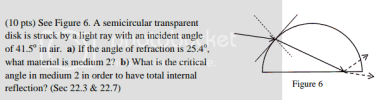
(10 pts) See Figure 6. A semicircular transparent disk is struck by a light ray with an incident angle of 41.50 in air. a) If the angle of refraction is 25.4° what material is medium 2? b) What is the critical angle in medium 2 in order to have total internal reflection? (Sec 22.3 & 22.7 Figure 6
must show all work and calculations.
(10 pts) See Figure 6. A semicircular transparent disk is struck by a light ray with an incident angle of 41.50 in air. a) If the angle of refraction is 25.4° what material is medium 2? b) What is the critical angle in medium 2 in order to have total internal reflection? (Sec 22.3 & 22.7 Figure 6
 2. At the Moho interface of the ocean crust, the velocities change as listed below. (a) Calculate the p and s wave reflection angles and the p and s wave refraction angles assuming a p-wave incident on the Moho making an angle of 30° from the vertical. (b) What is the critical angle? This is the incident angle that produces a refraction angle of 90°, i.e., the wave travels parallel to the boundary (see eq. 6.1 in your book). Layer...
 14) A glass prism with an index of refraction of 1.53 sits on a horizontal surface, as shown. A ray of light traveling horizontally, enters the prism on its vertical face, as shown. If the labeled angle is O= 470, then will there be total internal reflection when the light ray strikes the slanted face of the prism? Show your work IDENTIFY: Fill in the blanks with "vertical", "horizontal","zero" or "90". The normal to the vertical face of the prism...
 3. The following figure shows light travelling from medium 1 to medium 2. Please draw the refracted ray for the following two cases: a. Medium 1 has a higher refractive index than medium 2 b. Medium 1 has a lower refractive index than medium 2 c. In which case is it possible to get total internal reflection? d. If the angle of incidence is 37°, the refractive indices of the two mediums are, n = 1.2 and n2 = 1.35,...
 can you please answer these question
Question 3 0/5 pts In the figure below, a light ray enters a glass slab (whose index of refraction, nglass = 1.594) at point A and then undergoes total internal reflection at point B. Find the initial angle of incidence, 0; in degrees, for which total internal reflection can take place. The medium that surrounds the glass slab is a liquid whose index of refraction, niquid= 1.291. Please round your answer to the nearest...
can you please answer these question
Question 3 0/5 pts In the figure below, a light ray enters a glass slab (whose index of refraction, nglass = 1.594) at point A and then undergoes total internal reflection at point B. Find the initial angle of incidence, 0; in degrees, for which total internal reflection can take place. The medium that surrounds the glass slab is a liquid whose index of refraction, niquid= 1.291. Please round your answer to the nearest...
 water interface (the surface of the lake), it is partly
reflected back into the air and partly refracted
or transmitted into the water. This explains why on the surface of
a lake sometimes you see the reflection of the surrounding
landscape and other times the underwater vegetation.
These effects on light propagation occur because light travels at
different speeds depending on the medium. The index of refraction
of a material, denoted by n, gives an indication of the speed of...
water interface (the surface of the lake), it is partly
reflected back into the air and partly refracted
or transmitted into the water. This explains why on the surface of
a lake sometimes you see the reflection of the surrounding
landscape and other times the underwater vegetation.
These effects on light propagation occur because light travels at
different speeds depending on the medium. The index of refraction
of a material, denoted by n, gives an indication of the speed of...
 (a) A spectrum of colours has the following wavelengths: violet, 415 nm: blue, 475nm. green 517 nm; yellow 575 mm; orange 620 nm; and red, 680 nm. Determine the frequencies of (i) green and (ii) red light (the speed of light = 3.00 x 10^8 m/s) (b) Calculate the energy of photons corresponding to (i) violet and (ii) orange light (Planck's constant is 6.63 x 10^-34 Js) (c) Ignoring curvature, calculate the angle of refraction for a light ray with...
 must show all work and calculations.
(10 pts) See Figure 6. A semicircular transparent disk is struck by a light ray with an incident angle of 41.50 in air. a) If the angle of refraction is 25.4° what material is medium 2? b) What is the critical angle in medium 2 in order to have total internal reflection? (Sec 22.3 & 22.7 Figure 6
must show all work and calculations.
(10 pts) See Figure 6. A semicircular transparent disk is struck by a light ray with an incident angle of 41.50 in air. a) If the angle of refraction is 25.4° what material is medium 2? b) What is the critical angle in medium 2 in order to have total internal reflection? (Sec 22.3 & 22.7 Figure 6
Most questions answered within 3 hours.
-
Where is the error in this code sequence?
String s1 = "Hello";
String s2 = "ello";...
asked 10 months ago -
Financial data for Joel de Paris, Inc., for last year
follow:
Joel de Paris, Inc.
Balance...
asked 10 months ago -
Consider this reaction:
Al2(SO4)3 (aq)+ BaCl3
(aq) Al2Cl6 (aq)- +
3BaSO4(s) . What is the...
asked 10 months ago -
Suppose that Savneet is considering increasing her
recent random sample from 20 car rentals to 40...
asked 10 months ago -
Trucks arrive at an unloading terminal at an average rate of 120
per hour.
Trucks arrive...
asked 10 months ago -
Why are methanol and ethanol completely soluble in water while
octanol is not very little soluble....
asked 10 months ago -
A facilities manager at a university reads in a research report
that the mean amount of...
asked 10 months ago -
When the CuSO4 is rehydrated by adding water to the anhydrous
compound, is this an endothermic...
asked 10 months ago -
A ray of sunlight is passing from diamond into crown glass; the
angle of incidence is...
asked 10 months ago -
A block of mass 0.249 kg is placed on top of a light, vertical
spring of...
asked 10 months ago -
how do the kidneys compensate in the presences of acidosis
a) trigger hyperventilate
b) reserve acid...
asked 10 months ago -
Question 501 pts
The rental rate of capital to the firm increases. Which of the
following...
asked 10 months ago