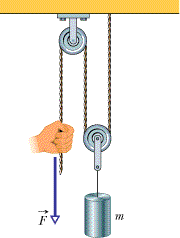
In the figure, a cord runs around two massless, frictionless pulleys. A canister with mass m = 42 kg hangs from one pulley, and you exert a force F on the free end of the cord. (a) What must be the magnitude of F if you are to lift the canister at a constant speed? (b) To lift the canister by 4.0 cm, how far must you pull the free end of the cord? During that lift, what is the work done on the canister by (c) your force (via the cord) and (d) the gravitational force? (Hint: When a cord loops around a pulley as shown, it pulls on the pulley with a net force that is twice the tension in the cord.)
Homework Answers

Add Answer to:
In the figure, a cord runs around two massless, frictionless
pulleys. A canister with mass m...
if you In the figurecord runs around two mosless, frictionless puleys. A canister with mau m...
 if you In the figurecord runs around two mosless, frictionless puleys. A canister with mau m = 17 kg hangs from one outley, and you exert a force on the free end of the cord. (a) what must be the magnitude of are to in the canister at a constant speed? (6) To the canister by 1.7 cm, how for must you pull the free end of the cord? During that it, what is the work done on the canister...
The fiqure shows a man sitting in a bosun's chair that dangles from a massless rope, which runs over a massless, fr...
 The fiqure shows a man sitting in a bosun's chair that dangles from a massless rope, which runs over a massless, frictionless pulley and back down to the man's hand. The combined mass of man and chair is 78.4 kg. With what force magnitude must the man pull on the rope if he is to rise (a) with a constant velocity and (b) with an upward acceleration of 1.42 m/s2? (Hint: A free-body diagram can really help.) Problem continues below...
To start her lawn mower, Julie pulls on a cord that is wrapped around a pulley....
To start her lawn mower, Julie pulls on a cord that is wrapped around a pulley. The pulley has a moment of inertia about its central axis of I = 0.520kg?m2 and a radius of 6.00cm . There is an equivalent frictional torque impeding her pull of ?f = 0.410m?N . A. To accelerate the pulley at ? = 4.70rad/s2 , how much torque does Julie need to apply to the pulley? B. How much tension must the rope exert?
An object with the mass m= 2.0 kg hangs from a cord around a light pulley....
An object with the mass m= 2.0 kg hangs from a cord around a light pulley. The length of the cord between point P and the pulley is L= 2.0 m (Ignore the mass of the vertical section of the cord) a) When the vibrator is set to a frequency of 160 Hz, a standing wave with six loops is formed. What must be the linear mass density of the cord in kg/m? b) How many loops (if any) will...
A small block of mass m2 hangs from a massless rope wrapped around the inner cylinder...
A small block of mass m2 hangs from a massless rope wrapped around the inner cylinder of a pulley with inner radius of R2. The moment of inertia of the entire pulley is I = 4m2(R2)2. Another block m1= m2 is connected to the outer cylinder of the pulley via a horizontal massless rope wrapped around the outer cylinder of the pulley with radius R1=2R2. The coefficient of kinetic friction between the block and the horizontal surface is μk =...
In the arrangement shown in the figure below, an object of mass m = 2.0 kg...
 In the arrangement shown in the figure below, an object of mass
m = 2.0 kg hangs from a cord around a light pulley. The length of
the cord between point P and the pulley is L = 2.0 m. (Ignore the
mass of the vertical section of the cord.)
(a) When the vibrator is set to a frequency of 140 Hz, a
standing wave with six loops is formed. What must be the linear
mass density of the cord?...
In the arrangement shown in the figure below, an object of mass
m = 2.0 kg hangs from a cord around a light pulley. The length of
the cord between point P and the pulley is L = 2.0 m. (Ignore the
mass of the vertical section of the cord.)
(a) When the vibrator is set to a frequency of 140 Hz, a
standing wave with six loops is formed. What must be the linear
mass density of the cord?...
1.A block of mass m = 5.00 kg is pulled along a horizontal frictionless floor by...
1.A block of mass m = 5.00 kg is pulled along a horizontal frictionless floor by a cord that exerts a force of magnitude F = 12.0 N at an angle θ = 25o . (a) Draw the free body diagram of the block. (b) Find the normal force. 2.Two crates are at rest on frictionless horizontal surface. Both crates are connected by a light rope. A woman wearing golf shoes (so she can get traction on the ice) pulls...
The figure shows a man sitting in a bosun's chair that dangles from a massless rope,...
 The figure shows a man sitting in a bosun's chair that dangles
from a massless rope, which runs over a massless, frictionless
pulley and back down to the man's hand. The combined mass of man
and chair is 83.1 kg. With what force magnitude must the man pull
on the rope if he is to rise (a) with a constant
velocity and (b) with an upward acceleration of
1.27 m/s2? (Hint: A free-body diagram can really help.) Problem
continues below....
The figure shows a man sitting in a bosun's chair that dangles
from a massless rope, which runs over a massless, frictionless
pulley and back down to the man's hand. The combined mass of man
and chair is 83.1 kg. With what force magnitude must the man pull
on the rope if he is to rise (a) with a constant
velocity and (b) with an upward acceleration of
1.27 m/s2? (Hint: A free-body diagram can really help.) Problem
continues below....
The figure shows a man sitting in a bosun's chair that dangles from a massless rope,...
The figure shows a man sitting in a bosun's chair that dangles from a massless rope, which runs over a massless, frictionless pulley and back down to the man's hand. The combined mass of man and chair is 66.7 kg. With what force magnitude must the man pull on the rope if he is to rise (a) with a constant velocity and (b) with an upward acceleration of 1.34 m/s2? (Hint: A free-body diagram can really help.) Problem continues below....
 if you In the figurecord runs around two mosless, frictionless puleys. A canister with mau m = 17 kg hangs from one outley, and you exert a force on the free end of the cord. (a) what must be the magnitude of are to in the canister at a constant speed? (6) To the canister by 1.7 cm, how for must you pull the free end of the cord? During that it, what is the work done on the canister...
 The fiqure shows a man sitting in a bosun's chair that dangles from a massless rope, which runs over a massless, frictionless pulley and back down to the man's hand. The combined mass of man and chair is 78.4 kg. With what force magnitude must the man pull on the rope if he is to rise (a) with a constant velocity and (b) with an upward acceleration of 1.42 m/s2? (Hint: A free-body diagram can really help.) Problem continues below...
 In the arrangement shown in the figure below, an object of mass
m = 2.0 kg hangs from a cord around a light pulley. The length of
the cord between point P and the pulley is L = 2.0 m. (Ignore the
mass of the vertical section of the cord.)
(a) When the vibrator is set to a frequency of 140 Hz, a
standing wave with six loops is formed. What must be the linear
mass density of the cord?...
In the arrangement shown in the figure below, an object of mass
m = 2.0 kg hangs from a cord around a light pulley. The length of
the cord between point P and the pulley is L = 2.0 m. (Ignore the
mass of the vertical section of the cord.)
(a) When the vibrator is set to a frequency of 140 Hz, a
standing wave with six loops is formed. What must be the linear
mass density of the cord?...
 The figure shows a man sitting in a bosun's chair that dangles
from a massless rope, which runs over a massless, frictionless
pulley and back down to the man's hand. The combined mass of man
and chair is 83.1 kg. With what force magnitude must the man pull
on the rope if he is to rise (a) with a constant
velocity and (b) with an upward acceleration of
1.27 m/s2? (Hint: A free-body diagram can really help.) Problem
continues below....
The figure shows a man sitting in a bosun's chair that dangles
from a massless rope, which runs over a massless, frictionless
pulley and back down to the man's hand. The combined mass of man
and chair is 83.1 kg. With what force magnitude must the man pull
on the rope if he is to rise (a) with a constant
velocity and (b) with an upward acceleration of
1.27 m/s2? (Hint: A free-body diagram can really help.) Problem
continues below....
Most questions answered within 3 hours.
-
Where is the error in this code sequence?
String s1 = "Hello";
String s2 = "ello";...
asked 10 months ago -
Financial data for Joel de Paris, Inc., for last year
follow:
Joel de Paris, Inc.
Balance...
asked 10 months ago -
Consider this reaction:
Al2(SO4)3 (aq)+ BaCl3
(aq) Al2Cl6 (aq)- +
3BaSO4(s) . What is the...
asked 10 months ago -
Suppose that Savneet is considering increasing her
recent random sample from 20 car rentals to 40...
asked 10 months ago -
Trucks arrive at an unloading terminal at an average rate of 120
per hour.
Trucks arrive...
asked 10 months ago -
Why are methanol and ethanol completely soluble in water while
octanol is not very little soluble....
asked 10 months ago -
A facilities manager at a university reads in a research report
that the mean amount of...
asked 10 months ago -
When the CuSO4 is rehydrated by adding water to the anhydrous
compound, is this an endothermic...
asked 10 months ago -
A ray of sunlight is passing from diamond into crown glass; the
angle of incidence is...
asked 10 months ago -
A block of mass 0.249 kg is placed on top of a light, vertical
spring of...
asked 10 months ago -
how do the kidneys compensate in the presences of acidosis
a) trigger hyperventilate
b) reserve acid...
asked 10 months ago -
Question 501 pts
The rental rate of capital to the firm increases. Which of the
following...
asked 10 months ago