

Homework Answers

Add Answer to:
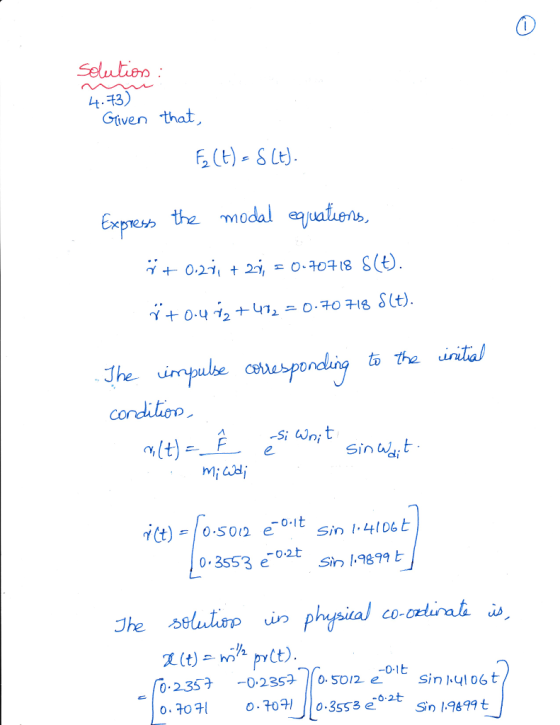
4.73. Calculate the response of the system of Figure P4.73 discussed in Example 4.6.1if (1) =...
14. There is a two-degree-of-freedom system with no external force as shown in Figure 4. Here,...
 14. There is a two-degree-of-freedom system with no external force as shown in Figure 4. Here, kı=kz=k=10kN/m, ka=ks=2kN/m and m:=m2=2kg, answer the following. (25 points) 14-1. Find the equation of motion in matrix-vector form. 14-2. Find the natural frequencies W1, W2 (rad/sec) through the eigenvalue problem. 14-3. Find the eigenvectors corresponding to the eigenfrequencies through the eigenvalue problem, except that the first element is 1. X + ke ki 111; W ke Figure 4. Two degree of freedom model
Test Consider a two-degrees-of-freedom system shown below. ド. PN What is the amplitude of vibration (particular solution only) of mass 2 (at the input frequency)? The answer must be positive. Ke...
 Test Consider a two-degrees-of-freedom system shown below. ド. PN What is the amplitude of vibration (particular solution only) of mass 2 (at the input frequency)? The answer must be positive. Keep 3 significant figures, and omit units. Use m1 2 kg m2 4 kg k1 147 N/m k2 146 N/m K3 192 N/m F1 # 411 cos(0.50 N Note that the system is not damped. The homogeneous response does not decay to zero. The masses vibrates at three different frequencies...
1. Use the MATLAB command freqz to calculate the DTFT of System 1, to find its frequency response...
 1. Use the MATLAB command freqz to calculate the DTFT of System 1, to find its frequency response 0.25r[n] + 0.25r|n -2]. H(). For this exercise, System 1 has a different difference equation yn] Find H1 (w) for- aK π, with frequency steps of Δα-π/100. 2. Plot both the magnitude |H1(2)| and the phase LH1(w) vs w, for-π < ώ < π. Use abs and angle commands to obtain magnitude and phase. Label and title both plots and include in...
Figure 1 shows a basic model of an automobile, travelling over horizontal road. The car has...
 Figure 1 shows a basic model of an automobile, travelling over horizontal road. The car has a mass M, and a mass moment of inertia Jo= Ma(measured with respect to the center of gravity (c.g)). The vertical displacement of the center of gravity is e(t), and the rotation is e(t) (measured with respect to the position of static equilibrium). The total stiffness at the front wheels is equal to ki and the total stiffness at the rear wheels is ke....
Problem 51: (25 points) Figure 5 is an example of a feedback control system that is designed to r...
 Problem 51: (25 points) Figure 5 is an example of a feedback control system that is designed to regulate the angular position θ(t) of a motor shaft to a desired value θr(t). The signal e(t) represents the error between the measured shaft angle θ(t) and the desired shaft angle θ (t). The Laplace transforms ofa,(t), θ(t), and e(t) are denoted as ΘR(s), θ(s), and E(s), respectively. The control gains Ki and K2 are chosen by the control engineer to achieve...
control system System Description: The figure 1 and 2 below show, respectively, components and block diagram...
 control system
System Description: The figure 1 and 2 below show, respectively, components and block diagram of a motor and the measurements of velocity (via the tacho unit) and position (via the potentiometer). n represents the gearbox ratio between the rotating shaft and the output shaft. The left-hand side of the diagram represents the controller. A reference set point for the rotating shaft is entered in degrees and this is equivalent voltage. The error is calculated by subtracting the measured...
control system
System Description: The figure 1 and 2 below show, respectively, components and block diagram of a motor and the measurements of velocity (via the tacho unit) and position (via the potentiometer). n represents the gearbox ratio between the rotating shaft and the output shaft. The left-hand side of the diagram represents the controller. A reference set point for the rotating shaft is entered in degrees and this is equivalent voltage. The error is calculated by subtracting the measured...
Homework 7: Undamped, 2-DOF System 1. A system with two masses of which the origins are...
 Homework 7: Undamped, 2-DOF System 1. A system with two masses of which the origins are at the SEPs is shown in Figure 1. The mass of m2 is acted by the external force of f(t). Assume that the cable between the two springs, k2 and k3 is not stretchable. Solve the following problems (a) Draw free-body diagrams for the two masses and derive their EOMs (b) Represent the EOMs in a matrix fornm (c) Find the undamped, natural frequencies...
M1 m2 Figure 1: 2dof 1. Consider the system above. Derive the equation of motion and calculate th...
 m1 m2 Figure 1: 2dof 1. Consider the system above. Derive the equation of motion and calculate the mass and stiffness matrices Note that setting k30 in your solution should result in the stiffness matrix given by Eq. (4.9). a. Calculate the characteristic equation from problem 4.1 for the case m1-9 kg m2-1 kg ki-24 N/m 2 3 N/m k 3 N/m and solve for the system's natural frequencies. b. Calculate the eigenvectors u1 and u2. c. Calculate 띠(t) and...
Problem #1 A truck suspension system including tire model is shown in the figure. A load...
 Problem #1 A truck suspension system including tire model is shown in the figure. A load added to a truck results in a force F on the support spring, and the tire flexes. The truck vehicle mass is my and the tire mass is mt. Assume that the gravity is neglected. (a) Determine the two independent equations of motion. (b) Obtain the equations of motion in terms of Laplace transform, assuming that the initial conditions are zero. (c) Obtain the...
Additional Prob. 1: Consider a two-mass quarter-car model of a suspension system as shown in figure....
 Additional Prob. 1: Consider a two-mass quarter-car model of a suspension system as shown in figure. The system properties are: m1 = 240 kg, m2 = 36 kg, k1 = 1.6 x 10⁴ N/m, k2 = 1.6 x 10⁵ N/m, C1 = 98 N-s/m a. Find equations of motion for the system. c. If y(t) is a unit step function, find the responses X1 and x between 0-10 s using Simulink. m m,
 14. There is a two-degree-of-freedom system with no external force as shown in Figure 4. Here, kı=kz=k=10kN/m, ka=ks=2kN/m and m:=m2=2kg, answer the following. (25 points) 14-1. Find the equation of motion in matrix-vector form. 14-2. Find the natural frequencies W1, W2 (rad/sec) through the eigenvalue problem. 14-3. Find the eigenvectors corresponding to the eigenfrequencies through the eigenvalue problem, except that the first element is 1. X + ke ki 111; W ke Figure 4. Two degree of freedom model
 Test Consider a two-degrees-of-freedom system shown below. ド. PN What is the amplitude of vibration (particular solution only) of mass 2 (at the input frequency)? The answer must be positive. Keep 3 significant figures, and omit units. Use m1 2 kg m2 4 kg k1 147 N/m k2 146 N/m K3 192 N/m F1 # 411 cos(0.50 N Note that the system is not damped. The homogeneous response does not decay to zero. The masses vibrates at three different frequencies...
 1. Use the MATLAB command freqz to calculate the DTFT of System 1, to find its frequency response 0.25r[n] + 0.25r|n -2]. H(). For this exercise, System 1 has a different difference equation yn] Find H1 (w) for- aK π, with frequency steps of Δα-π/100. 2. Plot both the magnitude |H1(2)| and the phase LH1(w) vs w, for-π < ώ < π. Use abs and angle commands to obtain magnitude and phase. Label and title both plots and include in...
 Figure 1 shows a basic model of an automobile, travelling over horizontal road. The car has a mass M, and a mass moment of inertia Jo= Ma(measured with respect to the center of gravity (c.g)). The vertical displacement of the center of gravity is e(t), and the rotation is e(t) (measured with respect to the position of static equilibrium). The total stiffness at the front wheels is equal to ki and the total stiffness at the rear wheels is ke....
 Problem 51: (25 points) Figure 5 is an example of a feedback control system that is designed to regulate the angular position θ(t) of a motor shaft to a desired value θr(t). The signal e(t) represents the error between the measured shaft angle θ(t) and the desired shaft angle θ (t). The Laplace transforms ofa,(t), θ(t), and e(t) are denoted as ΘR(s), θ(s), and E(s), respectively. The control gains Ki and K2 are chosen by the control engineer to achieve...
 control system
System Description: The figure 1 and 2 below show, respectively, components and block diagram of a motor and the measurements of velocity (via the tacho unit) and position (via the potentiometer). n represents the gearbox ratio between the rotating shaft and the output shaft. The left-hand side of the diagram represents the controller. A reference set point for the rotating shaft is entered in degrees and this is equivalent voltage. The error is calculated by subtracting the measured...
control system
System Description: The figure 1 and 2 below show, respectively, components and block diagram of a motor and the measurements of velocity (via the tacho unit) and position (via the potentiometer). n represents the gearbox ratio between the rotating shaft and the output shaft. The left-hand side of the diagram represents the controller. A reference set point for the rotating shaft is entered in degrees and this is equivalent voltage. The error is calculated by subtracting the measured...
 Homework 7: Undamped, 2-DOF System 1. A system with two masses of which the origins are at the SEPs is shown in Figure 1. The mass of m2 is acted by the external force of f(t). Assume that the cable between the two springs, k2 and k3 is not stretchable. Solve the following problems (a) Draw free-body diagrams for the two masses and derive their EOMs (b) Represent the EOMs in a matrix fornm (c) Find the undamped, natural frequencies...
 m1 m2 Figure 1: 2dof 1. Consider the system above. Derive the equation of motion and calculate the mass and stiffness matrices Note that setting k30 in your solution should result in the stiffness matrix given by Eq. (4.9). a. Calculate the characteristic equation from problem 4.1 for the case m1-9 kg m2-1 kg ki-24 N/m 2 3 N/m k 3 N/m and solve for the system's natural frequencies. b. Calculate the eigenvectors u1 and u2. c. Calculate 띠(t) and...
 Problem #1 A truck suspension system including tire model is shown in the figure. A load added to a truck results in a force F on the support spring, and the tire flexes. The truck vehicle mass is my and the tire mass is mt. Assume that the gravity is neglected. (a) Determine the two independent equations of motion. (b) Obtain the equations of motion in terms of Laplace transform, assuming that the initial conditions are zero. (c) Obtain the...
 Additional Prob. 1: Consider a two-mass quarter-car model of a suspension system as shown in figure. The system properties are: m1 = 240 kg, m2 = 36 kg, k1 = 1.6 x 10⁴ N/m, k2 = 1.6 x 10⁵ N/m, C1 = 98 N-s/m a. Find equations of motion for the system. c. If y(t) is a unit step function, find the responses X1 and x between 0-10 s using Simulink. m m,
Most questions answered within 3 hours.
-
Where is the error in this code sequence?
String s1 = "Hello";
String s2 = "ello";...
asked 11 months ago -
Financial data for Joel de Paris, Inc., for last year
follow:
Joel de Paris, Inc.
Balance...
asked 11 months ago -
Consider this reaction:
Al2(SO4)3 (aq)+ BaCl3
(aq) Al2Cl6 (aq)- +
3BaSO4(s) . What is the...
asked 11 months ago -
Suppose that Savneet is considering increasing her
recent random sample from 20 car rentals to 40...
asked 11 months ago -
Trucks arrive at an unloading terminal at an average rate of 120
per hour.
Trucks arrive...
asked 11 months ago -
Why are methanol and ethanol completely soluble in water while
octanol is not very little soluble....
asked 11 months ago -
A facilities manager at a university reads in a research report
that the mean amount of...
asked 11 months ago -
When the CuSO4 is rehydrated by adding water to the anhydrous
compound, is this an endothermic...
asked 11 months ago -
A ray of sunlight is passing from diamond into crown glass; the
angle of incidence is...
asked 11 months ago -
A block of mass 0.249 kg is placed on top of a light, vertical
spring of...
asked 11 months ago -
how do the kidneys compensate in the presences of acidosis
a) trigger hyperventilate
b) reserve acid...
asked 11 months ago -
Question 501 pts
The rental rate of capital to the firm increases. Which of the
following...
asked 11 months ago