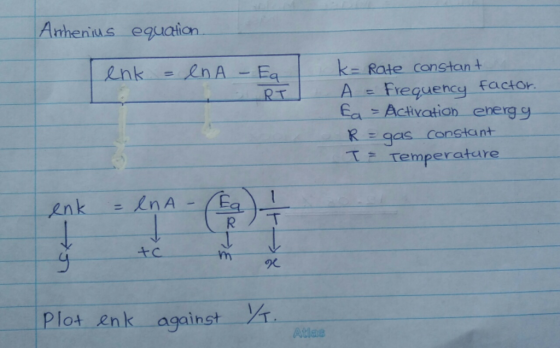
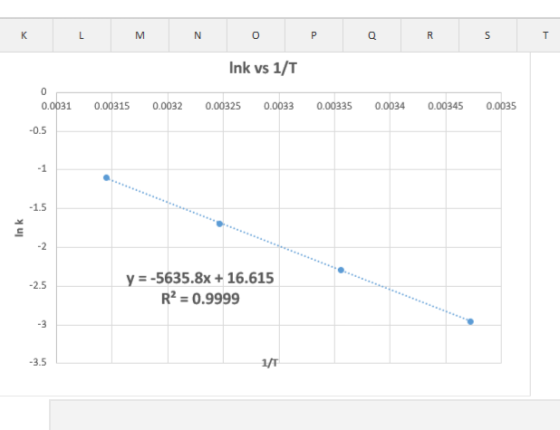
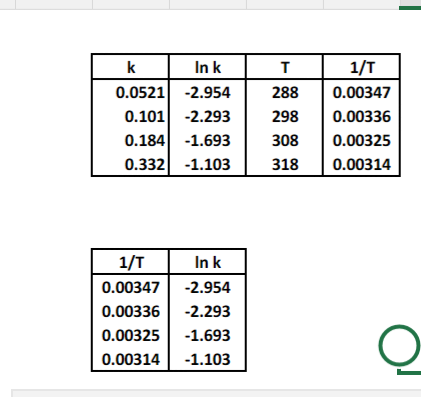
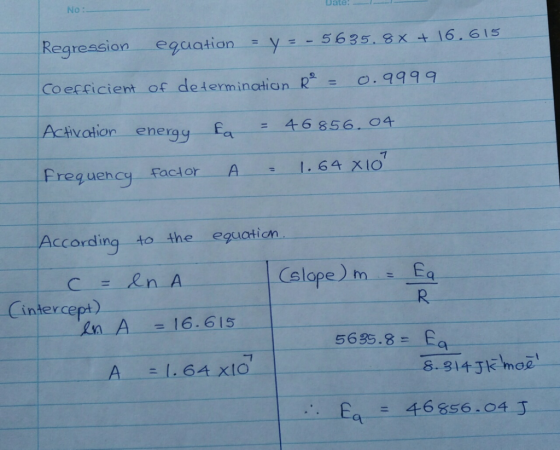
![3. A student obtained the following data for the hydrolysis of an organic ester: Rate, k, Expt. [Esterl Ho] TK mol/Ls Vmol-s 1 0.100 0.200 288 1.04 x10 0.0521 2 0.100 0.200 298 2.02 x 10 0.101 3 0.100 0.200 308 3.68 x 10 0.184 4 0.100 0.200 318 6.64x 10 0.332 1 0.100 a. Prepare a plot of the rate constant as a function of temperature (attach plot); b. Prepare an Arrhenius plot, In k as a function of inverse temperature (attach plot); c. Determine the activation energy and frequency factor for this reaction. Regression equation for Arrhenius plot: Coefficient of determination, R: Activation Energy, E Frequency factor, A Labels containing an asterisk () require an example calculation to obtain credit. Show your example calculations below (No credit will be given without example calculations being presented based on your data). Clearly label the identity of the calculation (continue on the back or attach a separate sheet):](http://img.homeworklib.com/questions/250f7bd0-d684-11ea-93da-333d6c512724.png?x-oss-process=image/resize,w_560)
Homework Answers
Add Answer to:
3. A student obtained the following data for the hydrolysis of an organic ester: Rate, k,...
Helpful Stuff Gas Arrhenius Equation: k = Ae-Ea/RT Constant: R= 8.314 J/mol K Integrated Rate Laws...
 Helpful Stuff Gas Arrhenius Equation: k = Ae-Ea/RT Constant: R= 8.314 J/mol K Integrated Rate Laws and Half-Lives: Zero order: [A] = -kt + [A]. t1/2 =[A]/2k • First order: In[A] = -kt + In[A]. t1/2 = 0.693/k • Second order: 1/[A] = kt + 1/[A] t1/2 = 1/k[A] • Pseudo first order: Use first order integrated rate law for the pseudo-first order reactant; other reactant concentrations remain constant, but are still present in overall rate law 1. You study...
rates of chemical reactions Plz help!! how do I find specific rate constant k, 1/T, In...
 rates of chemical reactions
Plz help!! how do I find specific rate constant k, 1/T, In
K
thank you
Rates of Chemical Reactions: Report Form Rate Law Summary: (a) From your measurements, what are the reaction orders with respect to each of the three reactants H;O; HOO (b) What is the rate expression (rate law) for the uncatalyzed reaction? Rate = K LT-] [H202) (c) What is the total reaction order? 2 3. Effect of Temperature on the Reaction Rate...
rates of chemical reactions
Plz help!! how do I find specific rate constant k, 1/T, In
K
thank you
Rates of Chemical Reactions: Report Form Rate Law Summary: (a) From your measurements, what are the reaction orders with respect to each of the three reactants H;O; HOO (b) What is the rate expression (rate law) for the uncatalyzed reaction? Rate = K LT-] [H202) (c) What is the total reaction order? 2 3. Effect of Temperature on the Reaction Rate...
will work with up to 3 partners (similar to a lab group) to prepare a written report which analyzes kinetic data that has been provided to you. All student groups will receive data for the hy...
 will work with up to 3 partners (similar to a lab group) to prepare a written report which analyzes kinetic data that has been provided to you. All student groups will receive data for the hypothetical reaction aAlE) products where a is a numeric variable and A is a chemical variable. The reaction therefore has the form of a decomposition reaction, in which a single substance forms one or more new substances. For consistency, all concentrations start out at 1.000...
just one example/demonstration! Data needed to be calculated is in highlighted in green boxes. And I...
 just one example/demonstration!
Data needed to be calculated is in highlighted in green boxes.
And I highlighted in red an equation (not sure if thats what you
use to calculate it) And ignore the lab instructions on completeing
a graph!! I already know how to do that in excel, just curious how
Ln (relative rate) and 1/T in K^-1 is calculated by hand*
here is the rest of that lab leading up to the question as I
know its typically...
just one example/demonstration!
Data needed to be calculated is in highlighted in green boxes.
And I highlighted in red an equation (not sure if thats what you
use to calculate it) And ignore the lab instructions on completeing
a graph!! I already know how to do that in excel, just curious how
Ln (relative rate) and 1/T in K^-1 is calculated by hand*
here is the rest of that lab leading up to the question as I
know its typically...
 Helpful Stuff Gas Arrhenius Equation: k = Ae-Ea/RT Constant: R= 8.314 J/mol K Integrated Rate Laws and Half-Lives: Zero order: [A] = -kt + [A]. t1/2 =[A]/2k • First order: In[A] = -kt + In[A]. t1/2 = 0.693/k • Second order: 1/[A] = kt + 1/[A] t1/2 = 1/k[A] • Pseudo first order: Use first order integrated rate law for the pseudo-first order reactant; other reactant concentrations remain constant, but are still present in overall rate law 1. You study...
 rates of chemical reactions
Plz help!! how do I find specific rate constant k, 1/T, In
K
thank you
Rates of Chemical Reactions: Report Form Rate Law Summary: (a) From your measurements, what are the reaction orders with respect to each of the three reactants H;O; HOO (b) What is the rate expression (rate law) for the uncatalyzed reaction? Rate = K LT-] [H202) (c) What is the total reaction order? 2 3. Effect of Temperature on the Reaction Rate...
rates of chemical reactions
Plz help!! how do I find specific rate constant k, 1/T, In
K
thank you
Rates of Chemical Reactions: Report Form Rate Law Summary: (a) From your measurements, what are the reaction orders with respect to each of the three reactants H;O; HOO (b) What is the rate expression (rate law) for the uncatalyzed reaction? Rate = K LT-] [H202) (c) What is the total reaction order? 2 3. Effect of Temperature on the Reaction Rate...
 will work with up to 3 partners (similar to a lab group) to prepare a written report which analyzes kinetic data that has been provided to you. All student groups will receive data for the hypothetical reaction aAlE) products where a is a numeric variable and A is a chemical variable. The reaction therefore has the form of a decomposition reaction, in which a single substance forms one or more new substances. For consistency, all concentrations start out at 1.000...
 just one example/demonstration!
Data needed to be calculated is in highlighted in green boxes.
And I highlighted in red an equation (not sure if thats what you
use to calculate it) And ignore the lab instructions on completeing
a graph!! I already know how to do that in excel, just curious how
Ln (relative rate) and 1/T in K^-1 is calculated by hand*
here is the rest of that lab leading up to the question as I
know its typically...
just one example/demonstration!
Data needed to be calculated is in highlighted in green boxes.
And I highlighted in red an equation (not sure if thats what you
use to calculate it) And ignore the lab instructions on completeing
a graph!! I already know how to do that in excel, just curious how
Ln (relative rate) and 1/T in K^-1 is calculated by hand*
here is the rest of that lab leading up to the question as I
know its typically...
Most questions answered within 3 hours.
-
Where is the error in this code sequence?
String s1 = "Hello";
String s2 = "ello";...
asked 10 months ago -
Financial data for Joel de Paris, Inc., for last year
follow:
Joel de Paris, Inc.
Balance...
asked 10 months ago -
Consider this reaction:
Al2(SO4)3 (aq)+ BaCl3
(aq) Al2Cl6 (aq)- +
3BaSO4(s) . What is the...
asked 10 months ago -
Suppose that Savneet is considering increasing her
recent random sample from 20 car rentals to 40...
asked 10 months ago -
Trucks arrive at an unloading terminal at an average rate of 120
per hour.
Trucks arrive...
asked 10 months ago -
Why are methanol and ethanol completely soluble in water while
octanol is not very little soluble....
asked 10 months ago -
A facilities manager at a university reads in a research report
that the mean amount of...
asked 10 months ago -
When the CuSO4 is rehydrated by adding water to the anhydrous
compound, is this an endothermic...
asked 10 months ago -
A ray of sunlight is passing from diamond into crown glass; the
angle of incidence is...
asked 10 months ago -
A block of mass 0.249 kg is placed on top of a light, vertical
spring of...
asked 10 months ago -
how do the kidneys compensate in the presences of acidosis
a) trigger hyperventilate
b) reserve acid...
asked 10 months ago -
Question 501 pts
The rental rate of capital to the firm increases. Which of the
following...
asked 10 months ago