 Will need step-by-step
instructions and answer to this question, many thanks. Will be
rewarded asap.
Will need step-by-step
instructions and answer to this question, many thanks. Will be
rewarded asap.
Homework Answers
Note that
A = Ao e^(-t/T)
--> T = -t / ln (A/Ao)
for exponential decay where A is the amount at time t.
As
A = 5.0E5 decay/s
Ao = 4.0E6 decay/s
t = 6.0 s
T = mean life time
Plugging these values in,
T = 2.88 s [mean lifetime]
*************************
Note that
Half life = T ln 2
Thus,
Half life = 2.0 seconds [ANSWER]
***********************
At t = 20 s,
A = Ao e^(-t/T)
= 5.0E5 e^(-20/2.88)
= 488 decay/s [ANSWER]
*************************
Add Answer to:
Will need step-by-step
instructions and answer to this question, many thanks. Will be
rewarded asap.
A...
Please answer 2 3 and 4. thanks . 1. In this activity, we will be exploring...
 Please answer 2 3 and 4. thanks .
1. In this activity, we will be exploring the relationship between the amount of a radioactive substance and the rate of decay. There are many forms of radioactive decay. For this activity we will be using beta (8) decay, when a neutron decays into an electron and proton, and gamma (7) decay, when an atom emits energy through a gamma photon. B- Decay y Decay High Energy+ Unstable Atom Neutron Low Energy+...
Please answer 2 3 and 4. thanks .
1. In this activity, we will be exploring the relationship between the amount of a radioactive substance and the rate of decay. There are many forms of radioactive decay. For this activity we will be using beta (8) decay, when a neutron decays into an electron and proton, and gamma (7) decay, when an atom emits energy through a gamma photon. B- Decay y Decay High Energy+ Unstable Atom Neutron Low Energy+...
please help with parts in case 1 and case 2! thanks you! Correct (100,0%) submit Find...
 please help with parts in case 1 and case 2! thanks you!
Correct (100,0%) submit Find its decay constant in write the result in terms of 10 Keep 4 decimal places. 1.2327 Correct (100.046) Submit x10-7-1 Case 1: The mass of the initial radioactive sample is 6.20 kg. Some time after the initial sample was prepared, it was found that 0.447 kg radioactive materials has decayed. (h) What is the mass in kg) of the radioactive material that remains in...
please help with parts in case 1 and case 2! thanks you!
Correct (100,0%) submit Find its decay constant in write the result in terms of 10 Keep 4 decimal places. 1.2327 Correct (100.046) Submit x10-7-1 Case 1: The mass of the initial radioactive sample is 6.20 kg. Some time after the initial sample was prepared, it was found that 0.447 kg radioactive materials has decayed. (h) What is the mass in kg) of the radioactive material that remains in...
I need step by step solution to the following this question asap,answer should cover no more...
I need step by step solution to the following this question asap,answer should cover no more than half a page .I have limited time so please do it quickly with detailed explanation .thanks in advance/Ha Q“The root causes of the vast differences in output per head across countries are not well understood.” Do you agree?
The following question is about the fundamental forces. 13. List the four force interactions in the...
 The
following question is about the fundamental forces.
13. List the four force interactions in the universe (in order
from strongest to weakest)
The decay curve of a radioactive nuclide sample is shown. It’s
initial activity Is measured to be X Bq.
14. What is the population at t=8.0 hours?
15. After how many half lives will the population be 125
nuclides
16. What will be the level of activity (in terms of X) after
two half lives have elapsed?...
The
following question is about the fundamental forces.
13. List the four force interactions in the universe (in order
from strongest to weakest)
The decay curve of a radioactive nuclide sample is shown. It’s
initial activity Is measured to be X Bq.
14. What is the population at t=8.0 hours?
15. After how many half lives will the population be 125
nuclides
16. What will be the level of activity (in terms of X) after
two half lives have elapsed?...
Answers for questions 13-23 please. The following question is about the fundamental forces 13. List the...
 Answers for questions 13-23 please.
The following question is about the fundamental forces 13. List the four force interactions in the universe (in order from strongest to weakest) together with their associated particles The decay curve of a radioactive nuclide sample is shown. Its initial activity is measured to be X 6q 14. What is the population at t8.0 hours?14. 15. After how many half lives will the 0 population be 125 nuclides? 15. 16. What will be the level...
Answers for questions 13-23 please.
The following question is about the fundamental forces 13. List the four force interactions in the universe (in order from strongest to weakest) together with their associated particles The decay curve of a radioactive nuclide sample is shown. Its initial activity is measured to be X 6q 14. What is the population at t8.0 hours?14. 15. After how many half lives will the 0 population be 125 nuclides? 15. 16. What will be the level...
Use the following information to answer the next question While studying a radioactive phosphorous 34 p,...
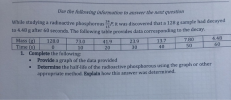 Use the following information to answer the next question While studying a radioactive phosphorous 34 p, it was discovered that a 128 g sample had decayed to 4.48 g after 60 seconds. The following table provides data corresponding to the decay. Mass (g) 128.0 4.48 73.0 41.9 23.9 7.80 Time (S) 60 0 50 10 20 1. Complete the following: Provide a graph of the data provided Determine the half-life of the radioactive phosphorous using the graph or other appropriate...
i need help on this 2 question ill like answer 5. How many grams of 2°N...
 i
need help on this 2 question ill like answer
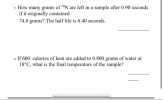
5. How many grams of 2°N are left in a sample after 0.90 seconds if it originally contained 74.0 grams? The half life is 0.40 seconds. 6. If 600. calories of heat are added to 0.800 grams of water at 18°C, what is the final temperature of the sample?
i
need help on this 2 question ill like answer
5. How many grams of 2°N are left in a sample after 0.90 seconds if it originally contained 74.0 grams? The half life is 0.40 seconds. 6. If 600. calories of heat are added to 0.800 grams of water at 18°C, what is the final temperature of the sample?
question. Correct answers for each question will be made available once the maximum number of attempts...
 question. Correct answers for each question will be made available once the maximum number of attempts have been made for each submission. Nuclear Physics - Binding Energy 1 Nuclear Physics - Binding Energy Fod work The above figure shows a nuclear reaction in which an alpha particle separates into individual nucleons. An a particle is a He nucleus (2 protons, 4 nucleons). The relevant rest masses are: He = 4.002602 u, neutron = 1.008665 u, proton = 1.007825 u. (a)...
plz answer all questions ASAP plz A Hide Time Remaining A Question 6 of 20 5...
 plz
answer all questions ASAP plz
A Hide Time Remaining A Question 6 of 20 5 Points For which of the following isotopes would it be unlikely to observe B decay? O ABN OB. 190 OC. 27 MB D. OF E. 200 Reset Selection Time Remaining: 01:04:44 A Hide Time Remaining A Part 2 of 2 Question 7 of 20 5 Points 175pt undergoes alpha decay, what is the daughter nucleus? Previous Next Save Events Map Apply Search/A-Z 2.20 Site...
plz
answer all questions ASAP plz
A Hide Time Remaining A Question 6 of 20 5 Points For which of the following isotopes would it be unlikely to observe B decay? O ABN OB. 190 OC. 27 MB D. OF E. 200 Reset Selection Time Remaining: 01:04:44 A Hide Time Remaining A Part 2 of 2 Question 7 of 20 5 Points 175pt undergoes alpha decay, what is the daughter nucleus? Previous Next Save Events Map Apply Search/A-Z 2.20 Site...
Background (Part 1): We are continuously exposed to ionizing radiation from natural and artificial sources. All...
Background (Part 1): We are continuously exposed to ionizing radiation from natural and artificial sources. All of us are exposed to radiation every day, from natural sources such as minerals in the ground and cosmic radiation to man-made sources such as medical x-rays. According to the National Council on Radiation Protection and Measurements (NCRP), the average annual radiation dose per person in the U.S. is 620 millirem. In this activity, you will use the interactive online dose calculator to estimate...
 Please answer 2 3 and 4. thanks .
1. In this activity, we will be exploring the relationship between the amount of a radioactive substance and the rate of decay. There are many forms of radioactive decay. For this activity we will be using beta (8) decay, when a neutron decays into an electron and proton, and gamma (7) decay, when an atom emits energy through a gamma photon. B- Decay y Decay High Energy+ Unstable Atom Neutron Low Energy+...
Please answer 2 3 and 4. thanks .
1. In this activity, we will be exploring the relationship between the amount of a radioactive substance and the rate of decay. There are many forms of radioactive decay. For this activity we will be using beta (8) decay, when a neutron decays into an electron and proton, and gamma (7) decay, when an atom emits energy through a gamma photon. B- Decay y Decay High Energy+ Unstable Atom Neutron Low Energy+...
 please help with parts in case 1 and case 2! thanks you!
Correct (100,0%) submit Find its decay constant in write the result in terms of 10 Keep 4 decimal places. 1.2327 Correct (100.046) Submit x10-7-1 Case 1: The mass of the initial radioactive sample is 6.20 kg. Some time after the initial sample was prepared, it was found that 0.447 kg radioactive materials has decayed. (h) What is the mass in kg) of the radioactive material that remains in...
please help with parts in case 1 and case 2! thanks you!
Correct (100,0%) submit Find its decay constant in write the result in terms of 10 Keep 4 decimal places. 1.2327 Correct (100.046) Submit x10-7-1 Case 1: The mass of the initial radioactive sample is 6.20 kg. Some time after the initial sample was prepared, it was found that 0.447 kg radioactive materials has decayed. (h) What is the mass in kg) of the radioactive material that remains in...
 The
following question is about the fundamental forces.
13. List the four force interactions in the universe (in order
from strongest to weakest)
The decay curve of a radioactive nuclide sample is shown. It’s
initial activity Is measured to be X Bq.
14. What is the population at t=8.0 hours?
15. After how many half lives will the population be 125
nuclides
16. What will be the level of activity (in terms of X) after
two half lives have elapsed?...
The
following question is about the fundamental forces.
13. List the four force interactions in the universe (in order
from strongest to weakest)
The decay curve of a radioactive nuclide sample is shown. It’s
initial activity Is measured to be X Bq.
14. What is the population at t=8.0 hours?
15. After how many half lives will the population be 125
nuclides
16. What will be the level of activity (in terms of X) after
two half lives have elapsed?...
 Answers for questions 13-23 please.
The following question is about the fundamental forces 13. List the four force interactions in the universe (in order from strongest to weakest) together with their associated particles The decay curve of a radioactive nuclide sample is shown. Its initial activity is measured to be X 6q 14. What is the population at t8.0 hours?14. 15. After how many half lives will the 0 population be 125 nuclides? 15. 16. What will be the level...
Answers for questions 13-23 please.
The following question is about the fundamental forces 13. List the four force interactions in the universe (in order from strongest to weakest) together with their associated particles The decay curve of a radioactive nuclide sample is shown. Its initial activity is measured to be X 6q 14. What is the population at t8.0 hours?14. 15. After how many half lives will the 0 population be 125 nuclides? 15. 16. What will be the level...
 Use the following information to answer the next question While studying a radioactive phosphorous 34 p, it was discovered that a 128 g sample had decayed to 4.48 g after 60 seconds. The following table provides data corresponding to the decay. Mass (g) 128.0 4.48 73.0 41.9 23.9 7.80 Time (S) 60 0 50 10 20 1. Complete the following: Provide a graph of the data provided Determine the half-life of the radioactive phosphorous using the graph or other appropriate...
 i
need help on this 2 question ill like answer
5. How many grams of 2°N are left in a sample after 0.90 seconds if it originally contained 74.0 grams? The half life is 0.40 seconds. 6. If 600. calories of heat are added to 0.800 grams of water at 18°C, what is the final temperature of the sample?
i
need help on this 2 question ill like answer
5. How many grams of 2°N are left in a sample after 0.90 seconds if it originally contained 74.0 grams? The half life is 0.40 seconds. 6. If 600. calories of heat are added to 0.800 grams of water at 18°C, what is the final temperature of the sample?
 question. Correct answers for each question will be made available once the maximum number of attempts have been made for each submission. Nuclear Physics - Binding Energy 1 Nuclear Physics - Binding Energy Fod work The above figure shows a nuclear reaction in which an alpha particle separates into individual nucleons. An a particle is a He nucleus (2 protons, 4 nucleons). The relevant rest masses are: He = 4.002602 u, neutron = 1.008665 u, proton = 1.007825 u. (a)...
 plz
answer all questions ASAP plz
A Hide Time Remaining A Question 6 of 20 5 Points For which of the following isotopes would it be unlikely to observe B decay? O ABN OB. 190 OC. 27 MB D. OF E. 200 Reset Selection Time Remaining: 01:04:44 A Hide Time Remaining A Part 2 of 2 Question 7 of 20 5 Points 175pt undergoes alpha decay, what is the daughter nucleus? Previous Next Save Events Map Apply Search/A-Z 2.20 Site...
plz
answer all questions ASAP plz
A Hide Time Remaining A Question 6 of 20 5 Points For which of the following isotopes would it be unlikely to observe B decay? O ABN OB. 190 OC. 27 MB D. OF E. 200 Reset Selection Time Remaining: 01:04:44 A Hide Time Remaining A Part 2 of 2 Question 7 of 20 5 Points 175pt undergoes alpha decay, what is the daughter nucleus? Previous Next Save Events Map Apply Search/A-Z 2.20 Site...
Most questions answered within 3 hours.
-
Where is the error in this code sequence?
String s1 = "Hello";
String s2 = "ello";...
asked 1 year ago -
Financial data for Joel de Paris, Inc., for last year
follow:
Joel de Paris, Inc.
Balance...
asked 1 year ago -
Consider this reaction:
Al2(SO4)3 (aq)+ BaCl3
(aq) Al2Cl6 (aq)- +
3BaSO4(s) . What is the...
asked 1 year ago -
Suppose that Savneet is considering increasing her
recent random sample from 20 car rentals to 40...
asked 1 year ago -
Trucks arrive at an unloading terminal at an average rate of 120
per hour.
Trucks arrive...
asked 1 year ago -
Why are methanol and ethanol completely soluble in water while
octanol is not very little soluble....
asked 1 year ago -
A facilities manager at a university reads in a research report
that the mean amount of...
asked 1 year ago -
When the CuSO4 is rehydrated by adding water to the anhydrous
compound, is this an endothermic...
asked 1 year ago -
A ray of sunlight is passing from diamond into crown glass; the
angle of incidence is...
asked 1 year ago -
A block of mass 0.249 kg is placed on top of a light, vertical
spring of...
asked 1 year ago -
how do the kidneys compensate in the presences of acidosis
a) trigger hyperventilate
b) reserve acid...
asked 1 year ago -
Question 501 pts
The rental rate of capital to the firm increases. Which of the
following...
asked 1 year ago