) What reactants would you need to perform the anionic polymerization of isoprene? What is the...
) What reactants would you need to perform the anionic polymerization of isoprene? What is the mass of reactants would you need to synthesize 10g of polyisoprene with Mn=12000g/mol? Suggest conditions.
Homework Answers

Add Answer to:
) What reactants would you need to perform the anionic
polymerization of isoprene? What is the...
Polystyrene can be polymerized from the starting monomer (styrene) pictured below. a. Anionic polymerization is one...
 Polystyrene can be polymerized from the starting monomer
(styrene) pictured below.
a. Anionic polymerization is one method of polymerization that
can be used to generate polystyrene from styrene. Explain what type
of initiator should be used for this reaction
and draw an example of a styrene monomer that has reacted with
initiator.
b. Using this anionic polymerization method and a starting
concentration of 1M styrene and 1mM initiator, what degree of
polymerization (Xn) would you expect if you use up...
Polystyrene can be polymerized from the starting monomer
(styrene) pictured below.
a. Anionic polymerization is one method of polymerization that
can be used to generate polystyrene from styrene. Explain what type
of initiator should be used for this reaction
and draw an example of a styrene monomer that has reacted with
initiator.
b. Using this anionic polymerization method and a starting
concentration of 1M styrene and 1mM initiator, what degree of
polymerization (Xn) would you expect if you use up...
Q3 (25 pts) The polymerization is done by the anionic mechanism, and 2 mol of polystyrene...
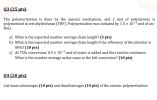 Q3 (25 pts) The polymerization is done by the anionic mechanism, and 2 mol of polystyrene is polymerized in tetrahydrofuran (THF). Polymerization was initiated by 1.5 x 10⁻³ mol of sec- Buli. a) What is the expected number average chain length? (5 pts) b) What is the expected number average chain length if the efficiency of the initiator is 80%? (10 pts) c) At 75% conversion, 0.5 x 10⁻³ mol of water is added and the reaction continues. What is...
acylating agent and activated monomer in the anionic ring- 2. What are the roles of an...
 acylating agent and activated monomer in the anionic ring- 2. What are the roles of an haln opening polymerization of lactam? (10 points) 3. For the sequential anionic block copolymerizations of styrene and a -methyl styrene under the conditions given below, provide the: (a) Electron arrow-pushing mechanisms; [5 points (b) Intermediates; [5 points (c) Final products; [5 points -80 °C 30 min 80PC 30 min CH OH (d) Imagine that the temperature for the polymerization was misread as 80 °C....
What type of polymerization is required to produce the polymer below? Describe brief sequence of steps...
 What type of polymerization is required to produce the polymer
below? Describe brief sequence of steps you would use (including
monomers used and order of processing) to achieve the desired
polymer.
There's anionic polymerization of styrene, there's cationic
polymerization, etc. I think anionic may help the most so I
provided that. But no idea. Or forming a graft copolymer?
What type of polymerization is required to produce the polymer
below? Describe brief sequence of steps you would use (including
monomers used and order of processing) to achieve the desired
polymer.
There's anionic polymerization of styrene, there's cationic
polymerization, etc. I think anionic may help the most so I
provided that. But no idea. Or forming a graft copolymer?
What would be the number-average molecular weight of polystyrene obtained at the completion of an anionic...
What would be the number-average molecular weight of polystyrene obtained at the completion of an anionic (i.e., “living”) polymerization in which 0.01 g of n-butyllithium and 10 g of styrene monomer are used? The molecular weight of butyllithium and styrene are 64.06 and 104.12, respectively.
4. What monomer would you start with to make the polymer shown? Would the polymer be...
 4. What monomer would you start with to make the polymer shown?
Would the polymer be made more effectively using a cationic or an
anionic polymerization?
CN CN CN
4. What monomer would you start with to make the polymer shown?
Would the polymer be made more effectively using a cationic or an
anionic polymerization?
CN CN CN
2) You are studying actin polymerization in a solution. You perform an experiment where you add...
2) You are studying actin polymerization in a solution. You perform an experiment where you add free actin, and wait a sufficiently long time. You notice that at some concentration of added actin, increasing the concentration of actin beyond that point increases the average actin filament mass in grams/mL A) The point at which actin filament mass increases is the critical concentration B) dPol/dt=0, so free actin concentration is the same across the entire range of added concentrations. C) Above...
In the lab, you will need to perform serial dilutions. What would be the concentration of...
In the lab, you will need to perform serial dilutions. What would be the concentration of the new solution made if you took 2.50 mL of a 0.10 M Cu(2+) solution and diluted it to 10.00 mL?
provide reactants/solvents/reagents not sure what additional info would be needed, just need the reactants to get...
 provide reactants/solvents/reagents
not sure what additional info would be needed, just
need the reactants to get to the final product, it's not from a
book, but a worksheet.
Me Me Me Me Ph
provide reactants/solvents/reagents
not sure what additional info would be needed, just
need the reactants to get to the final product, it's not from a
book, but a worksheet.
Me Me Me Me Ph
State, giving your reasoning the method of radical polymerization you would use to prepare each of...
State, giving your reasoning the method of radical polymerization you would use to prepare each of the following polymers. (a) Poly(vinyl acetate) for use in waterborne adhesives. (b) Poly(methacrylate acid) with a number-average molar mass of 10 kg mol-1 and low molar mass density. (c) Polyacrylonitrile for use in the production of acrylic fibers. (d) Poly(methyl methacrylate) for use in optical applications. (e )Low molar mass poly(t-butyl methacrylate) with terminal C C double bonds. (f) Polystyrene for use in solvent-born...
 Polystyrene can be polymerized from the starting monomer
(styrene) pictured below.
a. Anionic polymerization is one method of polymerization that
can be used to generate polystyrene from styrene. Explain what type
of initiator should be used for this reaction
and draw an example of a styrene monomer that has reacted with
initiator.
b. Using this anionic polymerization method and a starting
concentration of 1M styrene and 1mM initiator, what degree of
polymerization (Xn) would you expect if you use up...
Polystyrene can be polymerized from the starting monomer
(styrene) pictured below.
a. Anionic polymerization is one method of polymerization that
can be used to generate polystyrene from styrene. Explain what type
of initiator should be used for this reaction
and draw an example of a styrene monomer that has reacted with
initiator.
b. Using this anionic polymerization method and a starting
concentration of 1M styrene and 1mM initiator, what degree of
polymerization (Xn) would you expect if you use up...
 Q3 (25 pts) The polymerization is done by the anionic mechanism, and 2 mol of polystyrene is polymerized in tetrahydrofuran (THF). Polymerization was initiated by 1.5 x 10⁻³ mol of sec- Buli. a) What is the expected number average chain length? (5 pts) b) What is the expected number average chain length if the efficiency of the initiator is 80%? (10 pts) c) At 75% conversion, 0.5 x 10⁻³ mol of water is added and the reaction continues. What is...
 acylating agent and activated monomer in the anionic ring- 2. What are the roles of an haln opening polymerization of lactam? (10 points) 3. For the sequential anionic block copolymerizations of styrene and a -methyl styrene under the conditions given below, provide the: (a) Electron arrow-pushing mechanisms; [5 points (b) Intermediates; [5 points (c) Final products; [5 points -80 °C 30 min 80PC 30 min CH OH (d) Imagine that the temperature for the polymerization was misread as 80 °C....
 What type of polymerization is required to produce the polymer
below? Describe brief sequence of steps you would use (including
monomers used and order of processing) to achieve the desired
polymer.
There's anionic polymerization of styrene, there's cationic
polymerization, etc. I think anionic may help the most so I
provided that. But no idea. Or forming a graft copolymer?
What type of polymerization is required to produce the polymer
below? Describe brief sequence of steps you would use (including
monomers used and order of processing) to achieve the desired
polymer.
There's anionic polymerization of styrene, there's cationic
polymerization, etc. I think anionic may help the most so I
provided that. But no idea. Or forming a graft copolymer?
 4. What monomer would you start with to make the polymer shown?
Would the polymer be made more effectively using a cationic or an
anionic polymerization?
CN CN CN
4. What monomer would you start with to make the polymer shown?
Would the polymer be made more effectively using a cationic or an
anionic polymerization?
CN CN CN
 provide reactants/solvents/reagents
not sure what additional info would be needed, just
need the reactants to get to the final product, it's not from a
book, but a worksheet.
Me Me Me Me Ph
provide reactants/solvents/reagents
not sure what additional info would be needed, just
need the reactants to get to the final product, it's not from a
book, but a worksheet.
Me Me Me Me Ph
Most questions answered within 3 hours.
-
Where is the error in this code sequence?
String s1 = "Hello";
String s2 = "ello";...
asked 11 months ago -
Financial data for Joel de Paris, Inc., for last year
follow:
Joel de Paris, Inc.
Balance...
asked 11 months ago -
Consider this reaction:
Al2(SO4)3 (aq)+ BaCl3
(aq) Al2Cl6 (aq)- +
3BaSO4(s) . What is the...
asked 11 months ago -
Suppose that Savneet is considering increasing her
recent random sample from 20 car rentals to 40...
asked 11 months ago -
Trucks arrive at an unloading terminal at an average rate of 120
per hour.
Trucks arrive...
asked 11 months ago -
Why are methanol and ethanol completely soluble in water while
octanol is not very little soluble....
asked 11 months ago -
A facilities manager at a university reads in a research report
that the mean amount of...
asked 11 months ago -
When the CuSO4 is rehydrated by adding water to the anhydrous
compound, is this an endothermic...
asked 11 months ago -
A ray of sunlight is passing from diamond into crown glass; the
angle of incidence is...
asked 11 months ago -
A block of mass 0.249 kg is placed on top of a light, vertical
spring of...
asked 11 months ago -
how do the kidneys compensate in the presences of acidosis
a) trigger hyperventilate
b) reserve acid...
asked 11 months ago -
Question 501 pts
The rental rate of capital to the firm increases. Which of the
following...
asked 11 months ago