The kinetics of the following reaction have been studied: 4 NO + O2 → 2 N2O3...
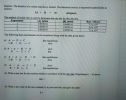
The kinetics of the following reaction have been studied: 4 NO + O2 → 2 N2O3
The rate of appearance of N2O3 was measured as ∆[N2O3]/∆t = 9.00 x 10⁻² mol L-1 s-1
(a) What is the rate of the reaction in mol L-1 s-1?
(b) What is ∆[NO]/∆t in mol L-1 s-1?
(c) What is ∆[O2]/∆t in mol L-1 s-1?
Homework Answers
![solution : UNO & O - qN, 02 Rate of Reaction - 1 dino) at -- MO₂) di I MM00) 4 at giuen AN303] 9.08 102 mol [-sect At a) Rate](http://img.homeworklib.com/questions/9626fa60-d6a9-11ea-89c4-69c3df9d69b6.png?x-oss-process=image/resize,w_560)
Add Answer to:
The kinetics of the following reaction have been studied: 4 NO +
O2 → 2 N2O3...
1. The kinetics of the following reaction have been studied: N2 + 3 H2 → 2...
 1. The kinetics of the following reaction have been studied: N2
+ 3 H2 → 2 NH3 The rate of of appearance of NH3 was measured as
∆[NH3]/∆t = 9.00 x 10⁻² mol L-1 s-1
(a) What is the rate of the reaction in mol L-1 s-1?
(b) What is ∆[N2]/∆t in mol L-1 s-1?
(c) What is ∆[H2]/∆t in mol L-1 s-1?
2. The initial rate of the reaction of species A and B A + 2 B →...
1. The kinetics of the following reaction have been studied: N2
+ 3 H2 → 2 NH3 The rate of of appearance of NH3 was measured as
∆[NH3]/∆t = 9.00 x 10⁻² mol L-1 s-1
(a) What is the rate of the reaction in mol L-1 s-1?
(b) What is ∆[N2]/∆t in mol L-1 s-1?
(c) What is ∆[H2]/∆t in mol L-1 s-1?
2. The initial rate of the reaction of species A and B A + 2 B →...
1. The following chemical reaction: A → products shows first order kinetics with respect to A;...
1. The following chemical reaction: A → products shows first order kinetics with respect to A; rate = k[A]. Assume k = 10.09 x 10⁻⁴ s-1 . If the initial concentration of A was 0.82 mol L-1 and then decreased to 0.11 mol L-1 , how much time elapsed in minutes? 2. Consider the following balanced chemical equation: H2O2 (aq) + 3 I-(aq) + 2 H+(aq) → I3- (aq) + 2 H2O (l) In the first 62.9 seconds of the...
2. Good question. The reaction 2NO(g) + O2(g) → 2NO.(g) was studied by a CHEM 154...
 2. Good question. The reaction 2NO(g) + O2(g) → 2NO.(g) was studied by a CHEM 154 student and the following data were obtained for the rate of consumption of oxygen. Write the rate law for this reaction. What would be the initial rate for an experiment where [NO), = 1.03 x 10-mol/L and [O),= 1.22 x 10² mol/L? Expt. [NO], (M) (01. (M) Initial rate (M/s) 1 1.66 x 10⁻³ 1.66 x 10⁻³ 3.32 x 10⁻⁵ 2 4.98 x 10-...
Lab 1l: Kinetics In the Kinetics Lab, the reaction of iodide with persulfate was studied, and it ...
 Lab 1l: Kinetics In the Kinetics Lab, the reaction of iodide with persulfate was studied, and it was determined that the rate law was first order in each reactant. 21(a)s20 (22 S042(ag) rateS2091 (a) If [I-] = 0.0550 M, [S2O82-]-0.0350 M, and kー0.00400 M-1 s-1, what is the reaction rate? M/s (b) If [I-]-0.0500 M, [S2082-]-0.0350 M, and the reaction rate is 5.90×10⁻⁶ M/s, what is the rate constant? M-1s-1 (c) The reaction rate was determined indirectly in this lab...
Kinetics. The kinetics of a certain reaction is studied. The balanced reaction is expressed symbolically as...
 Kinetics. The kinetics of a certain reaction is studied. The balanced reaction is expressed symbolically as follows: 2A + B 20 (all gases) The method of initial rates is used to determine the rate law for this reaction. Experiment (A), initial (B). initial Rate (M/sec) 0.0100 M 0.0400 M 75 x 10 2 0.0200 M 0.0200 M 3.0 x 10 3 0.0100 M 0.0200 M 7.5 x 10 1 The following four mechanisms can be considered along with the data...
Please answer all, I rate, thank you. THE IODINE CLOCK- REACTION KINETICS EXPERIMENT 3 PRE-LABORATORY QUESTIONS...
 Please answer all, I rate, thank you.
THE IODINE CLOCK- REACTION KINETICS EXPERIMENT 3 PRE-LABORATORY QUESTIONS (WEEK 1) Fully answer these questions in your laboratory notebook before coming to lab. Show all work for numerical calculations. 1. If the rate law for a reaction is Rate [A][B What is the overall order of the reaction? a. b. If the concentration of A is doubled and the concentration of B is tripled, how will this affect the rate of the reaction?...
Please answer all, I rate, thank you.
THE IODINE CLOCK- REACTION KINETICS EXPERIMENT 3 PRE-LABORATORY QUESTIONS (WEEK 1) Fully answer these questions in your laboratory notebook before coming to lab. Show all work for numerical calculations. 1. If the rate law for a reaction is Rate [A][B What is the overall order of the reaction? a. b. If the concentration of A is doubled and the concentration of B is tripled, how will this affect the rate of the reaction?...
The following chemical reaction: A → products shows second order kinetics with respect to A; rate...
The following chemical reaction: A → products shows second order kinetics with respect to A; rate = k[A]2. Assume k = 3.40 x 10⁻⁴ mol-1 L s-1 . If the initial concentration of A is 0.77 mol L-1, what is the concentration of A (in mol L-1) after 8.69 minutes?
The kinetics of the following second-order reaction were studied as a function of temperature: C2H5Br(aq)+OH−(aq)→C2H5OH(l)+Br−(aq) Temperature...
The kinetics of the following second-order reaction were studied as a function of temperature: C2H5Br(aq)+OH−(aq)→C2H5OH(l)+Br−(aq) Temperature (∘C) k (L/mol⋅s) 25 8.81×10⁻⁵ 35 0.000285 45 0.000854 55 0.00239 65 0.00633 If a reaction mixture is 0.155 M in C2H5Br, and 0.260 M in OH−, what is the initial rate of the reaction at 80 ∘C? Express your answer using two significant figures.
The rate of the elementary reaction C2H2 + O2C2H + HO2 has been studied as a...
 The rate of the elementary reaction
C2H2 +
O2C2H
+ HO2
has been studied as a function of temperature between
300 and 2500 K. The following
data were obtained for the rate constant k:
Temperature (K)
k (L mol-1 s-1)
300
6.25×10-45
740
1.19×10⁻¹²
1180
1.91×10⁻⁴
1620
1.07
(a) Calculate the activation energy of this
reaction. kJ mol-1
(b) Calculate the factor A in the Arrhenius equation for the
temperature dependence of the rate constant. L
mol-1 s-1
The rate of the elementary reaction
C2H2 +
O2C2H
+ HO2
has been studied as a function of temperature between
300 and 2500 K. The following
data were obtained for the rate constant k:
Temperature (K)
k (L mol-1 s-1)
300
6.25×10-45
740
1.19×10⁻¹²
1180
1.91×10⁻⁴
1620
1.07
(a) Calculate the activation energy of this
reaction. kJ mol-1
(b) Calculate the factor A in the Arrhenius equation for the
temperature dependence of the rate constant. L
mol-1 s-1
Consider the reaction: 2 NO(g) + O2 (g)--> 2 NO2 (g) The following data were obtained...
 Consider the reaction: 2 NO(g) + O2 (g)--> 2 NO2 (g)
The following data were obtained from three experiments using
the method of initial rates:
3. Consider the reaction: 2 NO(g) + O2(g) → 2 NO2(g) The following data were obtained from three experiments using the method of initial rates: Initial [NO] Initial rate NO Initial [02] mol mol L-1 mol L-1 L-15-1 0.010 0.010 Experiment 1 Experiment 2 Experiment 3 0.020 0.010 2.5 x 10⁻⁵ 1.0 x 10⁻⁴ 5.0...
Consider the reaction: 2 NO(g) + O2 (g)--> 2 NO2 (g)
The following data were obtained from three experiments using
the method of initial rates:
3. Consider the reaction: 2 NO(g) + O2(g) → 2 NO2(g) The following data were obtained from three experiments using the method of initial rates: Initial [NO] Initial rate NO Initial [02] mol mol L-1 mol L-1 L-15-1 0.010 0.010 Experiment 1 Experiment 2 Experiment 3 0.020 0.010 2.5 x 10⁻⁵ 1.0 x 10⁻⁴ 5.0...
 1. The kinetics of the following reaction have been studied: N2
+ 3 H2 → 2 NH3 The rate of of appearance of NH3 was measured as
∆[NH3]/∆t = 9.00 x 10⁻² mol L-1 s-1
(a) What is the rate of the reaction in mol L-1 s-1?
(b) What is ∆[N2]/∆t in mol L-1 s-1?
(c) What is ∆[H2]/∆t in mol L-1 s-1?
2. The initial rate of the reaction of species A and B A + 2 B →...
1. The kinetics of the following reaction have been studied: N2
+ 3 H2 → 2 NH3 The rate of of appearance of NH3 was measured as
∆[NH3]/∆t = 9.00 x 10⁻² mol L-1 s-1
(a) What is the rate of the reaction in mol L-1 s-1?
(b) What is ∆[N2]/∆t in mol L-1 s-1?
(c) What is ∆[H2]/∆t in mol L-1 s-1?
2. The initial rate of the reaction of species A and B A + 2 B →...
 2. Good question. The reaction 2NO(g) + O2(g) → 2NO.(g) was studied by a CHEM 154 student and the following data were obtained for the rate of consumption of oxygen. Write the rate law for this reaction. What would be the initial rate for an experiment where [NO), = 1.03 x 10-mol/L and [O),= 1.22 x 10² mol/L? Expt. [NO], (M) (01. (M) Initial rate (M/s) 1 1.66 x 10⁻³ 1.66 x 10⁻³ 3.32 x 10⁻⁵ 2 4.98 x 10-...
 Lab 1l: Kinetics In the Kinetics Lab, the reaction of iodide with persulfate was studied, and it was determined that the rate law was first order in each reactant. 21(a)s20 (22 S042(ag) rateS2091 (a) If [I-] = 0.0550 M, [S2O82-]-0.0350 M, and kー0.00400 M-1 s-1, what is the reaction rate? M/s (b) If [I-]-0.0500 M, [S2082-]-0.0350 M, and the reaction rate is 5.90×10⁻⁶ M/s, what is the rate constant? M-1s-1 (c) The reaction rate was determined indirectly in this lab...
 Kinetics. The kinetics of a certain reaction is studied. The balanced reaction is expressed symbolically as follows: 2A + B 20 (all gases) The method of initial rates is used to determine the rate law for this reaction. Experiment (A), initial (B). initial Rate (M/sec) 0.0100 M 0.0400 M 75 x 10 2 0.0200 M 0.0200 M 3.0 x 10 3 0.0100 M 0.0200 M 7.5 x 10 1 The following four mechanisms can be considered along with the data...
 Please answer all, I rate, thank you.
THE IODINE CLOCK- REACTION KINETICS EXPERIMENT 3 PRE-LABORATORY QUESTIONS (WEEK 1) Fully answer these questions in your laboratory notebook before coming to lab. Show all work for numerical calculations. 1. If the rate law for a reaction is Rate [A][B What is the overall order of the reaction? a. b. If the concentration of A is doubled and the concentration of B is tripled, how will this affect the rate of the reaction?...
Please answer all, I rate, thank you.
THE IODINE CLOCK- REACTION KINETICS EXPERIMENT 3 PRE-LABORATORY QUESTIONS (WEEK 1) Fully answer these questions in your laboratory notebook before coming to lab. Show all work for numerical calculations. 1. If the rate law for a reaction is Rate [A][B What is the overall order of the reaction? a. b. If the concentration of A is doubled and the concentration of B is tripled, how will this affect the rate of the reaction?...
 Consider the reaction: 2 NO(g) + O2 (g)--> 2 NO2 (g)
The following data were obtained from three experiments using
the method of initial rates:
3. Consider the reaction: 2 NO(g) + O2(g) → 2 NO2(g) The following data were obtained from three experiments using the method of initial rates: Initial [NO] Initial rate NO Initial [02] mol mol L-1 mol L-1 L-15-1 0.010 0.010 Experiment 1 Experiment 2 Experiment 3 0.020 0.010 2.5 x 10⁻⁵ 1.0 x 10⁻⁴ 5.0...
Consider the reaction: 2 NO(g) + O2 (g)--> 2 NO2 (g)
The following data were obtained from three experiments using
the method of initial rates:
3. Consider the reaction: 2 NO(g) + O2(g) → 2 NO2(g) The following data were obtained from three experiments using the method of initial rates: Initial [NO] Initial rate NO Initial [02] mol mol L-1 mol L-1 L-15-1 0.010 0.010 Experiment 1 Experiment 2 Experiment 3 0.020 0.010 2.5 x 10⁻⁵ 1.0 x 10⁻⁴ 5.0...
Most questions answered within 3 hours.
-
Where is the error in this code sequence?
String s1 = "Hello";
String s2 = "ello";...
asked 11 months ago -
Financial data for Joel de Paris, Inc., for last year
follow:
Joel de Paris, Inc.
Balance...
asked 11 months ago -
Consider this reaction:
Al2(SO4)3 (aq)+ BaCl3
(aq) Al2Cl6 (aq)- +
3BaSO4(s) . What is the...
asked 11 months ago -
Suppose that Savneet is considering increasing her
recent random sample from 20 car rentals to 40...
asked 11 months ago -
Trucks arrive at an unloading terminal at an average rate of 120
per hour.
Trucks arrive...
asked 11 months ago -
Why are methanol and ethanol completely soluble in water while
octanol is not very little soluble....
asked 11 months ago -
A facilities manager at a university reads in a research report
that the mean amount of...
asked 11 months ago -
When the CuSO4 is rehydrated by adding water to the anhydrous
compound, is this an endothermic...
asked 11 months ago -
A ray of sunlight is passing from diamond into crown glass; the
angle of incidence is...
asked 11 months ago -
A block of mass 0.249 kg is placed on top of a light, vertical
spring of...
asked 11 months ago -
how do the kidneys compensate in the presences of acidosis
a) trigger hyperventilate
b) reserve acid...
asked 11 months ago -
Question 501 pts
The rental rate of capital to the firm increases. Which of the
following...
asked 11 months ago