If stack is given as { 3 (bottom element) ,12, 2, 4, 5, 6, 1, 2(top...
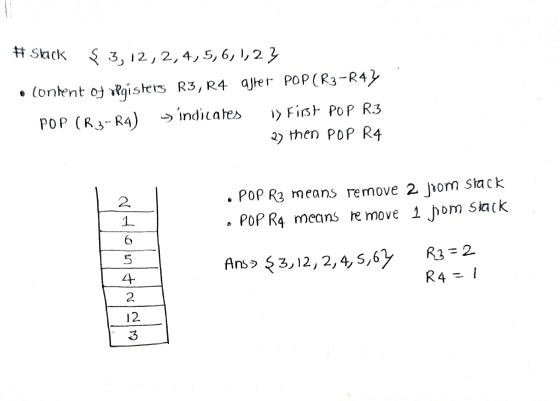
If stack is given as { 3 (bottom element) ,12, 2, 4, 5, 6, 1, 2(top element ) } .What will be the content of registers R3, R4 after the following operation: POP {R3-R4} .
Select one:
a. {3,12,2,4,5,6} , R3=2, R4=1
b. None
c. {1,2,6,5,4,2,} ,R3=12, R4=3
d. {3,12,2,4,5,6} , R3=1, R4=2
---------
KEIL
Homework Answers
Add Answer to:
If stack is given as { 3 (bottom element) ,12, 2, 4, 5,
6, 1, 2(top...
Stack Operation 10. (10 pts.) Show the contents of the stack and affected registers at the two marked points in the exe...
 Stack Operation 10. (10 pts.) Show the contents of the stack and affected registers at the two marked points in the execution of the followin code. Assume RO-0, R1-1, R2-2, R3-3, R4-4, R5-5, and R6-6. The initial value for stack pointer (prior to executing this code block) is given as SP-0x20001000 PUSH R2,R3) ADD R4, R1, Re ;<---A POP R5, R6) ADD R5, R5, R4 ADD R6, R6, R5 PUSH (R4-R6); SUBS Re, RO,R1-B a) Show the contents of Stack,...
Consider these functions: push() : push an element into the stack pop() : pop the top-of-the-stack...
Consider these functions: push() : push an element into the stack pop() : pop the top-of-the-stack element top() : returns the item stored in top-of-the-stack-node What will be the output after performing these sequence of operations (after performing top()) push(20); push(4); pop(); push(10); push(6); pop(); pop(); push(5); top();
explain this code, step by step (8) Question 2a. Assume initially R4-4, R5-5, R6-6, and R7-7...
 explain this code, step by step
(8) Question 2a. Assume initially R4-4, R5-5, R6-6, and R7-7 Consider the following assembly code PUSH IR5,R61 Top-) 5,6 Bottom R4 0 R5-3 ASR R4,R4,R7 EOR R7,R5,R6 R7 - 1012 1102-0112- 3 PUSH {R7,R4) Top-> 0,3,5,6 <-Bottom POP R7,R5, R4,R6 R4-0,R5-3,R6 5,R7-6 (stack empty) R6-5 R7-6 After executing these five instructions, what will be the final values for these four registers?
explain this code, step by step
(8) Question 2a. Assume initially R4-4, R5-5, R6-6, and R7-7 Consider the following assembly code PUSH IR5,R61 Top-) 5,6 Bottom R4 0 R5-3 ASR R4,R4,R7 EOR R7,R5,R6 R7 - 1012 1102-0112- 3 PUSH {R7,R4) Top-> 0,3,5,6 <-Bottom POP R7,R5, R4,R6 R4-0,R5-3,R6 5,R7-6 (stack empty) R6-5 R7-6 After executing these five instructions, what will be the final values for these four registers?
Say R1 = 5, R2 = 6. Push or pop the following registers to the stack...
Say R1 = 5, R2 = 6. Push or pop the following registers to the stack and see if they are equal. Specify the top and bottom of the stack. push {r2, r1} pop{r2, r1} AND push {r1, r2} pop{r2} pop{r1} AND Push {r1} Push{r2} Pop {r1, r2} Are these operations equivalent?
1. To implement a stack as an array, the top element would be the one with...
1. To implement a stack as an array, the top element would be the one with the lowest index. True or false 2. In a doubly-linked list, a node can be removed in constant time if you already have the reference to the node. True or false 3. Stack operations (push, pop, isEmpty) can be worst-case O(1) for a linked list implementation True or false
4. Given a stack variable stk which provides a push operation that places an integer o...
 4. Given a stack variable stk which provides a push operation that places an integer o top of the stack, and a pop operation which removes and returns the integer from t top of the stack, what would the stack look like, after the following code executed? for(int k 1; k < 10; k++) if(k % 3 :0) stk.push( k+ stk.pop()); else stk.push( k); 25. Given a queue variable que which provides an add operation which places an integer at...
Help asap 24. Given a stack variable stk which provides a push operation that places an...
 Help asap
24. Given a stack variable stk which provides a push operation that places an integer on he stack, and a pop operation which removes and returns the integer from t top of the stack, what would the stack look like, after the following code executed? top of t for(int k 1; k < 10; k++) if(k % 3 :0) stk.push( k+ stk.pop()); else stk.push( k);
Help asap
24. Given a stack variable stk which provides a push operation that places an integer on he stack, and a pop operation which removes and returns the integer from t top of the stack, what would the stack look like, after the following code executed? top of t for(int k 1; k < 10; k++) if(k % 3 :0) stk.push( k+ stk.pop()); else stk.push( k);
Suppose we execute the following stack operations on a stack of ints. push(1); pop(); // #1...
Suppose we execute the following stack operations on a stack of ints. push(1); pop(); // #1 push(10); pop(); // #2 push(7); push(4); push(3); pop(); // #3 push(5); pop(); //#4 Write the final state of the stack, and for each pop() operation, write the value that will be popped off the stack (pops are numbered so you can refer to them).
Given the following (1) EET (2) ET (3) TIF (4) TF (5) F→ (E) (6) Fņa...
 Given the following (1) EET (2) ET (3) TIF (4) TF (5) F→ (E) (6) Fņa a + 1) ETF . 1 2 3 55 - - - 56 r2 r4 - . 57 r4 54 . - . - . r2 . E. - - - 54 54 - . . . 6 . 3 5 - - 11 - r157 r11 3 . 13 13 5 . r5 r5 Trace iti$ Stack Input
Which of the following terms is NOT associated with a stack? push top get bottom Flag...
Which of the following terms is NOT associated with a stack? push top get bottom Flag this Question Question 21 pts Which of the following terms is NOT associated with a queue? add front FIFO enqueue pop Flag this Question Question 31 pts A stack exhibits what kind of behavior? Last In, First Out (LIFO) First In, First Out (FIFO) Last In, Last Out (LILO) Read-Only Write-Only Flag this Question Question 41 pts What are the final contents of myQueue...
 Stack Operation 10. (10 pts.) Show the contents of the stack and affected registers at the two marked points in the execution of the followin code. Assume RO-0, R1-1, R2-2, R3-3, R4-4, R5-5, and R6-6. The initial value for stack pointer (prior to executing this code block) is given as SP-0x20001000 PUSH R2,R3) ADD R4, R1, Re ;<---A POP R5, R6) ADD R5, R5, R4 ADD R6, R6, R5 PUSH (R4-R6); SUBS Re, RO,R1-B a) Show the contents of Stack,...
 explain this code, step by step
(8) Question 2a. Assume initially R4-4, R5-5, R6-6, and R7-7 Consider the following assembly code PUSH IR5,R61 Top-) 5,6 Bottom R4 0 R5-3 ASR R4,R4,R7 EOR R7,R5,R6 R7 - 1012 1102-0112- 3 PUSH {R7,R4) Top-> 0,3,5,6 <-Bottom POP R7,R5, R4,R6 R4-0,R5-3,R6 5,R7-6 (stack empty) R6-5 R7-6 After executing these five instructions, what will be the final values for these four registers?
explain this code, step by step
(8) Question 2a. Assume initially R4-4, R5-5, R6-6, and R7-7 Consider the following assembly code PUSH IR5,R61 Top-) 5,6 Bottom R4 0 R5-3 ASR R4,R4,R7 EOR R7,R5,R6 R7 - 1012 1102-0112- 3 PUSH {R7,R4) Top-> 0,3,5,6 <-Bottom POP R7,R5, R4,R6 R4-0,R5-3,R6 5,R7-6 (stack empty) R6-5 R7-6 After executing these five instructions, what will be the final values for these four registers?
 4. Given a stack variable stk which provides a push operation that places an integer o top of the stack, and a pop operation which removes and returns the integer from t top of the stack, what would the stack look like, after the following code executed? for(int k 1; k < 10; k++) if(k % 3 :0) stk.push( k+ stk.pop()); else stk.push( k); 25. Given a queue variable que which provides an add operation which places an integer at...
 Help asap
24. Given a stack variable stk which provides a push operation that places an integer on he stack, and a pop operation which removes and returns the integer from t top of the stack, what would the stack look like, after the following code executed? top of t for(int k 1; k < 10; k++) if(k % 3 :0) stk.push( k+ stk.pop()); else stk.push( k);
Help asap
24. Given a stack variable stk which provides a push operation that places an integer on he stack, and a pop operation which removes and returns the integer from t top of the stack, what would the stack look like, after the following code executed? top of t for(int k 1; k < 10; k++) if(k % 3 :0) stk.push( k+ stk.pop()); else stk.push( k);
 Given the following (1) EET (2) ET (3) TIF (4) TF (5) F→ (E) (6) Fņa a + 1) ETF . 1 2 3 55 - - - 56 r2 r4 - . 57 r4 54 . - . - . r2 . E. - - - 54 54 - . . . 6 . 3 5 - - 11 - r157 r11 3 . 13 13 5 . r5 r5 Trace iti$ Stack Input
Most questions answered within 3 hours.
-
Where is the error in this code sequence?
String s1 = "Hello";
String s2 = "ello";...
asked 10 months ago -
Financial data for Joel de Paris, Inc., for last year
follow:
Joel de Paris, Inc.
Balance...
asked 10 months ago -
Consider this reaction:
Al2(SO4)3 (aq)+ BaCl3
(aq) Al2Cl6 (aq)- +
3BaSO4(s) . What is the...
asked 10 months ago -
Suppose that Savneet is considering increasing her
recent random sample from 20 car rentals to 40...
asked 10 months ago -
Trucks arrive at an unloading terminal at an average rate of 120
per hour.
Trucks arrive...
asked 10 months ago -
Why are methanol and ethanol completely soluble in water while
octanol is not very little soluble....
asked 10 months ago -
A facilities manager at a university reads in a research report
that the mean amount of...
asked 10 months ago -
When the CuSO4 is rehydrated by adding water to the anhydrous
compound, is this an endothermic...
asked 10 months ago -
A ray of sunlight is passing from diamond into crown glass; the
angle of incidence is...
asked 10 months ago -
A block of mass 0.249 kg is placed on top of a light, vertical
spring of...
asked 10 months ago -
how do the kidneys compensate in the presences of acidosis
a) trigger hyperventilate
b) reserve acid...
asked 10 months ago -
Question 501 pts
The rental rate of capital to the firm increases. Which of the
following...
asked 10 months ago