
Homework Answers
JK Flip-flop is in toggle mode and it is triggering with negative edge clock of A signal and JK has two clock edges. D Flip-flop is triggering with positive clock edge which is B signal.
Initial states of Q1 and Q2 are at zero.
During edge 1 of B, Q2 is 0 up to edge 2 of B. Q1 is toggle mode and output Q1 is 1 up to edge of 2 of B and Q1 is 0 from edge 2 of edge 6 B because reset is active.

Add Answer to:
3.5. Suppose the initial states for Q1 and Q2 are 0. Draw the waveform for QI...
9. Let Q1 S Q2 be the eigenvalues of the matrix A and Qs 1 if Qi is a defective eigenvalue and Q....
 9. Let Q1 S Q2 be the eigenvalues of the matrix A and Qs 1 if Qi is a defective eigenvalue and Q. - 0 otherwise, where 86 100 01-81-94 T < 1 Let Q = 1013 + IQ1 + 2(Qal + 3(Qal). Then T = 5 sin2(100Q) satisfies:-(A) 0 (B) 1 T < 2.
9. Let Q1 S Q2 be the eigenvalues of the matrix A and Qs 1 if Qi is a defective eigenvalue and Q. - 0...
9. Let Q1 S Q2 be the eigenvalues of the matrix A and Qs 1 if Qi is a defective eigenvalue and Q. - 0 otherwise, where 86 100 01-81-94 T < 1 Let Q = 1013 + IQ1 + 2(Qal + 3(Qal). Then T = 5 sin2(100Q) satisfies:-(A) 0 (B) 1 T < 2.
9. Let Q1 S Q2 be the eigenvalues of the matrix A and Qs 1 if Qi is a defective eigenvalue and Q. - 0...
Consider the NFA N with states labeled q1, q2 and q3, where q1 is the start...
Consider the NFA N with states labeled q1, q2 and q3, where q1 is the start state and q2 and q3 are the final (accepting) states. The transition function for N is δ(q1,a) = {q1}, δ(q1,b) = {q1,q2}, δ(q2,a) = {q3}, δ(q2,b)= ∅, δ(q3,a)= ∅, and δ(q3,b)= ∅. Let L be the language recognized by N i.e. L(N). a) Draw the state diagram for N. b) Describe in plain English what's in the language L. c) Via the construction NFA to...
2.3.3. Suppose a and d are positive integers, and suppose also that qi and r (i...
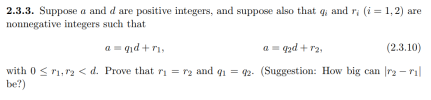 2.3.3. Suppose a and d are positive integers, and suppose also that qi and r (i 1,2) are nonnegative integers such that (2.3.10) with 0 S ri, r2 < d. Prove that r be?) 2 and q1-q2. (Suggestion: How big can r2 il
Constants Two point charges qi and q2 are held 4.00 cm apart. An electron released at...
 Constants Two point charges qi and q2 are held 4.00 cm apart. An electron released at a point that is equidistant from both charges (see the figure (Figure 1)) undergoes an initial acceleration of 8.80x10¹⁸ m/s2 directly upward in the figure parallel to the line connecting q1 and q2 Part A Find the magnitude and sign of qi and q2 Figure 1 of 1 Submit Request Answer Part B 00 cm I Submit Request Answer
Consider machine M (Q. Σ , Γ, δ, q1, qaccept, qreject), where Q ,{qi, q2, gs, qaccept, qreject}, Σ as follows: { 0.1 } , Γ { 0.1 U } , and the transition function δ is δ (qi. Ú)-(qreject, U, R) δ (qi...
 Consider machine M (Q. Σ , Γ, δ, q1, qaccept, qreject), where Q ,{qi, q2, gs, qaccept, qreject}, Σ as follows: { 0.1 } , Γ { 0.1 U } , and the transition function δ is δ (qi. Ú)-(qreject, U, R) δ (qi, 0)-(P-0, R) -(Gaccept, Prove that M is NOT a decider Describe in mathematical terms the language A that M recognises, and verify 1. your answer, ie prove that A- L(M)
Consider machine M (Q. Σ ,...
Consider machine M (Q. Σ , Γ, δ, q1, qaccept, qreject), where Q ,{qi, q2, gs, qaccept, qreject}, Σ as follows: { 0.1 } , Γ { 0.1 U } , and the transition function δ is δ (qi. Ú)-(qreject, U, R) δ (qi, 0)-(P-0, R) -(Gaccept, Prove that M is NOT a decider Describe in mathematical terms the language A that M recognises, and verify 1. your answer, ie prove that A- L(M)
Consider machine M (Q. Σ ,...
1. Suppose the utility function for goods q1 and q2 is given by U(q1, q2) =...
1. Suppose the utility function for goods q1 and q2 is given by U(q1, q2) = q1q2 + q2 (a) Calculate the uncompensated (Marshallian) demand functions for q1 and q2 (b) Describe how the uncompensated demand curves for q1 and q2 are shifted by changes in income (Y) or the price of the other good. (c) Calculate the expenditure function for q1 and q2 such that minimum expenditure = E(p1, p2, U) (d) Use the expenditure function calculated in part...
Suppose two firms compete by selecting quantities q1 and q2, respectively, with the market price given...
Suppose two firms compete by selecting quantities q1 and q2, respectively, with the market price given by p = 1000-3q1 -3q2. Firm 1 (the incumbent) is already in the market. Firm 2 (the potential entrant) must decide whether or not to enter and, if she enters, how much to produce. First the incumbent commits to its production level q2. The potential entrant, having seen q1, decides whether to enter the industry. If firm 2 chooses to enter, then it selects...
Two point charges, Q1 = 3.5 μC and Q2 = -2.1 μC , are placed on...
Two point charges, Q1 = 3.5 μC and Q2 = -2.1 μC , are placed on the x axis. Suppose that Q2 is placed at the origin, and Q1 is placed at the coordinate x1 = − 5.0 cm. Part A: At what point(s) along the x axis is the electric field zero? Determine the x-coordinate(s) of the point(s). Express your answer using two significant figures. If there is more than one answer, enter your answers in ascending order separated...
5) A point charge Q =-500 nC and two unknown point charges, q1 and q2, are...
 5) A point charge Q =-500 nC and two unknown point charges, q1 and q2, are placed as 5) shown in the figure. The electric field at the origin O, due to charges 0, qi and q2, is equal to zero. The charge qi is closest to 30° 41 O 1.1 m 1.3 m 92 A) B)
The figure shows three charges qi, q2 and q3 situated at corners of a rectangle of...
 The figure shows three charges qi, q2 and q3 situated at corners of a rectangle of sides a = 14.0 cm and b 8.0 cm. 2 For q1 = 5.00 μC, q2 =-5.00 μC, and q3-2.30 μC find the electric potential at the center of the rectangle. 2.56×10⁵ V You are correct. Previous Tries Continuing with the figure above, how much of the electric energy of the system would be expended in moving q3 to infinity while q1 and q2...
 9. Let Q1 S Q2 be the eigenvalues of the matrix A and Qs 1 if Qi is a defective eigenvalue and Q. - 0 otherwise, where 86 100 01-81-94 T < 1 Let Q = 1013 + IQ1 + 2(Qal + 3(Qal). Then T = 5 sin2(100Q) satisfies:-(A) 0 (B) 1 T < 2.
9. Let Q1 S Q2 be the eigenvalues of the matrix A and Qs 1 if Qi is a defective eigenvalue and Q. - 0...
9. Let Q1 S Q2 be the eigenvalues of the matrix A and Qs 1 if Qi is a defective eigenvalue and Q. - 0 otherwise, where 86 100 01-81-94 T < 1 Let Q = 1013 + IQ1 + 2(Qal + 3(Qal). Then T = 5 sin2(100Q) satisfies:-(A) 0 (B) 1 T < 2.
9. Let Q1 S Q2 be the eigenvalues of the matrix A and Qs 1 if Qi is a defective eigenvalue and Q. - 0...
 2.3.3. Suppose a and d are positive integers, and suppose also that qi and r (i 1,2) are nonnegative integers such that (2.3.10) with 0 S ri, r2 < d. Prove that r be?) 2 and q1-q2. (Suggestion: How big can r2 il
 Constants Two point charges qi and q2 are held 4.00 cm apart. An electron released at a point that is equidistant from both charges (see the figure (Figure 1)) undergoes an initial acceleration of 8.80x10¹⁸ m/s2 directly upward in the figure parallel to the line connecting q1 and q2 Part A Find the magnitude and sign of qi and q2 Figure 1 of 1 Submit Request Answer Part B 00 cm I Submit Request Answer
 Consider machine M (Q. Σ , Γ, δ, q1, qaccept, qreject), where Q ,{qi, q2, gs, qaccept, qreject}, Σ as follows: { 0.1 } , Γ { 0.1 U } , and the transition function δ is δ (qi. Ú)-(qreject, U, R) δ (qi, 0)-(P-0, R) -(Gaccept, Prove that M is NOT a decider Describe in mathematical terms the language A that M recognises, and verify 1. your answer, ie prove that A- L(M)
Consider machine M (Q. Σ ,...
Consider machine M (Q. Σ , Γ, δ, q1, qaccept, qreject), where Q ,{qi, q2, gs, qaccept, qreject}, Σ as follows: { 0.1 } , Γ { 0.1 U } , and the transition function δ is δ (qi. Ú)-(qreject, U, R) δ (qi, 0)-(P-0, R) -(Gaccept, Prove that M is NOT a decider Describe in mathematical terms the language A that M recognises, and verify 1. your answer, ie prove that A- L(M)
Consider machine M (Q. Σ ,...
 5) A point charge Q =-500 nC and two unknown point charges, q1 and q2, are placed as 5) shown in the figure. The electric field at the origin O, due to charges 0, qi and q2, is equal to zero. The charge qi is closest to 30° 41 O 1.1 m 1.3 m 92 A) B)
 The figure shows three charges qi, q2 and q3 situated at corners of a rectangle of sides a = 14.0 cm and b 8.0 cm. 2 For q1 = 5.00 μC, q2 =-5.00 μC, and q3-2.30 μC find the electric potential at the center of the rectangle. 2.56×10⁵ V You are correct. Previous Tries Continuing with the figure above, how much of the electric energy of the system would be expended in moving q3 to infinity while q1 and q2...
Most questions answered within 3 hours.
-
Where is the error in this code sequence?
String s1 = "Hello";
String s2 = "ello";...
asked 10 months ago -
Financial data for Joel de Paris, Inc., for last year
follow:
Joel de Paris, Inc.
Balance...
asked 10 months ago -
Consider this reaction:
Al2(SO4)3 (aq)+ BaCl3
(aq) Al2Cl6 (aq)- +
3BaSO4(s) . What is the...
asked 10 months ago -
Suppose that Savneet is considering increasing her
recent random sample from 20 car rentals to 40...
asked 10 months ago -
Trucks arrive at an unloading terminal at an average rate of 120
per hour.
Trucks arrive...
asked 10 months ago -
Why are methanol and ethanol completely soluble in water while
octanol is not very little soluble....
asked 10 months ago -
A facilities manager at a university reads in a research report
that the mean amount of...
asked 10 months ago -
When the CuSO4 is rehydrated by adding water to the anhydrous
compound, is this an endothermic...
asked 10 months ago -
A ray of sunlight is passing from diamond into crown glass; the
angle of incidence is...
asked 10 months ago -
A block of mass 0.249 kg is placed on top of a light, vertical
spring of...
asked 10 months ago -
how do the kidneys compensate in the presences of acidosis
a) trigger hyperventilate
b) reserve acid...
asked 10 months ago -
Question 501 pts
The rental rate of capital to the firm increases. Which of the
following...
asked 10 months ago