Consider a hydrogen atom with radius R=5.29×10^-11 m. Treat the orbiting electron as a current loop....
Consider a hydrogen atom with radius R=5.29×10^-11 m.
Treat the orbiting electron as a current loop. If this electron
proton system is placed in a magnetic field of 0.400T which is
perpendicular to the magnetic moment of the loop, what is the
torque?
Homework Answers
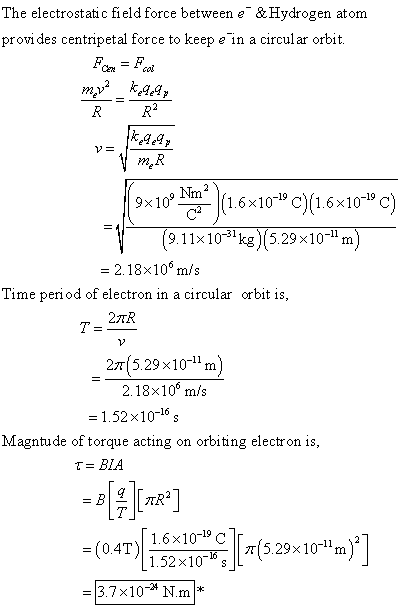
Add Answer to:
Consider a hydrogen atom with radius R=5.29×10^-11 m.
Treat the orbiting electron as a current loop....
Consider a hydrogen atom with radius R=5.29×10^-11 m. Treat the orbiting electron as a current loop....
Consider a hydrogen atom with radius R=5.29×10^-11 m. Treat the orbiting electron as a current loop. If this electron proton system is placed in a magnetic field of 0.400T which is perpendicular to the magnetic moment of the loop, what is the torque?
5. Consider a Hydrogen atom with radius R = 5.29x10m. current loop. If Treat the orbiting...
 5. Consider a Hydrogen atom with radius R = 5.29x10m. current loop. If Treat the orbiting electron as a this electron-proton system is placed in a magnetic field of 0.400T which is perpendicular to the magnetic moment of the loop, what is the torque ? (me = 9.11x10⁻³¹ kg 191- 1.60*10-19 C)
ON as Consider Hydrogen atom with radius R = 5.29x10 m. Treat the orbiting electron current...
 ON as Consider Hydrogen atom with radius R = 5.29x10 m. Treat the orbiting electron current loop. If this electron-proton system is placed in a magnetic field of 0.400 T which is perpendicular to the magnetic moment of the loop, what is the torque ? (me=9.11*10-31 kg 191-1.60x10¹⁹C
with required formula the position 5. Consider a electron as Hydrogen atom with radius R =...
 with required formula
the position 5. Consider a electron as Hydrogen atom with radius R = 5.29x10"m. current loop. If Treat the on orbiting this electron-proton system is placed in a magnetic field of 0.400T which is perpendicular to the magnetic moment of the loop, what is the torque ? (me = 9.11*10-31 kg , 1968- 1.60*10'SC)
with required formula
the position 5. Consider a electron as Hydrogen atom with radius R = 5.29x10"m. current loop. If Treat the on orbiting this electron-proton system is placed in a magnetic field of 0.400T which is perpendicular to the magnetic moment of the loop, what is the torque ? (me = 9.11*10-31 kg , 1968- 1.60*10'SC)
2. An electron moves in a circle of radius r = 5.66 x 10⁻¹¹ m with...
 2. An electron moves in a circle of radius r = 5.66 x 10⁻¹¹ m with a speed 2.09 x 10 m/s. Treat the circular path as a current loop with a constant current equal to the ratio of the electrons charge magnitude to the period of the motion. If the circle lies in a uniform magnetic field of magnitude B = 6.39 mT, what is the maximum possible magnitude of the torque, T, produced on the loop by the...
An electron moves in a circle of radius r = 5.26 × 10⁻¹¹ m with a...
An electron moves in a circle of radius r = 5.26 × 10⁻¹¹ m with a speed 2.54 × 10⁶ m/s. Treat the circular path as a current loop with a constant current equal to the ratio of the electron's charge magnitude to the period of the motion. If the circle lies in a uniform magnetic field of magnitude B = 7.31 mT, what is the maximum possible magnitude of the torque produced on the loop by the field?
The electron and the protone of a hydrogen atom in the basic condition are r=5.29·10-11 m...
 The electron and the protone of a hydrogen atom in the basic
condition are r=5.29·10-11
m From each other, and the gravity between them is
FG=3.63·10-47
N. If their electric charge was respectively.
-q And
+q Instead of the Elemar, what should
q So be that the electrical
cancer between them was the same size as the
FG?
The electron and the protone of a hydrogen atom in the basic
condition are r=5.29·10-11
m From each other, and the gravity between them is
FG=3.63·10-47
N. If their electric charge was respectively.
-q And
+q Instead of the Elemar, what should
q So be that the electrical
cancer between them was the same size as the
FG?
A flat circular loop of wire of radius R carrying a current I is placed in...
 A flat circular loop of wire of radius R carrying a current I is placed in a uniform magnetic field B that is directed in the plane of the current loop. What is the magnetic moment M of the loop? What is the magnitude of the torque acting on the loop? In which direction the loop will rotate under the influence of this torque?
Question 1: Consider the following situation: For the hydrogen atom in its ground state pictured on...
 Question 1: Consider the following situation: For the hydrogen atom in its ground state pictured on the right, classically orbiting at the Bohr Radius 20 = 5.29 + 10-11m, calculate: a) The speed the electron is traveling at. b) The angular momentum 1 =7 x 5 of the electron. Compare it to = 1.055 10-34J.s. c) The magnetic field due to the electron at the position of the proton. Is it into the page or out of the page? on-...
Consider a hydrogen atom modeled as a stationary proton with an electron orbiting in uniform circular...
 Consider a hydrogen atom modeled as a stationary proton with an electron orbiting in uniform circular motion. The radius of the orbit is a value given the name Bohr radius (you will have to look up this value). Calculate the total energy required to ionize the hydrogen atom.
 5. Consider a Hydrogen atom with radius R = 5.29x10m. current loop. If Treat the orbiting electron as a this electron-proton system is placed in a magnetic field of 0.400T which is perpendicular to the magnetic moment of the loop, what is the torque ? (me = 9.11x10⁻³¹ kg 191- 1.60*10-19 C)
 ON as Consider Hydrogen atom with radius R = 5.29x10 m. Treat the orbiting electron current loop. If this electron-proton system is placed in a magnetic field of 0.400 T which is perpendicular to the magnetic moment of the loop, what is the torque ? (me=9.11*10-31 kg 191-1.60x10¹⁹C
 with required formula
the position 5. Consider a electron as Hydrogen atom with radius R = 5.29x10"m. current loop. If Treat the on orbiting this electron-proton system is placed in a magnetic field of 0.400T which is perpendicular to the magnetic moment of the loop, what is the torque ? (me = 9.11*10-31 kg , 1968- 1.60*10'SC)
with required formula
the position 5. Consider a electron as Hydrogen atom with radius R = 5.29x10"m. current loop. If Treat the on orbiting this electron-proton system is placed in a magnetic field of 0.400T which is perpendicular to the magnetic moment of the loop, what is the torque ? (me = 9.11*10-31 kg , 1968- 1.60*10'SC)
 2. An electron moves in a circle of radius r = 5.66 x 10⁻¹¹ m with a speed 2.09 x 10 m/s. Treat the circular path as a current loop with a constant current equal to the ratio of the electrons charge magnitude to the period of the motion. If the circle lies in a uniform magnetic field of magnitude B = 6.39 mT, what is the maximum possible magnitude of the torque, T, produced on the loop by the...
 The electron and the protone of a hydrogen atom in the basic
condition are r=5.29·10-11
m From each other, and the gravity between them is
FG=3.63·10-47
N. If their electric charge was respectively.
-q And
+q Instead of the Elemar, what should
q So be that the electrical
cancer between them was the same size as the
FG?
The electron and the protone of a hydrogen atom in the basic
condition are r=5.29·10-11
m From each other, and the gravity between them is
FG=3.63·10-47
N. If their electric charge was respectively.
-q And
+q Instead of the Elemar, what should
q So be that the electrical
cancer between them was the same size as the
FG?
 A flat circular loop of wire of radius R carrying a current I is placed in a uniform magnetic field B that is directed in the plane of the current loop. What is the magnetic moment M of the loop? What is the magnitude of the torque acting on the loop? In which direction the loop will rotate under the influence of this torque?
 Question 1: Consider the following situation: For the hydrogen atom in its ground state pictured on the right, classically orbiting at the Bohr Radius 20 = 5.29 + 10-11m, calculate: a) The speed the electron is traveling at. b) The angular momentum 1 =7 x 5 of the electron. Compare it to = 1.055 10-34J.s. c) The magnetic field due to the electron at the position of the proton. Is it into the page or out of the page? on-...
 Consider a hydrogen atom modeled as a stationary proton with an electron orbiting in uniform circular motion. The radius of the orbit is a value given the name Bohr radius (you will have to look up this value). Calculate the total energy required to ionize the hydrogen atom.
Most questions answered within 3 hours.
-
Where is the error in this code sequence?
String s1 = "Hello";
String s2 = "ello";...
asked 10 months ago -
Financial data for Joel de Paris, Inc., for last year
follow:
Joel de Paris, Inc.
Balance...
asked 10 months ago -
Consider this reaction:
Al2(SO4)3 (aq)+ BaCl3
(aq) Al2Cl6 (aq)- +
3BaSO4(s) . What is the...
asked 10 months ago -
Suppose that Savneet is considering increasing her
recent random sample from 20 car rentals to 40...
asked 10 months ago -
Trucks arrive at an unloading terminal at an average rate of 120
per hour.
Trucks arrive...
asked 10 months ago -
Why are methanol and ethanol completely soluble in water while
octanol is not very little soluble....
asked 10 months ago -
A facilities manager at a university reads in a research report
that the mean amount of...
asked 10 months ago -
When the CuSO4 is rehydrated by adding water to the anhydrous
compound, is this an endothermic...
asked 10 months ago -
A ray of sunlight is passing from diamond into crown glass; the
angle of incidence is...
asked 10 months ago -
A block of mass 0.249 kg is placed on top of a light, vertical
spring of...
asked 10 months ago -
how do the kidneys compensate in the presences of acidosis
a) trigger hyperventilate
b) reserve acid...
asked 10 months ago -
Question 501 pts
The rental rate of capital to the firm increases. Which of the
following...
asked 10 months ago