its a numerical analysis question
Homework Answers
![من (24) لمه JE [] 29 ال After first iteration x=2.106, og = 4.868 D: 32 -4 0 = 2S 4 4 6- 28 -0.63S1 60142 -6042 6042 4:56 014](http://img.homeworklib.com/questions/7a3a0f10-d726-11ea-aa3f-9f40864bfe45.png?x-oss-process=image/resize,w_560)
Add Answer to:
its a numerical analysis question
QUESTION 4 (a) A natural cubic spline that fits the data...
QUESTION 4 (10) (a) A natural cubic spline that fits the data given by f(3.0) =...
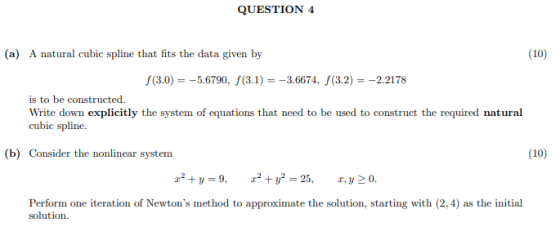
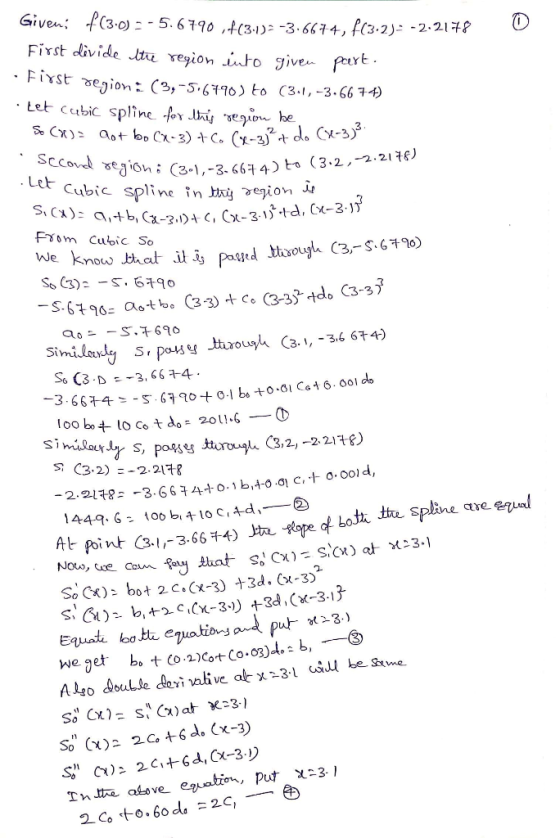
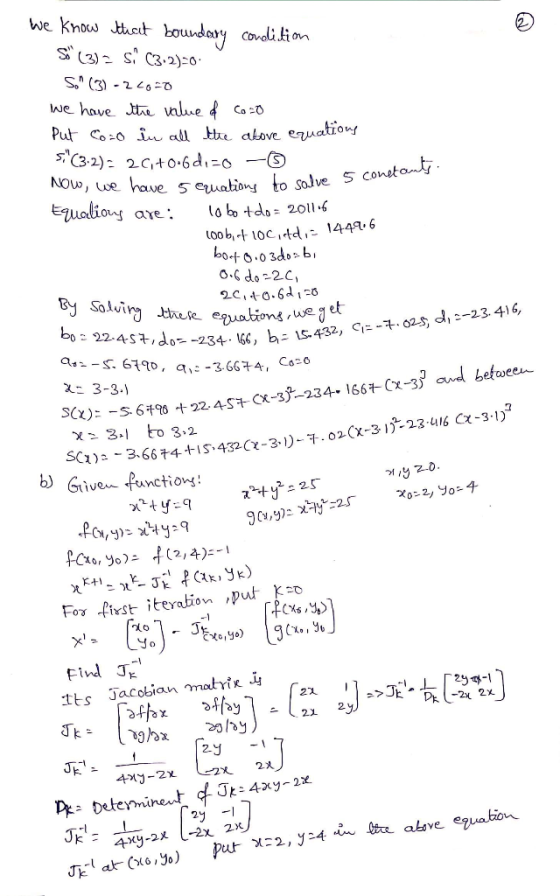
 QUESTION 4 (10) (a) A natural cubic spline that fits the data given by f(3.0) = -5.6790, f(3.1) = -3.6674, f(3.2) = -2.2178 is to be constructed. Write down explicitly the system of equations that need to be used to construct the required natural cubic spline. (b) Consider the nonlinear system (10) 2+y=9, 22 + y2 = 25, 2,y> 0. Perform one iteration of Newton's method to approximate the solution, starting with (2, 4) as the initial solution. [20]
QUESTION 4 (a) A natural cubic spline that fits the data given by f(3.0) = -5.6790,...
 QUESTION 4 (a) A natural cubic spline that fits the data given by f(3.0) = -5.6790, F (3.1) = -3.6674, f(3.2) = -2.2178 is to be constructed. Write down explicitly the system of equations that need to be used to construct the required natural cubic spline. (b) Consider the nonlinear system x2 + y = 9, 22 + y2 = 25, x, y > 0. Perform one iteration of Newton's method to approximate the solution, starting with (2, 4) as...
QUESTION 4 (10) (a) A natural cubic spline that fits the data given by f(3.0) =...
 QUESTION 4 (10) (a) A natural cubic spline that fits the data given by f(3.0) = -5.6790, (3.1) = -3.6674, f(3.2) = -2.2178 is to be constructed. Write down explicitly the system of equations that need to be used to construct the required natural cubic spline.
(b) Consider the nonlinear system (10) IP +y = 9 r? + y2 = 25, *20....
 (b) Consider the nonlinear system (10) IP +y = 9 r? + y2 = 25, *20. Perform one iteration of Newton's method to approximate the solution, starting with (2, 4) as the initial solution [20]
course: Numerical analysis 3. Consider Rosenbrock's banane valley function f(x,y) = (x-1) + 100 (4-x², henceforth...
 course: Numerical analysis
3. Consider Rosenbrock's banane valley function f(x,y) = (x-1) + 100 (4-x², henceforth called the banana function. (a) Compute the gradient I f(x,y) of the banana function (6) Using (xo, Yo) = (-1.2, 1.0) as an initial point perform one iteration of the method of steepest, descent to explicitly find (X,Y). Refer to attached graph of level curves of the banana function. (XY)(-1.0301067/27..., 1.069344-19888...) and f(X,Y) S 401280972736-n, (c) Using (xoxo) = (-1-2, 1.0) as an initial...
course: Numerical analysis
3. Consider Rosenbrock's banane valley function f(x,y) = (x-1) + 100 (4-x², henceforth called the banana function. (a) Compute the gradient I f(x,y) of the banana function (6) Using (xo, Yo) = (-1.2, 1.0) as an initial point perform one iteration of the method of steepest, descent to explicitly find (X,Y). Refer to attached graph of level curves of the banana function. (XY)(-1.0301067/27..., 1.069344-19888...) and f(X,Y) S 401280972736-n, (c) Using (xoxo) = (-1-2, 1.0) as an initial...
hele please 2. Will the 14 -1 01 (e) Let A = -1 4 -1, b...
 hele please
2. Will the 14 -1 01 (e) Let A = -1 4 -1, b E R3. The eigenvalues of A are 4, 4 0-14 Jacobi iteration converge to a solution of Ax=b? Explain. (f) Consider the 2 x 2 nonlinear system of equations for x = 0, y): cy=1 =y What are the two solutions of this system of equations? What is the set of all starting points for which Newton's method will immediately fail?
hele please
2. Will the 14 -1 01 (e) Let A = -1 4 -1, b E R3. The eigenvalues of A are 4, 4 0-14 Jacobi iteration converge to a solution of Ax=b? Explain. (f) Consider the 2 x 2 nonlinear system of equations for x = 0, y): cy=1 =y What are the two solutions of this system of equations? What is the set of all starting points for which Newton's method will immediately fail?
this is numerical analysis QUESTION 1 (a) Apart from 1 = 0 the equation f(1) =...
 this is numerical analysis
QUESTION 1 (a) Apart from 1 = 0 the equation f(1) = x2 - 4 sin r = 0 has another root in (1, 2.5). Perform three (10) iterations of the bisection method to approximate the root. State the accuracy of the root after the three iterations. (b) Perform three iterations of Newton's method for the function in (a) above, using x) = 1.5 as the initial (10) solution. Compare the error from the Newton's approximation...
this is numerical analysis
QUESTION 1 (a) Apart from 1 = 0 the equation f(1) = x2 - 4 sin r = 0 has another root in (1, 2.5). Perform three (10) iterations of the bisection method to approximate the root. State the accuracy of the root after the three iterations. (b) Perform three iterations of Newton's method for the function in (a) above, using x) = 1.5 as the initial (10) solution. Compare the error from the Newton's approximation...
Question 3 (a) Grven that f(-2)= 46, f(-1) 4, J(1) 1, f(3)= 156, and f(4)= 484, formula to estimate f(0) Use four-d...
 Question 3 (a) Grven that f(-2)= 46, f(-1) 4, J(1) 1, f(3)= 156, and f(4)= 484, formula to estimate f(0) Use four-decimal arithmetac with rounding use the Lagrange interpolation (8) (b) Why should the Lagrange formula be used in practice only with caution" (2) (e) Wnte down the system of equations that need to be solved in order Function for the following data to construct the natural cubic spline 30 -5 6790 -3 6674 3 1 32-22178 (8) Note You...
Question 3 (a) Consider the data. 00 0 25 0.5 05 () Construct the divaded difference's table for the data (u) Co...
 Question 3 (a) Consider the data. 00 0 25 0.5 05 () Construct the divaded difference's table for the data (u) Construct the Newton form of the polynomial of lowest degree that interpolates /() at these points (3) (ii) Suppose that these data were generated by the function cos 2 ()=1+ 2 Use the next term rule to approximate the error Ip(z)- f() over the interval 0,0 5 Your answer should be a pumber 3 (b) Let F ((z) co+...
OU USE 4A14 ILIS MATH2114_1950) Student Test Page - Numerical Question Question 5 (2 marks) Attempt...
 OU USE 4A14 ILIS MATH2114_1950) Student Test Page - Numerical Question Question 5 (2 marks) Attempt 1 An autonomous system of two first order differential equations can be written as: dy = f(uu), ulto)=u, die = g(u, v), vſto)=vo. A third order explicit Runge-Kutta scheme for an autonomous system of two first order equations is ki = hf(Un, Un), l1 = hg( m, Une) k2 = hf(Wq+şkı,un +şl1). 12 = hg(Un +şk1, 0n +341), k3 = hf(Wn+şk2,vn +şla), 13 =...
 QUESTION 4 (10) (a) A natural cubic spline that fits the data given by f(3.0) = -5.6790, f(3.1) = -3.6674, f(3.2) = -2.2178 is to be constructed. Write down explicitly the system of equations that need to be used to construct the required natural cubic spline. (b) Consider the nonlinear system (10) 2+y=9, 22 + y2 = 25, 2,y> 0. Perform one iteration of Newton's method to approximate the solution, starting with (2, 4) as the initial solution. [20]
 QUESTION 4 (a) A natural cubic spline that fits the data given by f(3.0) = -5.6790, F (3.1) = -3.6674, f(3.2) = -2.2178 is to be constructed. Write down explicitly the system of equations that need to be used to construct the required natural cubic spline. (b) Consider the nonlinear system x2 + y = 9, 22 + y2 = 25, x, y > 0. Perform one iteration of Newton's method to approximate the solution, starting with (2, 4) as...
 QUESTION 4 (10) (a) A natural cubic spline that fits the data given by f(3.0) = -5.6790, (3.1) = -3.6674, f(3.2) = -2.2178 is to be constructed. Write down explicitly the system of equations that need to be used to construct the required natural cubic spline.
 (b) Consider the nonlinear system (10) IP +y = 9 r? + y2 = 25, *20. Perform one iteration of Newton's method to approximate the solution, starting with (2, 4) as the initial solution [20]
 course: Numerical analysis
3. Consider Rosenbrock's banane valley function f(x,y) = (x-1) + 100 (4-x², henceforth called the banana function. (a) Compute the gradient I f(x,y) of the banana function (6) Using (xo, Yo) = (-1.2, 1.0) as an initial point perform one iteration of the method of steepest, descent to explicitly find (X,Y). Refer to attached graph of level curves of the banana function. (XY)(-1.0301067/27..., 1.069344-19888...) and f(X,Y) S 401280972736-n, (c) Using (xoxo) = (-1-2, 1.0) as an initial...
course: Numerical analysis
3. Consider Rosenbrock's banane valley function f(x,y) = (x-1) + 100 (4-x², henceforth called the banana function. (a) Compute the gradient I f(x,y) of the banana function (6) Using (xo, Yo) = (-1.2, 1.0) as an initial point perform one iteration of the method of steepest, descent to explicitly find (X,Y). Refer to attached graph of level curves of the banana function. (XY)(-1.0301067/27..., 1.069344-19888...) and f(X,Y) S 401280972736-n, (c) Using (xoxo) = (-1-2, 1.0) as an initial...
 hele please
2. Will the 14 -1 01 (e) Let A = -1 4 -1, b E R3. The eigenvalues of A are 4, 4 0-14 Jacobi iteration converge to a solution of Ax=b? Explain. (f) Consider the 2 x 2 nonlinear system of equations for x = 0, y): cy=1 =y What are the two solutions of this system of equations? What is the set of all starting points for which Newton's method will immediately fail?
hele please
2. Will the 14 -1 01 (e) Let A = -1 4 -1, b E R3. The eigenvalues of A are 4, 4 0-14 Jacobi iteration converge to a solution of Ax=b? Explain. (f) Consider the 2 x 2 nonlinear system of equations for x = 0, y): cy=1 =y What are the two solutions of this system of equations? What is the set of all starting points for which Newton's method will immediately fail?
 this is numerical analysis
QUESTION 1 (a) Apart from 1 = 0 the equation f(1) = x2 - 4 sin r = 0 has another root in (1, 2.5). Perform three (10) iterations of the bisection method to approximate the root. State the accuracy of the root after the three iterations. (b) Perform three iterations of Newton's method for the function in (a) above, using x) = 1.5 as the initial (10) solution. Compare the error from the Newton's approximation...
this is numerical analysis
QUESTION 1 (a) Apart from 1 = 0 the equation f(1) = x2 - 4 sin r = 0 has another root in (1, 2.5). Perform three (10) iterations of the bisection method to approximate the root. State the accuracy of the root after the three iterations. (b) Perform three iterations of Newton's method for the function in (a) above, using x) = 1.5 as the initial (10) solution. Compare the error from the Newton's approximation...
 Question 3 (a) Grven that f(-2)= 46, f(-1) 4, J(1) 1, f(3)= 156, and f(4)= 484, formula to estimate f(0) Use four-decimal arithmetac with rounding use the Lagrange interpolation (8) (b) Why should the Lagrange formula be used in practice only with caution" (2) (e) Wnte down the system of equations that need to be solved in order Function for the following data to construct the natural cubic spline 30 -5 6790 -3 6674 3 1 32-22178 (8) Note You...
 Question 3 (a) Consider the data. 00 0 25 0.5 05 () Construct the divaded difference's table for the data (u) Construct the Newton form of the polynomial of lowest degree that interpolates /() at these points (3) (ii) Suppose that these data were generated by the function cos 2 ()=1+ 2 Use the next term rule to approximate the error Ip(z)- f() over the interval 0,0 5 Your answer should be a pumber 3 (b) Let F ((z) co+...
 OU USE 4A14 ILIS MATH2114_1950) Student Test Page - Numerical Question Question 5 (2 marks) Attempt 1 An autonomous system of two first order differential equations can be written as: dy = f(uu), ulto)=u, die = g(u, v), vſto)=vo. A third order explicit Runge-Kutta scheme for an autonomous system of two first order equations is ki = hf(Un, Un), l1 = hg( m, Une) k2 = hf(Wq+şkı,un +şl1). 12 = hg(Un +şk1, 0n +341), k3 = hf(Wn+şk2,vn +şla), 13 =...
Most questions answered within 3 hours.
-
Where is the error in this code sequence?
String s1 = "Hello";
String s2 = "ello";...
asked 11 months ago -
Financial data for Joel de Paris, Inc., for last year
follow:
Joel de Paris, Inc.
Balance...
asked 11 months ago -
Consider this reaction:
Al2(SO4)3 (aq)+ BaCl3
(aq) Al2Cl6 (aq)- +
3BaSO4(s) . What is the...
asked 11 months ago -
Suppose that Savneet is considering increasing her
recent random sample from 20 car rentals to 40...
asked 11 months ago -
Trucks arrive at an unloading terminal at an average rate of 120
per hour.
Trucks arrive...
asked 11 months ago -
Why are methanol and ethanol completely soluble in water while
octanol is not very little soluble....
asked 11 months ago -
A facilities manager at a university reads in a research report
that the mean amount of...
asked 11 months ago -
When the CuSO4 is rehydrated by adding water to the anhydrous
compound, is this an endothermic...
asked 11 months ago -
A ray of sunlight is passing from diamond into crown glass; the
angle of incidence is...
asked 11 months ago -
A block of mass 0.249 kg is placed on top of a light, vertical
spring of...
asked 11 months ago -
how do the kidneys compensate in the presences of acidosis
a) trigger hyperventilate
b) reserve acid...
asked 11 months ago -
Question 501 pts
The rental rate of capital to the firm increases. Which of the
following...
asked 11 months ago