


Homework Answers

Add Answer to:
PLEASE HELP THX U
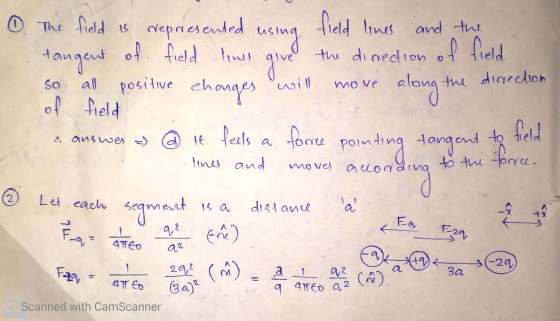
A positive charge is placed in an electric field. It starts at...
Make a qualitative sketch of the electric field lines produced by two equal positive charges, +q,...
 Make a qualitative sketch of the electric field lines produced by two equal positive charges, +q, that are separated by a distance d. How does your sketch change if one of the charges is instead negative? How does your sketch change if one of the charges is instead +2q? Gaussian surface 1 has twice the surface area of Gaussian surface 2. Both surfaces enclose the same charge, +Q. Is the electric flux through surface 1 greater than, less than, or...
8) A charge of +2 micro-coulombs is placed in a uniform electric field and electric force...
8) A charge of +2 micro-coulombs is placed in a uniform electric field and electric force acting on the charge is 14.7 Newtons in the +x direction. What is the magnitude of the electric field in x 106 N/C and in what direction is it? Indicate the -x direction, by including a negative sign. 9) A positive charge of 9 micro-coulombs with some mass is placed on a string and placed in a uniform electric field of 4.1 x 10⁶...
Please show all work and steps! 13.3 Electric Field - Discrete and Continuous Distributions 2A 2c0...
 Please show all work and steps!
13.3 Electric Field - Discrete and Continuous Distributions 2A 2c0 Separately, draw the electric field lines produced by a positive point charge +g: a negative point charge, +2g i q; a charge 2. Draw a constant electric field arrows to the right.) Ignore the electric fields generated by the charges themselves. (a) Place a positive charge q in it. Draw the force vector on this charge. (b) Also, now, place a negative charge q...
Please show all work and steps!
13.3 Electric Field - Discrete and Continuous Distributions 2A 2c0 Separately, draw the electric field lines produced by a positive point charge +g: a negative point charge, +2g i q; a charge 2. Draw a constant electric field arrows to the right.) Ignore the electric fields generated by the charges themselves. (a) Place a positive charge q in it. Draw the force vector on this charge. (b) Also, now, place a negative charge q...
The top left diagram below shows a 1-C positive charge placed in a uniform external electric field. The electric field...
 The top left diagram below shows a 1-C positive charge placed in
a uniform external electric field. The electric field in which the
charge is placed is represented by field lines (drawn in red), and
the resulting electric force on the charge is represented by the
blue vector. Suppose the 1-C charge is removed, and is replaced, in
turn, by each of the charges shown in the other three diagrams
below. Assuming that the external electric field remains the same,...
The top left diagram below shows a 1-C positive charge placed in
a uniform external electric field. The electric field in which the
charge is placed is represented by field lines (drawn in red), and
the resulting electric force on the charge is represented by the
blue vector. Suppose the 1-C charge is removed, and is replaced, in
turn, by each of the charges shown in the other three diagrams
below. Assuming that the external electric field remains the same,...
A free positive charge released in an electric field will accelerate in a direction perpendicular to the electric fiel...
 A free positive charge released in an electric field will accelerate in a direction perpendicular to the electric field. remain at rest. accelerate in the direction opposite the electric field. accelerate in the same direction as the electric field is pointing. accelerate along a circular path.
An unknown positive point charge is placed at x = -0.49 m, y = 0 m,...
An unknown positive point charge is placed at x = -0.49 m, y = 0 m, a charge of -2.7 micro-coulombs is placed at x = 0 m, y = -0.34 m, a charge of +2.6 micro-coulombs is placed at x = +0.23 m, y = -0.43 m, and charge of +2.7 micro-coulombs is placed at x = 0 m, y = +0.34 m. If the total electric field due to all four charges at the origin is 3.2 x...
Theory Electric field is a measure of the degree to which a source charge Q distorts...
 Theory Electric field is a measure of the degree to which a source charge Q distorts its surrounding space. As a result of this distortion, the motion of other charges q are driven by the electric force Fe the source charge exerts on them. In this regard, electric field is defined as the ratio of the force (which the source charge Q exerts other charge q) to charge q: F Ē 9 The direction of electric field at a point...
select True or False for the follwing statements about electric field lines. A positive point charge...
select True or False for the follwing statements about electric field lines. A positive point charge released from rest will initially accelerate along an E-field line. E-field lines make circles around positive charges. E-field lines point inward toward negative charges. E-field lines may cross. E-field lines point outward from positive charges. Where the E-field lines are dense the E-field must be weak. E-field lines do not begin or end in a charge-free region except at infinity.
Select True or False for the following statements about electric field lines. A positive point charge...
Select True or False for the following statements about electric field lines. A positive point charge released from rest will initially accelerate along an E-field line. E-field lines may cross. Where the E-field lines are dense the E-field must be weak. E-field lines point inward toward negative charges. E-field lines do not begin or end in a charge-free region except at infinity. E-field lines point outward from positive charges. E-field lines make circles around positive charges.
A positive charge Q sitting at the origin will produce an electric field of kQ/r2 at...
A positive charge Q sitting at the origin will produce an electric field of kQ/r2 at r in the radial direction. The electric field (E) at (1.00 m, 0 m) produced by 1.00 C sitting at the origin is...what? (k = 8.99 x 10^9). The electric field E at a point is equal to the force experienced by a unit charge at that point. If the electric field E at (1.0 m, 0 m) is 4.5 N/C in the +x...
 Make a qualitative sketch of the electric field lines produced by two equal positive charges, +q, that are separated by a distance d. How does your sketch change if one of the charges is instead negative? How does your sketch change if one of the charges is instead +2q? Gaussian surface 1 has twice the surface area of Gaussian surface 2. Both surfaces enclose the same charge, +Q. Is the electric flux through surface 1 greater than, less than, or...
 Please show all work and steps!
13.3 Electric Field - Discrete and Continuous Distributions 2A 2c0 Separately, draw the electric field lines produced by a positive point charge +g: a negative point charge, +2g i q; a charge 2. Draw a constant electric field arrows to the right.) Ignore the electric fields generated by the charges themselves. (a) Place a positive charge q in it. Draw the force vector on this charge. (b) Also, now, place a negative charge q...
Please show all work and steps!
13.3 Electric Field - Discrete and Continuous Distributions 2A 2c0 Separately, draw the electric field lines produced by a positive point charge +g: a negative point charge, +2g i q; a charge 2. Draw a constant electric field arrows to the right.) Ignore the electric fields generated by the charges themselves. (a) Place a positive charge q in it. Draw the force vector on this charge. (b) Also, now, place a negative charge q...
 The top left diagram below shows a 1-C positive charge placed in
a uniform external electric field. The electric field in which the
charge is placed is represented by field lines (drawn in red), and
the resulting electric force on the charge is represented by the
blue vector. Suppose the 1-C charge is removed, and is replaced, in
turn, by each of the charges shown in the other three diagrams
below. Assuming that the external electric field remains the same,...
The top left diagram below shows a 1-C positive charge placed in
a uniform external electric field. The electric field in which the
charge is placed is represented by field lines (drawn in red), and
the resulting electric force on the charge is represented by the
blue vector. Suppose the 1-C charge is removed, and is replaced, in
turn, by each of the charges shown in the other three diagrams
below. Assuming that the external electric field remains the same,...
 A free positive charge released in an electric field will accelerate in a direction perpendicular to the electric field. remain at rest. accelerate in the direction opposite the electric field. accelerate in the same direction as the electric field is pointing. accelerate along a circular path.
 Theory Electric field is a measure of the degree to which a source charge Q distorts its surrounding space. As a result of this distortion, the motion of other charges q are driven by the electric force Fe the source charge exerts on them. In this regard, electric field is defined as the ratio of the force (which the source charge Q exerts other charge q) to charge q: F Ē 9 The direction of electric field at a point...
Most questions answered within 3 hours.
-
Where is the error in this code sequence?
String s1 = "Hello";
String s2 = "ello";...
asked 11 months ago -
Financial data for Joel de Paris, Inc., for last year
follow:
Joel de Paris, Inc.
Balance...
asked 11 months ago -
Consider this reaction:
Al2(SO4)3 (aq)+ BaCl3
(aq) Al2Cl6 (aq)- +
3BaSO4(s) . What is the...
asked 11 months ago -
Suppose that Savneet is considering increasing her
recent random sample from 20 car rentals to 40...
asked 11 months ago -
Trucks arrive at an unloading terminal at an average rate of 120
per hour.
Trucks arrive...
asked 11 months ago -
Why are methanol and ethanol completely soluble in water while
octanol is not very little soluble....
asked 11 months ago -
A facilities manager at a university reads in a research report
that the mean amount of...
asked 11 months ago -
When the CuSO4 is rehydrated by adding water to the anhydrous
compound, is this an endothermic...
asked 11 months ago -
A ray of sunlight is passing from diamond into crown glass; the
angle of incidence is...
asked 11 months ago -
A block of mass 0.249 kg is placed on top of a light, vertical
spring of...
asked 11 months ago -
how do the kidneys compensate in the presences of acidosis
a) trigger hyperventilate
b) reserve acid...
asked 11 months ago -
Question 501 pts
The rental rate of capital to the firm increases. Which of the
following...
asked 11 months ago