Unknown nuclear reaction proceeds by the hypothetical X --> Y + Z. At some beginning time,...
Unknown nuclear reaction proceeds by the hypothetical X --> Y + Z. At some beginning time, the activity of a sample is 1.9x10¹⁵ per second and produces 298Watts of power. After one year, the activity of the sample is 1.2x10¹⁵ per second. 1) If it is known that the mass of (Y+Z) is 123.456789012u, what is the mass of X (in u)? 2) What is the expected power output after 4 years from the beginning time?
Homework Answers
1)
amount of energy released per per one reaction,
E = 298/(1.9*10^15)
= 1.5684210526*10^-13 J
The amount of mass converted to energy, m = E/c^2
= 1.5684210526*10^-13/(3*10^8)^2
= 1.7426900584*10^-30 kg
= 1.7426900584*10^-30/(1.66054*10^-27)
= 0.00104947189 u
so mass of X = mass of (X + Y) + m
= 123.456789012 + 0.00104947189
= 123.457838483 u <<<<<<<<<<-----------------------Answer
2) Expected power after 4 year, P_new = P_old*(1.2*10^15/(1.9*10^15))
= 298*1.2/1.9
= 188 W <<<<<<<<<<-----------------------Answer
Add Answer to:
Unknown nuclear reaction proceeds by the hypothetical X --> Y
+ Z. At some beginning time,...
4. Consider a hypothetical reaction involving two reactants, X + Y Z a) Write a "generic...
 4. Consider a hypothetical reaction involving two reactants, X + Y Z a) Write a "generic rate law for this reaction using variables for the orders of each reactant. b) We want to use the method of integrated rates to determine the order of the reaction with respect to reactant X. What should be true about the concentration of Y in our experiment in order to isolate the behavior of X? c) Write an expression for the pseudo rate constant...
Consider the hypothetical reaction and its rate of the reaction expression: 4 X + 2 Y→...
Consider the hypothetical reaction and its rate of the reaction expression: 4 X + 2 Y→ Z + 6 U In certain experiment, over a specific time period, rate of consuming of reactant X: = – 0.0024 M/s. What are (a) the rate of changing of reactant Y in this experiment; (b) the rate of production of Z; (c) the rate of production of U; (d) the rate of the reaction? Hint: Keep in mind that reactant X is consuming and...
In a study of the decomposition of the compound X via the reaction X(g)⇌Y(g)+Z(g) the following...
In a study of the decomposition of the compound X via the reaction X(g)⇌Y(g)+Z(g) the following concentration-time data were collected: Time (min) [X](M) 0 0.467 1 0.267 2 0.187 3 0.144 4 0.117 5 0.099 6 0.085 7 0.075 What is the order of the reaction? The reaction is second order. Part B Given that the rate constant for the decomposition of hypothetical compound X from part A is 1.60 M−1⋅min−1, calculate the concentration of X after 15.0 min ....
Consider the hypothetical reaction: 2 X + Y → Z and its general rate law Rate...
Consider the hypothetical reaction: 2 X + Y → Z and its general rate law Rate = k[X]m[Y]n The following data was obtained when the reaction studied at –10°C: [X], M [Y], M Rate, M/min 0.10 0.10 0.18 0.10 0.20 0.36 0.20 0.20 1.45 (a) What is the order of reaction with respect to X? (2 points) (b) What is the order of reaction with respect to Y? (2 points) (c) What is the overall order of reaction?...
Which of the following correctly balances this nuclear fission reaction? n(A-1, Z-0)+ U(A-235, Z-92)(A-131,-53+ X (A-2, Z-)+3n(A-1, Z-0)? y A light ray of wavelength 589 nm (produced by a sodium...
 Which of the following correctly balances this nuclear fission reaction? n(A-1, Z-0)+ U(A-235, Z-92)(A-131,-53+ X (A-2, Z-)+3n(A-1, Z-0)? y A light ray of wavelength 589 nm (produced by a sodium lamp) traveling through air is incident on a smooth, flat slab of crown glass at an angle of 30.0° to the normal, as sketched in the figure. Find the angle of refraction, 02
Which of the following correctly balances this nuclear fission reaction? n(A-1, Z-0)+ U(A-235, Z-92)(A-131,-53+ X (A-2, Z-)+3n(A-1,...
Which of the following correctly balances this nuclear fission reaction? n(A-1, Z-0)+ U(A-235, Z-92)(A-131,-53+ X (A-2, Z-)+3n(A-1, Z-0)? y A light ray of wavelength 589 nm (produced by a sodium lamp) traveling through air is incident on a smooth, flat slab of crown glass at an angle of 30.0° to the normal, as sketched in the figure. Find the angle of refraction, 02
Which of the following correctly balances this nuclear fission reaction? n(A-1, Z-0)+ U(A-235, Z-92)(A-131,-53+ X (A-2, Z-)+3n(A-1,...
At 25°C, some second-order reaction 2 X (g)→ Y (g) + Z (g) has a half-life...
At 25°C, some second-order reaction 2 X (g)→ Y (g) + Z (g) has a half-life of 4.62 hours when the initial concentration of X is 3.47 M. How much X will be left after 5.6 hours?
For example , if a nuclear fission reactor produces an average power of 1.0 GW over...
For example , if a nuclear fission reactor produces an average power of 1.0 GW over the year (10^9 W), what mass of U-235 has undergone fission in that time? Use the stat that on average 200 MeV energy is released per fission reaction. Please not that on average a mole of uranium (containing 6.023 × 10²³ nuclei) has a mass of 235.043930 g
For some second-order reaction: 2 X (g)→ 2 Y (g) + Z (g). The following data...
For some second-order reaction: 2 X (g)→ 2 Y (g) + Z (g). The following data were obtained at 95°C: [A]o = 7.38 x 10⁻³ M [A]t = 2.67 x 10⁻³ M t = 720 s Calculate the rate constant for this reaction.
13.An enzyme catalyzes the reaction X – Y + Z. In a series of experiments, it...
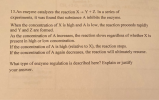 13.An enzyme catalyzes the reaction X – Y + Z. In a series of experiments, it was found that substance A inhibits the enzyme. When the concentration of X is high and A is low, the reaction proceeds rapidly and Y and Z are formed. As the concentration of A increases, the reaction slows regardless of whether X is present in high or low concentration. If the concentration of A is high (relative to X), the reaction stops. If the...
. Question 11 3 pts Let X be normally distributed with some unknown mean and standard...
 . Question 11 3 pts Let X be normally distributed with some unknown mean and standard deviation X- o=2. The variable Z = is distributed according to the standard normal A distribution. Enter the value for A = . It is known that P(X > 14) = 0.2 What is P(Z > 7 - ) = (enter a decimal value). Use R to determine di = (round to the second decimal place).
 4. Consider a hypothetical reaction involving two reactants, X + Y Z a) Write a "generic rate law for this reaction using variables for the orders of each reactant. b) We want to use the method of integrated rates to determine the order of the reaction with respect to reactant X. What should be true about the concentration of Y in our experiment in order to isolate the behavior of X? c) Write an expression for the pseudo rate constant...
 Which of the following correctly balances this nuclear fission reaction? n(A-1, Z-0)+ U(A-235, Z-92)(A-131,-53+ X (A-2, Z-)+3n(A-1, Z-0)? y A light ray of wavelength 589 nm (produced by a sodium lamp) traveling through air is incident on a smooth, flat slab of crown glass at an angle of 30.0° to the normal, as sketched in the figure. Find the angle of refraction, 02
Which of the following correctly balances this nuclear fission reaction? n(A-1, Z-0)+ U(A-235, Z-92)(A-131,-53+ X (A-2, Z-)+3n(A-1,...
Which of the following correctly balances this nuclear fission reaction? n(A-1, Z-0)+ U(A-235, Z-92)(A-131,-53+ X (A-2, Z-)+3n(A-1, Z-0)? y A light ray of wavelength 589 nm (produced by a sodium lamp) traveling through air is incident on a smooth, flat slab of crown glass at an angle of 30.0° to the normal, as sketched in the figure. Find the angle of refraction, 02
Which of the following correctly balances this nuclear fission reaction? n(A-1, Z-0)+ U(A-235, Z-92)(A-131,-53+ X (A-2, Z-)+3n(A-1,...
 13.An enzyme catalyzes the reaction X – Y + Z. In a series of experiments, it was found that substance A inhibits the enzyme. When the concentration of X is high and A is low, the reaction proceeds rapidly and Y and Z are formed. As the concentration of A increases, the reaction slows regardless of whether X is present in high or low concentration. If the concentration of A is high (relative to X), the reaction stops. If the...
 . Question 11 3 pts Let X be normally distributed with some unknown mean and standard deviation X- o=2. The variable Z = is distributed according to the standard normal A distribution. Enter the value for A = . It is known that P(X > 14) = 0.2 What is P(Z > 7 - ) = (enter a decimal value). Use R to determine di = (round to the second decimal place).
Most questions answered within 3 hours.
-
Where is the error in this code sequence?
String s1 = "Hello";
String s2 = "ello";...
asked 10 months ago -
Financial data for Joel de Paris, Inc., for last year
follow:
Joel de Paris, Inc.
Balance...
asked 10 months ago -
Consider this reaction:
Al2(SO4)3 (aq)+ BaCl3
(aq) Al2Cl6 (aq)- +
3BaSO4(s) . What is the...
asked 10 months ago -
Suppose that Savneet is considering increasing her
recent random sample from 20 car rentals to 40...
asked 10 months ago -
Trucks arrive at an unloading terminal at an average rate of 120
per hour.
Trucks arrive...
asked 10 months ago -
Why are methanol and ethanol completely soluble in water while
octanol is not very little soluble....
asked 10 months ago -
A facilities manager at a university reads in a research report
that the mean amount of...
asked 10 months ago -
When the CuSO4 is rehydrated by adding water to the anhydrous
compound, is this an endothermic...
asked 10 months ago -
A ray of sunlight is passing from diamond into crown glass; the
angle of incidence is...
asked 10 months ago -
A block of mass 0.249 kg is placed on top of a light, vertical
spring of...
asked 10 months ago -
how do the kidneys compensate in the presences of acidosis
a) trigger hyperventilate
b) reserve acid...
asked 10 months ago -
Question 501 pts
The rental rate of capital to the firm increases. Which of the
following...
asked 10 months ago