A roller coaster of mass 80.0 kg is moving with a speed of 20.0
m/s at position A as shown in the
figure. The vertical height above ground level at position A is 200
m. Neglect friction.
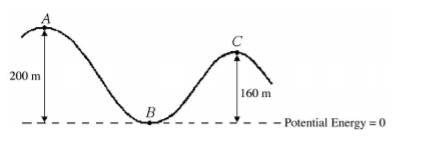
a. What is the total mechanical energy of the roller coaster at
point A?
EA =
b. What is the total mechanical energy of the roller coaster at
point B?
EB =
c. What is the speed of the roller coaster at point B?
vB =
d. What is the speed of the roller coaster at point C?
vC=
Homework Answers
![Aus @ ME = mgh + 2 mu (ME) 80*9.8 *200 + £ x 80 x (20)? (ME)A- 172800] 6 fearso only conservative forces acting. Mechanical e](http://img.homeworklib.com/questions/ba466ef0-d84a-11ea-9640-adbc963ef7bc.png?x-oss-process=image/resize,w_560)
Add Answer to:
A roller coaster of mass 80.0 kg is moving with a speed of 20.0
m/s at...
Suppose there is no friction on a roller coaster, a man of 80 Kg mass decides...
Suppose there is no friction on a roller coaster, a man of 80 Kg mass decides to skate on this roller coaster, the man is located at the highest point that is 32 m high, wants to get a speed record when he arrives to the lowest point. Determine: a) How much is the mechanical energy at the highest point, and still not moving? b) How much is the mechanical energy at the lowest point of the roller coaster? c)...
A car of mass 500. kg on a roller coaster ride is raised from the ground...
 A car of mass 500. kg on a roller coaster ride is raised from
the ground (horizontal dotted line) to point A as shown in the
diagram above. When the car passes point A, its speed is 5.0 m/s,
and then it rolls freely through the rest of the ride with
negligible friction, passing points B, C, D and E. Note that point
D is the highest portion of a circular loop, and point E is the
lowest portion of...
A car of mass 500. kg on a roller coaster ride is raised from
the ground (horizontal dotted line) to point A as shown in the
diagram above. When the car passes point A, its speed is 5.0 m/s,
and then it rolls freely through the rest of the ride with
negligible friction, passing points B, C, D and E. Note that point
D is the highest portion of a circular loop, and point E is the
lowest portion of...
14-86. The roller-coaster car has a speed of 15 ft/s whe it is at the crest of a vertical parabol...
 dynamic
14-86. The roller-coaster car has a speed of 15 ft/s whe it is at the crest of a vertical parabolic track. Determi the car's velocity and the normal force it exe on the track when it reaches point B. Neglect friction and the mass of the wheels. The total weight of the car and the passengers is 350 lb. ne VA 15 ft/s y y-200 (40 000-2) 200 ft 200 ft Prob. 14-86
14-86. The roller-coaster car has a...
dynamic
14-86. The roller-coaster car has a speed of 15 ft/s whe it is at the crest of a vertical parabolic track. Determi the car's velocity and the normal force it exe on the track when it reaches point B. Neglect friction and the mass of the wheels. The total weight of the car and the passengers is 350 lb. ne VA 15 ft/s y y-200 (40 000-2) 200 ft 200 ft Prob. 14-86
14-86. The roller-coaster car has a...
Problem 1: Looping. The looping of a roller coaster has the radius R. The roller coaster...
 Problem 1: Looping. The looping of a roller coaster has the radius R. The roller coaster starts at rest in height H over the deepest point of the looping (as shown in the figure). Neglect friction and consider the roller coaster as a mass point of mass m. Q.1) Express the total energy of the body. The reference point for the potential energy is at the center of the loop. Q.2) Find the speed of the body at the top...
A 4,500-kg roller coaster cart has a speed of 4.76 m/sm/s when it reaches its first...
A 4,500-kg roller coaster cart has a speed of 4.76 m/sm/s when it reaches its first peak at a 99.0 mm height from the ground level. After descending, it climbs up the second hill which is 84.2 mm above the ground level. How fast is the roller coaster cart at the top of the second hill? Assume there is no friction with the rails and no air resistance during the cart's motion.
A roller coaster has mass 3000.0 kg and needs to make it safely through a vertical...
A roller coaster has mass 3000.0 kg and needs to make it safely through a vertical circular loop of radius 50.0 m. What is the minimum angular momentum, in kg*m^2/s, of the coaster at the bottom of the loop to make it safely through? Neglect friction on the track. Take the coaster to be a point particle.
A roller coaster car of mass 800 kg when released from rest at point A (height...
 A roller coaster car of mass 800 kg when released from rest at
point A (height h above the ground) slides along the track and
inside the loop of radius 16.0 m. The car never loses contact with
the track.
A) Draw below a free body diagram for the car the car at the top
of the loop.
B) If the normal force acting on the car at the top is 1500 N,
what is the speed of the car...
A roller coaster car of mass 800 kg when released from rest at
point A (height h above the ground) slides along the track and
inside the loop of radius 16.0 m. The car never loses contact with
the track.
A) Draw below a free body diagram for the car the car at the top
of the loop.
B) If the normal force acting on the car at the top is 1500 N,
what is the speed of the car...
In the figure, a frictionless roller coaster car of mass m = 637 kg tops the...
 In the
figure, a frictionless roller coaster car of mass m = 637 kg tops the first
hill with speed v0 = 19.3 m/s at
height h = 37.2 m. How much work
does the gravitational force do on the car from that point
to (a) point A, (b) point B, and (c) point C? If the gravitational
potential energy of the car-Earth system is taken to be zero
at C, what is its value when
the car is at...
In the
figure, a frictionless roller coaster car of mass m = 637 kg tops the first
hill with speed v0 = 19.3 m/s at
height h = 37.2 m. How much work
does the gravitational force do on the car from that point
to (a) point A, (b) point B, and (c) point C? If the gravitational
potential energy of the car-Earth system is taken to be zero
at C, what is its value when
the car is at...
A 540 kg roller coaster has a speed of 21.0 m/s as it reaches the lowest...
A 540 kg roller coaster has a speed of 21.0 m/s as it reaches the lowest point on the track, which is at the bottom of a vertical curve with a radius of 13.0 m. What is the force of the track on the vehicle at this point?
 A car of mass 500. kg on a roller coaster ride is raised from
the ground (horizontal dotted line) to point A as shown in the
diagram above. When the car passes point A, its speed is 5.0 m/s,
and then it rolls freely through the rest of the ride with
negligible friction, passing points B, C, D and E. Note that point
D is the highest portion of a circular loop, and point E is the
lowest portion of...
A car of mass 500. kg on a roller coaster ride is raised from
the ground (horizontal dotted line) to point A as shown in the
diagram above. When the car passes point A, its speed is 5.0 m/s,
and then it rolls freely through the rest of the ride with
negligible friction, passing points B, C, D and E. Note that point
D is the highest portion of a circular loop, and point E is the
lowest portion of...
 dynamic
14-86. The roller-coaster car has a speed of 15 ft/s whe it is at the crest of a vertical parabolic track. Determi the car's velocity and the normal force it exe on the track when it reaches point B. Neglect friction and the mass of the wheels. The total weight of the car and the passengers is 350 lb. ne VA 15 ft/s y y-200 (40 000-2) 200 ft 200 ft Prob. 14-86
14-86. The roller-coaster car has a...
dynamic
14-86. The roller-coaster car has a speed of 15 ft/s whe it is at the crest of a vertical parabolic track. Determi the car's velocity and the normal force it exe on the track when it reaches point B. Neglect friction and the mass of the wheels. The total weight of the car and the passengers is 350 lb. ne VA 15 ft/s y y-200 (40 000-2) 200 ft 200 ft Prob. 14-86
14-86. The roller-coaster car has a...
 Problem 1: Looping. The looping of a roller coaster has the radius R. The roller coaster starts at rest in height H over the deepest point of the looping (as shown in the figure). Neglect friction and consider the roller coaster as a mass point of mass m. Q.1) Express the total energy of the body. The reference point for the potential energy is at the center of the loop. Q.2) Find the speed of the body at the top...
 A roller coaster car of mass 800 kg when released from rest at
point A (height h above the ground) slides along the track and
inside the loop of radius 16.0 m. The car never loses contact with
the track.
A) Draw below a free body diagram for the car the car at the top
of the loop.
B) If the normal force acting on the car at the top is 1500 N,
what is the speed of the car...
A roller coaster car of mass 800 kg when released from rest at
point A (height h above the ground) slides along the track and
inside the loop of radius 16.0 m. The car never loses contact with
the track.
A) Draw below a free body diagram for the car the car at the top
of the loop.
B) If the normal force acting on the car at the top is 1500 N,
what is the speed of the car...
 In the
figure, a frictionless roller coaster car of mass m = 637 kg tops the first
hill with speed v0 = 19.3 m/s at
height h = 37.2 m. How much work
does the gravitational force do on the car from that point
to (a) point A, (b) point B, and (c) point C? If the gravitational
potential energy of the car-Earth system is taken to be zero
at C, what is its value when
the car is at...
In the
figure, a frictionless roller coaster car of mass m = 637 kg tops the first
hill with speed v0 = 19.3 m/s at
height h = 37.2 m. How much work
does the gravitational force do on the car from that point
to (a) point A, (b) point B, and (c) point C? If the gravitational
potential energy of the car-Earth system is taken to be zero
at C, what is its value when
the car is at...
Most questions answered within 3 hours.
-
Where is the error in this code sequence?
String s1 = "Hello";
String s2 = "ello";...
asked 11 months ago -
Financial data for Joel de Paris, Inc., for last year
follow:
Joel de Paris, Inc.
Balance...
asked 11 months ago -
Consider this reaction:
Al2(SO4)3 (aq)+ BaCl3
(aq) Al2Cl6 (aq)- +
3BaSO4(s) . What is the...
asked 11 months ago -
Suppose that Savneet is considering increasing her
recent random sample from 20 car rentals to 40...
asked 11 months ago -
Trucks arrive at an unloading terminal at an average rate of 120
per hour.
Trucks arrive...
asked 11 months ago -
Why are methanol and ethanol completely soluble in water while
octanol is not very little soluble....
asked 11 months ago -
A facilities manager at a university reads in a research report
that the mean amount of...
asked 11 months ago -
When the CuSO4 is rehydrated by adding water to the anhydrous
compound, is this an endothermic...
asked 11 months ago -
A ray of sunlight is passing from diamond into crown glass; the
angle of incidence is...
asked 11 months ago -
A block of mass 0.249 kg is placed on top of a light, vertical
spring of...
asked 11 months ago -
how do the kidneys compensate in the presences of acidosis
a) trigger hyperventilate
b) reserve acid...
asked 11 months ago -
Question 501 pts
The rental rate of capital to the firm increases. Which of the
following...
asked 11 months ago