


Homework Answers
Add Answer to:
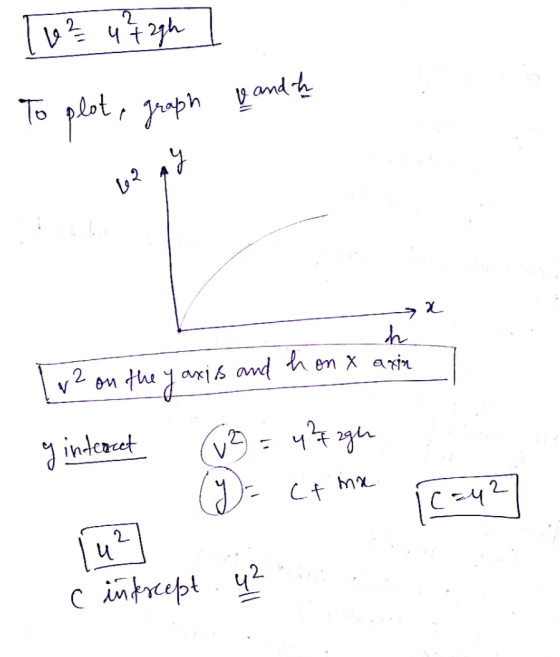
V = u2 + 2gh To plot the above equation linearly in terms of u and...
For the next two questions, consider the equation: V = Vu2 + 2gh When you plot...
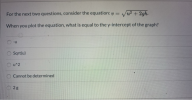 For the next two questions, consider the equation: V = Vu2 + 2gh When you plot the equation, what is equal to the y-intercept of the graph? -u Sqrt(u) Ou^2 Cannot be determined 1028 To plot the above equation linearly in terms of u and h, which of the following combination would you choose? v2 on the y-axis and h on the x-axis. v on the y-axis and h on the x-axis. v on the y-axis and h^2on the x-axis,...
Use the following steps to find the general equation of the plane that intersects the surface...
 Use the following steps to find the general equation of the plane that intersects the surface f (x, y) ye2x-y+5 at f(-1,3): = the y Choose any vector ū, u 0, in the xy-plane that is parallel to neither the x-axis nor product to show that i is parallel to neither axis. a) axis. Use a cross Find Df1,3) b) Choose any vector v, v 0, in the xy-plane that is orthogonal to u. Use the dot product to show...
Use the following steps to find the general equation of the plane that intersects the surface...
 Use the following steps to find the general equation of the plane that intersects the surface f(x, y) ye2x-y+5 at f(-1,3) Choose any vector ū, u # 0, in the xy-plane that is parallel to neither the x-axis nor the y а) axis. Use a cross product to show that u is parallel to neither axis. Find Duf-1,3) b) Choose any vector v, v *0, in the xy-plane that is orthogonal to u. Use the dot product to show that...
Surface D is given by r(u, v) = u, v, u2 + v^2 , above the...
Surface D is given by r(u, v) = u, v, u2 + v^2 , above the solid circle x 2 + y 2 ≤ 2, oriented upwards. The vector field F is (x^2 , xz, y2*z). Set up a double integral with the same value as Z ∂D F · dr, so that the integral is ready to evaluate. Do not evaluate either integral.
Need E, F, G, and H. Use the following steps to find the general equation of...
 Need E, F, G, and H.
Use the following steps to find the general equation of the plane that intersects the surface f(x, y) ye2x-y+5 at f(-1,3) Choose any vector ū, u # 0, in the xy-plane that is parallel to neither the x-axis nor the y а) axis. Use a cross product to show that u is parallel to neither axis. Find Duf-1,3) b) Choose any vector v, v *0, in the xy-plane that is orthogonal to u. Use...
Need E, F, G, and H.
Use the following steps to find the general equation of the plane that intersects the surface f(x, y) ye2x-y+5 at f(-1,3) Choose any vector ū, u # 0, in the xy-plane that is parallel to neither the x-axis nor the y а) axis. Use a cross product to show that u is parallel to neither axis. Find Duf-1,3) b) Choose any vector v, v *0, in the xy-plane that is orthogonal to u. Use...
4. The double-reciprocal transformation of the Michaelis-Menten equation, also called the Lineweaver-Burk plot, is give...
 4. The double-reciprocal transformation of the Michaelis-Menten equation, also called the Lineweaver-Burk plot, is given by: 1 Km 1 1 where, the plot of (1/V.) vs (1/[S]) is a linear plot. If you only know the x-axis and y-axis intercepts from this plot, how can you determine Vmax and Km? (A) multiply the reciprocal of the x-axis intercept by -1. (B) multiply the reciprocal of the y-axis intercept by -1. (C) take the reciprocal of the x-axis intercept. (D) take...
# 1: Consider the following curves in R la) 1822-32 x y + 37 U2 100. l ) 2x2 + 6 x y + 2 y-100. 1c) x2 + 4 x y + 4 y2-10:0. Write them in normal form. Give the change of variables that does this....
 # 1: Consider the following curves in R la) 1822-32 x y + 37 U2 100. l ) 2x2 + 6 x y + 2 y-100. 1c) x2 + 4 x y + 4 y2-10:0. Write them in normal form. Give the change of variables that does this. For example, in 1a) the orthonormal basis of eigenvectors are λί 5,V1 (2,1)'/V5 and λ2 = St ( 100. ) . That is, 45, ½ = (1,-2)t/V5.S ( 1/V 5-2/v/5 ) (V6,...
79. Parametrised Surface 1. Consider the parametrised surface defined by: x 2u, y u2+ v (a) Find a vector normal to the...
 79. Parametrised Surface 1. Consider the parametrised surface defined by: x 2u, y u2+ v (a) Find a vector normal to the surface in terms of u and v. (b) For what values of u and v is the surface smooth? (c) Find the equation of the tangent plane to the surface at (0,1, 1)
79. Parametrised Surface 1. Consider the parametrised surface defined by: x 2u, y u2+ v (a) Find a vector normal to the surface in terms...
79. Parametrised Surface 1. Consider the parametrised surface defined by: x 2u, y u2+ v (a) Find a vector normal to the surface in terms of u and v. (b) For what values of u and v is the surface smooth? (c) Find the equation of the tangent plane to the surface at (0,1, 1)
79. Parametrised Surface 1. Consider the parametrised surface defined by: x 2u, y u2+ v (a) Find a vector normal to the surface in terms...
Y = a X + b is the equation of a straight line. A student plot...
 Y = a X + b is the equation of a straight line. A student plot X vs Y instead of Y vs X, what will be the slope and the intercept on his graph in terms of a and b. Given that B + 16R-d/L = S-Q, B is the dependent variable and L is the independent variable, what is the expression for the slope and intercept of the linear graph?
Y= a X + b is the equation of a straight line. A student plot X...
Y= a X + b is the equation of a straight line. A student plot X vs Y instead of Y vs X, what will be the slope and the intercept on his graph in terms of a and b.
 For the next two questions, consider the equation: V = Vu2 + 2gh When you plot the equation, what is equal to the y-intercept of the graph? -u Sqrt(u) Ou^2 Cannot be determined 1028 To plot the above equation linearly in terms of u and h, which of the following combination would you choose? v2 on the y-axis and h on the x-axis. v on the y-axis and h on the x-axis. v on the y-axis and h^2on the x-axis,...
 Use the following steps to find the general equation of the plane that intersects the surface f (x, y) ye2x-y+5 at f(-1,3): = the y Choose any vector ū, u 0, in the xy-plane that is parallel to neither the x-axis nor product to show that i is parallel to neither axis. a) axis. Use a cross Find Df1,3) b) Choose any vector v, v 0, in the xy-plane that is orthogonal to u. Use the dot product to show...
 Use the following steps to find the general equation of the plane that intersects the surface f(x, y) ye2x-y+5 at f(-1,3) Choose any vector ū, u # 0, in the xy-plane that is parallel to neither the x-axis nor the y а) axis. Use a cross product to show that u is parallel to neither axis. Find Duf-1,3) b) Choose any vector v, v *0, in the xy-plane that is orthogonal to u. Use the dot product to show that...
 Need E, F, G, and H.
Use the following steps to find the general equation of the plane that intersects the surface f(x, y) ye2x-y+5 at f(-1,3) Choose any vector ū, u # 0, in the xy-plane that is parallel to neither the x-axis nor the y а) axis. Use a cross product to show that u is parallel to neither axis. Find Duf-1,3) b) Choose any vector v, v *0, in the xy-plane that is orthogonal to u. Use...
Need E, F, G, and H.
Use the following steps to find the general equation of the plane that intersects the surface f(x, y) ye2x-y+5 at f(-1,3) Choose any vector ū, u # 0, in the xy-plane that is parallel to neither the x-axis nor the y а) axis. Use a cross product to show that u is parallel to neither axis. Find Duf-1,3) b) Choose any vector v, v *0, in the xy-plane that is orthogonal to u. Use...
 4. The double-reciprocal transformation of the Michaelis-Menten equation, also called the Lineweaver-Burk plot, is given by: 1 Km 1 1 where, the plot of (1/V.) vs (1/[S]) is a linear plot. If you only know the x-axis and y-axis intercepts from this plot, how can you determine Vmax and Km? (A) multiply the reciprocal of the x-axis intercept by -1. (B) multiply the reciprocal of the y-axis intercept by -1. (C) take the reciprocal of the x-axis intercept. (D) take...
 # 1: Consider the following curves in R la) 1822-32 x y + 37 U2 100. l ) 2x2 + 6 x y + 2 y-100. 1c) x2 + 4 x y + 4 y2-10:0. Write them in normal form. Give the change of variables that does this. For example, in 1a) the orthonormal basis of eigenvectors are λί 5,V1 (2,1)'/V5 and λ2 = St ( 100. ) . That is, 45, ½ = (1,-2)t/V5.S ( 1/V 5-2/v/5 ) (V6,...
 79. Parametrised Surface 1. Consider the parametrised surface defined by: x 2u, y u2+ v (a) Find a vector normal to the surface in terms of u and v. (b) For what values of u and v is the surface smooth? (c) Find the equation of the tangent plane to the surface at (0,1, 1)
79. Parametrised Surface 1. Consider the parametrised surface defined by: x 2u, y u2+ v (a) Find a vector normal to the surface in terms...
79. Parametrised Surface 1. Consider the parametrised surface defined by: x 2u, y u2+ v (a) Find a vector normal to the surface in terms of u and v. (b) For what values of u and v is the surface smooth? (c) Find the equation of the tangent plane to the surface at (0,1, 1)
79. Parametrised Surface 1. Consider the parametrised surface defined by: x 2u, y u2+ v (a) Find a vector normal to the surface in terms...
 Y = a X + b is the equation of a straight line. A student plot X vs Y instead of Y vs X, what will be the slope and the intercept on his graph in terms of a and b. Given that B + 16R-d/L = S-Q, B is the dependent variable and L is the independent variable, what is the expression for the slope and intercept of the linear graph?
Most questions answered within 3 hours.
-
Where is the error in this code sequence?
String s1 = "Hello";
String s2 = "ello";...
asked 10 months ago -
Financial data for Joel de Paris, Inc., for last year
follow:
Joel de Paris, Inc.
Balance...
asked 10 months ago -
Consider this reaction:
Al2(SO4)3 (aq)+ BaCl3
(aq) Al2Cl6 (aq)- +
3BaSO4(s) . What is the...
asked 10 months ago -
Suppose that Savneet is considering increasing her
recent random sample from 20 car rentals to 40...
asked 10 months ago -
Trucks arrive at an unloading terminal at an average rate of 120
per hour.
Trucks arrive...
asked 10 months ago -
Why are methanol and ethanol completely soluble in water while
octanol is not very little soluble....
asked 10 months ago -
A facilities manager at a university reads in a research report
that the mean amount of...
asked 10 months ago -
When the CuSO4 is rehydrated by adding water to the anhydrous
compound, is this an endothermic...
asked 10 months ago -
A ray of sunlight is passing from diamond into crown glass; the
angle of incidence is...
asked 10 months ago -
A block of mass 0.249 kg is placed on top of a light, vertical
spring of...
asked 10 months ago -
how do the kidneys compensate in the presences of acidosis
a) trigger hyperventilate
b) reserve acid...
asked 10 months ago -
Question 501 pts
The rental rate of capital to the firm increases. Which of the
following...
asked 10 months ago