
Homework Answers
Charge of alpha particle, q = 2e = 2 x 1.6 x 10-19 C = 3.2 x 10⁻¹⁹ C
Charge of gold nucleus, Q = 79e = 79 x 1.6 x 10-19 C = 126.4 x 10⁻¹⁹ C
Initial speed of the alpha particle, v = 2.02 x 10⁷ m/s
Mass of alpha particle, m = 6.64 x 10⁻²⁷ kg
Kinetic energy of alpha particle, K = ½ mv2 = ½ x 6.64 x 10-27 x (2.02 x 107 )2 = 13.55 x 10⁻¹³ J
The alpha particle turns back when its kinetic energy completely converts into electric potential energy due to repulsion of gold nucleus. If d is the distance at which the alpha particle turns back then,
K = U = 1/4πε0 qQ/d
The distance, d = 1/4πε0 qQ/K
d= 9 x 109 x 3.2 x 10-19 x 126.4 x 10-19 /13.55 x 10-13 = 2.68 x 10⁻¹⁴ m
the distance, d = 2.68 x 10⁻¹⁴ m
Add Answer to:
Problem 8 In Rutherford's famous scattering experiments that led to the planetary model of the atom,...
Problem 8 In Rutherford's famous scattering experiments that led to the planetary model of the atom,...
 Problem 8 In Rutherford's famous scattering experiments that led to the planetary model of the atom, alpha particles (having charges of +2e and masses of 6.64 X 10⁻²⁷ kg) were fired toward a gold nucleus with charge +79e. An alpha particle, initially very far from the gold nucleus, is fired at 2.02 X 10⁷ m/s directly toward the nucleus, as in the figure below. How close does the alpha particle get to the gold nucleus before turning around? Assume the...
In Rutherford's famous scattering experiments that led to the planetary model of the atom, alpha particles...
 In Rutherford's famous scattering experiments that led to the planetary model of the atom, alpha particles (having charges of +2e and masses of 6.64 x 10⁻²⁷ kg) were fired toward a gold nucleus with charge +79e. An alpha particle, initially very far from the gold nucleus, is fired at 2.74 x 10⁷ m/s directly toward the nucleus, as in the figure below. How close does the alpha particle get to the gold nucleus before turning around? Assume the gold nucleus...
In Rutherford's famous scattering experiments that led to the planetary model of the atom, alpha particles...
 In Rutherford's famous scattering experiments that led to the planetary model of the atom, alpha particles (having charges of +2e and masses of 6.64 × 10⁻²⁷ kg) were fired toward a gold nucleus with charge +79e. An alpha particle, initially very far from the gold nucleus, is fired at 2.60 × 10' m/s directly toward the nucleus, as in the figure below How close does the alpha particle get to the gold nucleus before turning around? Assume the gold nucleus...
In Rutherford's famous scattering experiments that led to the planetary model of the atom, alpha particles...
 In Rutherford's famous scattering experiments that led to the
planetary model of the atom, alpha particles (having charges of
+2e and masses of 6.64 ✕ 10−27 kg) were fired
toward a gold nucleus with charge +79e. An alpha particle,
initially very far from the gold nucleus, is fired at 2.96 ✕
107 m/s directly toward the nucleus, as in the figure
below. How close does the alpha particle get to the gold nucleus
before turning around? Assume the gold nucleus...
In Rutherford's famous scattering experiments that led to the
planetary model of the atom, alpha particles (having charges of
+2e and masses of 6.64 ✕ 10−27 kg) were fired
toward a gold nucleus with charge +79e. An alpha particle,
initially very far from the gold nucleus, is fired at 2.96 ✕
107 m/s directly toward the nucleus, as in the figure
below. How close does the alpha particle get to the gold nucleus
before turning around? Assume the gold nucleus...
In Rutherford's scattering experiments, alpha particles (charge = +2e) were fired at a gold foil. Consider...
In Rutherford's scattering experiments, alpha particles (charge = +2e) were fired at a gold foil. Consider an alpha particle with an initial kinetic energy K heading directly for the nucleus of a gold atom (charge =+79e). The alpha particle will come to rest when all its initial kinetic energy has been converted to electrical potential energy. Find the distance of closest approach between the alpha particle and the gold nucleus for the case K = 3.5 MeV
In Rutherford's scattering experiments, alpha particles (charge = +2e) were fired at a gold foil. Consider...
In Rutherford's scattering experiments, alpha particles (charge = +2e) were fired at a gold foil. Consider an alpha particle with an initial kinetic energy K heading directly for the nucleus of a gold atom (charge =+79e). The alpha particle will come to rest when all its initial kinetic energy has been converted to electrical potential energy. Find the distance of closest approach between the alpha particle and the gold nucleus for the case K= 2.7 MeV . Find the answer...
1. In 1911, Ernest Rutherford and his assistants Geiger and Marsden conducted an experiment in which...
 1. In 1911, Ernest Rutherford and his assistants Geiger and Marsden conducted an experiment in which they scattered alpha particles (nuclei of helium atoms) from thin sheets of gold. An alpha particle, having charge +2e and mass 6.64 x 1027kg, is a product of certain radioactive decays. The results of the experiment led Rutherford to the idea that most of the atom's mass is in a very small nucleus, with electrons in orbit around it. (This is the planetary classic...
Q-1 Rutherford's solar system model of the atom was inspired by the surprising results from his...
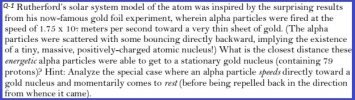 Q-1 Rutherford's solar system model of the atom was inspired by the surprising results from his now-famous gold foil experiment, wherein alpha particles were fired at the speed of 1.75 x 10 meters per second toward a very thin sheet of gold. (The alpha particles were scattered with some bouncing directly backward, implying the existence of a tiny, massive, positively-charged atomic nucleus!) What is the closest distance these energetic alpha particles were able to get to a stationary gold nucleus...
In 1911, Ernest Rutherford and his assistants Geiger and Marsden conducted an experiment in which they...
In 1911, Ernest Rutherford and his assistants Geiger and Marsden conducted an experiment in which they scattered alpha particles (nuclei of helium atoms) from thin sheets of gold. An alpha particle, having charge +2e and mass 6.64 10-27 kg, is a product of certain radioactive decays. The results of the experiment led Rutherford to the idea that most of an atom's mass is in a very small nucleus, with electrons in orbit around it. Assume an alpha particle, initially very...
In 1911, Ernest Rutherford and his assistants Geiger and Marsden conducted an experiment in which they...
 In 1911, Ernest Rutherford and his assistants Geiger and Marsden conducted an experiment in which they scattered alpha particles (nuclei of helium atoms) from thin sheets of gold. An alpha particle, having charge ÷2e and mass 6.64 × 10⁻²⁷ kg, is a product of certain radioactive decays. The results of the experiment led Rutherford to the idea that most of an atom's mass is In a very small nucleus, with electrons in orbit around it. Assume an alpha particle, initially...
 Problem 8 In Rutherford's famous scattering experiments that led to the planetary model of the atom, alpha particles (having charges of +2e and masses of 6.64 X 10⁻²⁷ kg) were fired toward a gold nucleus with charge +79e. An alpha particle, initially very far from the gold nucleus, is fired at 2.02 X 10⁷ m/s directly toward the nucleus, as in the figure below. How close does the alpha particle get to the gold nucleus before turning around? Assume the...
 In Rutherford's famous scattering experiments that led to the planetary model of the atom, alpha particles (having charges of +2e and masses of 6.64 x 10⁻²⁷ kg) were fired toward a gold nucleus with charge +79e. An alpha particle, initially very far from the gold nucleus, is fired at 2.74 x 10⁷ m/s directly toward the nucleus, as in the figure below. How close does the alpha particle get to the gold nucleus before turning around? Assume the gold nucleus...
 In Rutherford's famous scattering experiments that led to the planetary model of the atom, alpha particles (having charges of +2e and masses of 6.64 × 10⁻²⁷ kg) were fired toward a gold nucleus with charge +79e. An alpha particle, initially very far from the gold nucleus, is fired at 2.60 × 10' m/s directly toward the nucleus, as in the figure below How close does the alpha particle get to the gold nucleus before turning around? Assume the gold nucleus...
 In Rutherford's famous scattering experiments that led to the
planetary model of the atom, alpha particles (having charges of
+2e and masses of 6.64 ✕ 10−27 kg) were fired
toward a gold nucleus with charge +79e. An alpha particle,
initially very far from the gold nucleus, is fired at 2.96 ✕
107 m/s directly toward the nucleus, as in the figure
below. How close does the alpha particle get to the gold nucleus
before turning around? Assume the gold nucleus...
In Rutherford's famous scattering experiments that led to the
planetary model of the atom, alpha particles (having charges of
+2e and masses of 6.64 ✕ 10−27 kg) were fired
toward a gold nucleus with charge +79e. An alpha particle,
initially very far from the gold nucleus, is fired at 2.96 ✕
107 m/s directly toward the nucleus, as in the figure
below. How close does the alpha particle get to the gold nucleus
before turning around? Assume the gold nucleus...
 1. In 1911, Ernest Rutherford and his assistants Geiger and Marsden conducted an experiment in which they scattered alpha particles (nuclei of helium atoms) from thin sheets of gold. An alpha particle, having charge +2e and mass 6.64 x 1027kg, is a product of certain radioactive decays. The results of the experiment led Rutherford to the idea that most of the atom's mass is in a very small nucleus, with electrons in orbit around it. (This is the planetary classic...
 Q-1 Rutherford's solar system model of the atom was inspired by the surprising results from his now-famous gold foil experiment, wherein alpha particles were fired at the speed of 1.75 x 10 meters per second toward a very thin sheet of gold. (The alpha particles were scattered with some bouncing directly backward, implying the existence of a tiny, massive, positively-charged atomic nucleus!) What is the closest distance these energetic alpha particles were able to get to a stationary gold nucleus...
 In 1911, Ernest Rutherford and his assistants Geiger and Marsden conducted an experiment in which they scattered alpha particles (nuclei of helium atoms) from thin sheets of gold. An alpha particle, having charge ÷2e and mass 6.64 × 10⁻²⁷ kg, is a product of certain radioactive decays. The results of the experiment led Rutherford to the idea that most of an atom's mass is In a very small nucleus, with electrons in orbit around it. Assume an alpha particle, initially...
Most questions answered within 3 hours.
-
Where is the error in this code sequence?
String s1 = "Hello";
String s2 = "ello";...
asked 10 months ago -
Financial data for Joel de Paris, Inc., for last year
follow:
Joel de Paris, Inc.
Balance...
asked 10 months ago -
Consider this reaction:
Al2(SO4)3 (aq)+ BaCl3
(aq) Al2Cl6 (aq)- +
3BaSO4(s) . What is the...
asked 10 months ago -
Suppose that Savneet is considering increasing her
recent random sample from 20 car rentals to 40...
asked 10 months ago -
Trucks arrive at an unloading terminal at an average rate of 120
per hour.
Trucks arrive...
asked 10 months ago -
Why are methanol and ethanol completely soluble in water while
octanol is not very little soluble....
asked 10 months ago -
A facilities manager at a university reads in a research report
that the mean amount of...
asked 10 months ago -
When the CuSO4 is rehydrated by adding water to the anhydrous
compound, is this an endothermic...
asked 10 months ago -
A ray of sunlight is passing from diamond into crown glass; the
angle of incidence is...
asked 10 months ago -
A block of mass 0.249 kg is placed on top of a light, vertical
spring of...
asked 10 months ago -
how do the kidneys compensate in the presences of acidosis
a) trigger hyperventilate
b) reserve acid...
asked 10 months ago -
Question 501 pts
The rental rate of capital to the firm increases. Which of the
following...
asked 10 months ago