

Homework Answers
Add Answer to:
A 46.0 kg crate, starting from rest, is pulled across a floor with a constant horizontal...
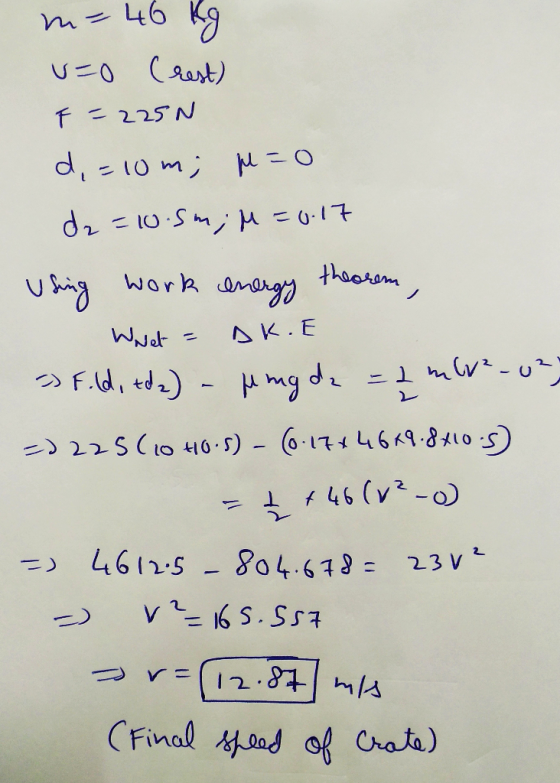
A 46.0-kg crate, starting from rest, is pulled across a floor with a constant horizontal force of 225 N. For th...
A 46.0-kg crate, starting from rest, is pulled across a floor with a constant horizontal force of 225 N. For the first 11.0 m the floor is frictionless, and for the next 10.0 m the coefficient of friction is 0.20. What is the final speed of the crate after being pulled these 21.0 m?
Prompt: A 42.0-kg crate, starting from rest, is pulled across a floor with a constant horizontal...
Prompt: A 42.0-kg crate, starting from rest, is pulled across a floor with a constant horizontal force of 225 N. For the first 11.0 m the floor is frictionless, and for the next 10.0 m the coefficient of friction is 0.20. Question: What is the final speed of the crate after being pulled these 21.0 m?
A 24.0-kg crate, starting from rest, is pulled across a floor with a constant horizontal force of 225 N. For the first...
A 24.0-kg crate, starting from rest, is pulled across a floor with a constant horizontal force of 225 N. For the first 11.0 m the floor is frictionless, and for the next 10.0 m the coefficient of friction is 0.20. What is the final speed of the crate after being pulled these 21.0 m ?
A 96 kg crate, starting from rest, is pulled across a floor with a constant horizontal...
A 96 kg crate, starting from rest, is pulled across a floor with a constant horizontal force of 380 N . For the first 15 m the floor is frictionless, and for the next 15 m the coefficient of friction is 0.25. What is the final speed of the crate?
A 20.0-kg crate, starting from rest, is pulled across a floor with a constant horizontal force...
A 20.0-kg crate, starting from rest, is pulled across a floor with a constant horizontal force F. for the first 9.00 m the floor is frictionless, and for the next 12.0 m the coefficient of friction is 0.200. The final speed of the crate after being pulled these 21.0 m is 18.0 m/s. How much is the constant horizontal force F mentioned above?
A 96kg crate, starting from rest, is pulled across a floor with a constant horizontal force...
A 96kg crate, starting from rest, is pulled across a floor with a constant horizontal force of 350N. For the first 15m the floor is frictionless, and for the next 15m the coefficient of friction is 0.25. What is the final speed of the crate? PLEASE ANSWER USING CONSERVATION OF ENERGY IF POSSIBLE!
A 10 kg crate is pulled along a warchouse floor across a distance of 35 m...
 A 10 kg crate is pulled along a warchouse floor across a distance of 35 m by a horizontal rope. The force of the rope is 22.0 N; the block starts from rest. At the end of the 35 m, the final velocity of the block is 1.8 m/s. What is the coefficient of kinetic friction? (15 pts)
Part C Review A 4.5 kg box slides down a 5.2-m -high frictionless hill starting from rest, across a 2.3-m -wide horizontal surface then hits a horizontal spring with spring constant 470 N/m How far i...
 Part C Review A 4.5 kg box slides down a 5.2-m -high frictionless hill starting from rest, across a 2.3-m -wide horizontal surface then hits a horizontal spring with spring constant 470 N/m How far is the spring compressed? Express your answer using two significant figures The other end of the spring is anchored against a wall The ground under the spring is frictionless, but the 2.3-m- long horizontal surface is rough. The coefficient of kinetic friction of the box...
1- How much work is done by the horizontal force Fp = 150N on the 18-kg...
1- How much work is done by the horizontal force Fp = 150N on the 18-kg block when the force pushes the block 5.0 m up along the 32° frictionless incline? (b) How much work is done by the gravitational force on the block during this displacement? (c) How much work is done by the normal force? (d) What is the speed of the block (assume that it is zero initially) after this displacement? [Hint: Work-energy involves net work done.]...
A large crate is at rest on a horizontal floor. The coefficient of static friction between...
A large crate is at rest on a horizontal floor. The coefficient of static friction between the crate and the floor is 0.500. A force F⃗ is applied to the crate in a direction 30.0∘ above the horizontal. The minimum value of F required to get the crate to start sliding is 410 N. Part A What is the mass of the crate? Express your answer with the appropriate units.
 A 10 kg crate is pulled along a warchouse floor across a distance of 35 m by a horizontal rope. The force of the rope is 22.0 N; the block starts from rest. At the end of the 35 m, the final velocity of the block is 1.8 m/s. What is the coefficient of kinetic friction? (15 pts)
 Part C Review A 4.5 kg box slides down a 5.2-m -high frictionless hill starting from rest, across a 2.3-m -wide horizontal surface then hits a horizontal spring with spring constant 470 N/m How far is the spring compressed? Express your answer using two significant figures The other end of the spring is anchored against a wall The ground under the spring is frictionless, but the 2.3-m- long horizontal surface is rough. The coefficient of kinetic friction of the box...
Most questions answered within 3 hours.
-
Where is the error in this code sequence?
String s1 = "Hello";
String s2 = "ello";...
asked 11 months ago -
Financial data for Joel de Paris, Inc., for last year
follow:
Joel de Paris, Inc.
Balance...
asked 11 months ago -
Consider this reaction:
Al2(SO4)3 (aq)+ BaCl3
(aq) Al2Cl6 (aq)- +
3BaSO4(s) . What is the...
asked 11 months ago -
Suppose that Savneet is considering increasing her
recent random sample from 20 car rentals to 40...
asked 11 months ago -
Trucks arrive at an unloading terminal at an average rate of 120
per hour.
Trucks arrive...
asked 11 months ago -
Why are methanol and ethanol completely soluble in water while
octanol is not very little soluble....
asked 11 months ago -
A facilities manager at a university reads in a research report
that the mean amount of...
asked 11 months ago -
When the CuSO4 is rehydrated by adding water to the anhydrous
compound, is this an endothermic...
asked 11 months ago -
A ray of sunlight is passing from diamond into crown glass; the
angle of incidence is...
asked 11 months ago -
A block of mass 0.249 kg is placed on top of a light, vertical
spring of...
asked 11 months ago -
how do the kidneys compensate in the presences of acidosis
a) trigger hyperventilate
b) reserve acid...
asked 11 months ago -
Question 501 pts
The rental rate of capital to the firm increases. Which of the
following...
asked 11 months ago