A 7.8 ×× 102121 kgkg moon orbits a distant planet in a circular orbit of radius...
|
A 7.8 ×× 102121 kgkg moon orbits a distant planet in a circular orbit of radius 1.5 ×× 1088 mm. It experiences a 1.1 ×× 101919 NN gravitational pull from the planet. |
Part A What is the moon's orbital period in earth days? |
Homework Answers
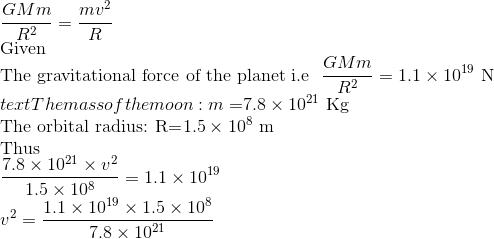
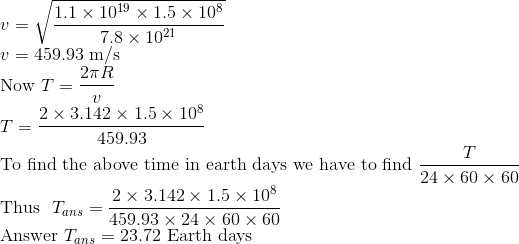
In a stable orbit, the gravitational pull due to the planet on the moon will be equal and opposite to the centrpetal force it experiences due to its orbital velocity and orbit length i.e
Add Answer to:
A 7.8 ×× 102121 kgkg moon orbits a distant planet in a circular
orbit of radius...
A 4.6 × 10²¹ kg moon orbits a distant planet in a circular orbit of radius...
A 4.6 × 10²¹ kg moon orbits a distant planet in a circular orbit of radius 1.5 × 10⁸ m. It experiences a 1.1 × 10¹⁹ N gravitational pull from the planet. What is the moon's orbital period in earth days?
A 3.0 x 10²¹ kg moon orbits a distant planet in a circular orbit of radius...
 A 3.0 x 10²¹ kg moon orbits a distant planet in a circular orbit of radius 1.5 × 10⁸ m. It experiences a 1.1 X 10¹⁹ N gravitational pull from the planet. Part A What is the moon's orbital period in earth days?
A 7.0 × 10 21 kg moon orbits a distant planet in a circular orbit of...
A 7.0 × 10 21 kg moon orbits a distant planet in a circular orbit of radius 1.5 × 10 8 m . It experiences a 1.1 × 10 19 N gravitational pull from the planet. Part A What is the moon's orbital period in earth days?
Two moons orbit a planet in circular orbits. The first has an orbital radius of r1...
Two moons orbit a planet in circular orbits. The first has an orbital radius of r1 and a period of T1. The second has twice the orbit radius as the first. Find the period of the second planet. 4.8T1 1.4T1 2.8T1 3.8T1
points A newly discovered planet is in a circular orbit around a distant star with an...
 points A newly discovered planet is in a circular orbit around a distant star with an orbital period of 400 Earth days. The planet also rotates on its axis, making one full rotation every 4.00 Earth days. The radius of the planet is rp = 7.00 × 10⁶ m and the radius of the planet's orbit about the star is r 7.00×10¹¹ m. My Notes Ask Your Tea Determine the ratio of the radial acceleration, due to the rotation of...
An undiscovered planet, many lightyears from Earth, has one moon in a periodic orbit. This moon takes 1960 x 103 se...
 An undiscovered planet, many lightyears from Earth, has one moon in a periodic orbit. This moon takes 1960 x 103 seconds (about 23 days) on average to complete one nearly circular revolution around the unnamed planet. If the distance from the center of the moon to the surface of the planet is 295.0 x 10⁶ m and the planet has a radius of 3.70 x 10% m, calculate the moon's radial acceleration a.
An undiscovered planet, many lightyears from Earth,...
An undiscovered planet, many lightyears from Earth, has one moon in a periodic orbit. This moon takes 1960 x 103 seconds (about 23 days) on average to complete one nearly circular revolution around the unnamed planet. If the distance from the center of the moon to the surface of the planet is 295.0 x 10⁶ m and the planet has a radius of 3.70 x 10% m, calculate the moon's radial acceleration a.
An undiscovered planet, many lightyears from Earth,...
An undiscovered planet, many lightyears from Earth, has one moon in a periodic orbit. This moon...
An undiscovered planet, many lightyears from Earth, has one moon in a periodic orbit. This moon takes 23.0 days on average to complete one nearly circular revolution around the unnamed planet. If the distance from the center of the moon to the surface of the planet is 2.240× 10 5 km and the planet has a radius of 3.250× 10 3 km, calculate the moon's radial acceleration ?.
An undiscovered planet, many lightyears from Earth, has one moon in a periodic orbit. This moon...
An undiscovered planet, many lightyears from Earth, has one moon in a periodic orbit. This moon takes 1960 × 103 seconds (about 23 days) on average to complete one nearly circular revolution around the unnamed planet. If the distance from the center of the moon to the surface of the planet is 275.0 × 10⁶ m and the planet has a radius of 3.20 × 10⁶ m, calculate the moon's radial acceleration ?c.
An undiscovered planet, many lightyears from Earth, has one moon in a periodic orbit. This moon...
An undiscovered planet, many lightyears from Earth, has one moon in a periodic orbit. This moon takes 1960 × 103 seconds (about 23 days) on average to complete one nearly circular revolution around the unnamed planet. If the distance from the center of the moon to the surface of the planet is 275.0 × 10⁶ m and the planet has a radius of 3.20 × 10⁶ m, calculate the moon's radial acceleration ?c .
An undiscovered planet, many lightyears from Earth, has one moon in a periodic orbit. This moon...
An undiscovered planet, many lightyears from Earth, has one moon in a periodic orbit. This moon takes 2160 × 10^3 seconds (about 25 days) on average to complete one nearly circular revolution around the unnamed planet. If the distance from the center of the moon to the surface of the planet is 225.0 × 10^6 m and the planet has a radius of 3.80 × 10^6 m, calculate the moon's radial acceleration ?c .
 A 3.0 x 10²¹ kg moon orbits a distant planet in a circular orbit of radius 1.5 × 10⁸ m. It experiences a 1.1 X 10¹⁹ N gravitational pull from the planet. Part A What is the moon's orbital period in earth days?
 points A newly discovered planet is in a circular orbit around a distant star with an orbital period of 400 Earth days. The planet also rotates on its axis, making one full rotation every 4.00 Earth days. The radius of the planet is rp = 7.00 × 10⁶ m and the radius of the planet's orbit about the star is r 7.00×10¹¹ m. My Notes Ask Your Tea Determine the ratio of the radial acceleration, due to the rotation of...
 An undiscovered planet, many lightyears from Earth, has one moon in a periodic orbit. This moon takes 1960 x 103 seconds (about 23 days) on average to complete one nearly circular revolution around the unnamed planet. If the distance from the center of the moon to the surface of the planet is 295.0 x 10⁶ m and the planet has a radius of 3.70 x 10% m, calculate the moon's radial acceleration a.
An undiscovered planet, many lightyears from Earth,...
An undiscovered planet, many lightyears from Earth, has one moon in a periodic orbit. This moon takes 1960 x 103 seconds (about 23 days) on average to complete one nearly circular revolution around the unnamed planet. If the distance from the center of the moon to the surface of the planet is 295.0 x 10⁶ m and the planet has a radius of 3.70 x 10% m, calculate the moon's radial acceleration a.
An undiscovered planet, many lightyears from Earth,...
Most questions answered within 3 hours.
-
Where is the error in this code sequence?
String s1 = "Hello";
String s2 = "ello";...
asked 10 months ago -
Financial data for Joel de Paris, Inc., for last year
follow:
Joel de Paris, Inc.
Balance...
asked 10 months ago -
Consider this reaction:
Al2(SO4)3 (aq)+ BaCl3
(aq) Al2Cl6 (aq)- +
3BaSO4(s) . What is the...
asked 10 months ago -
Suppose that Savneet is considering increasing her
recent random sample from 20 car rentals to 40...
asked 10 months ago -
Trucks arrive at an unloading terminal at an average rate of 120
per hour.
Trucks arrive...
asked 10 months ago -
Why are methanol and ethanol completely soluble in water while
octanol is not very little soluble....
asked 10 months ago -
A facilities manager at a university reads in a research report
that the mean amount of...
asked 10 months ago -
When the CuSO4 is rehydrated by adding water to the anhydrous
compound, is this an endothermic...
asked 10 months ago -
A ray of sunlight is passing from diamond into crown glass; the
angle of incidence is...
asked 10 months ago -
A block of mass 0.249 kg is placed on top of a light, vertical
spring of...
asked 10 months ago -
how do the kidneys compensate in the presences of acidosis
a) trigger hyperventilate
b) reserve acid...
asked 10 months ago -
Question 501 pts
The rental rate of capital to the firm increases. Which of the
following...
asked 10 months ago