
Please solve and explain the problem step to step. Thank you.
Homework Answers

Add Answer to:
Please solve and explain the problem step to step. Thank
you.
Highlight Rotate Markup Search a...
As shown in the figure, a metal bar is in contact with a pair of parallel...
 As shown in the figure, a metal bar is in contact with a pair of parallel rails and is in motion with an upward velocity of magnitude v. A uniform magnetic field is present, directed downward as shown. The direction of the induced magnetic field (as a result of the induced emf) is Upward No magnetic field is induced. From b to a о не 1. What is the aldol addition product formed from the reaction of the following compound...
Please solve this question with showing the intermediate process. Thank you. 2) 18 p Thick copper...
 Please solve this question with showing the intermediate
process.
Thank you.
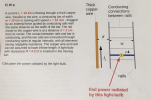
2) 18 p Thick copper wire Conducting connections between rails A current I, = 10 kA is flowing through a thick copper wire. Parallel to the wire, a conducting bar of width w = 10 cm is moving with speed v = 10 m/s, dragged by an external force guided by conducting rails with the same distance as the width of the bar. The rail closer to the copper...
Please solve this question with showing the intermediate
process.
Thank you.
2) 18 p Thick copper wire Conducting connections between rails A current I, = 10 kA is flowing through a thick copper wire. Parallel to the wire, a conducting bar of width w = 10 cm is moving with speed v = 10 m/s, dragged by an external force guided by conducting rails with the same distance as the width of the bar. The rail closer to the copper...
Will someone please solve this and explain every single step? I keep getting lost. Thank you!...
 Will someone please solve this and explain every single step? I
keep getting lost. Thank you!
The figure shows the magnetic flux through a single loop coil as a function of time. If phi_0 = 2 times 10^-2 Wb, calculate the induced emf in the coil at the following times. t = 0.05 s Your response differs from the correct answer by more than 10%. Double check your calculations. V t = 0.15 s t = 0.5 s V
Will someone please solve this and explain every single step? I
keep getting lost. Thank you!
The figure shows the magnetic flux through a single loop coil as a function of time. If phi_0 = 2 times 10^-2 Wb, calculate the induced emf in the coil at the following times. t = 0.05 s Your response differs from the correct answer by more than 10%. Double check your calculations. V t = 0.15 s t = 0.5 s V
PLEASE HELP ME AND SHOW STEPS. THANK YOU 1) It is desined to step up a...
 PLEASE HELP ME AND SHOW STEPS. THANK YOU
1) It is desined to step up a vollage of 120 V to 96,000 v. The turns ratio N/N, of the transformer a) I/28 b) (64 x 10y )28 d) 8001 if the voltage is stepped that power is not lost in an ideal transformer, consider the situation in the above question. 2) Starting from the idea t up 800 times, the current is a) the same, since power is the same...
PLEASE HELP ME AND SHOW STEPS. THANK YOU
1) It is desined to step up a vollage of 120 V to 96,000 v. The turns ratio N/N, of the transformer a) I/28 b) (64 x 10y )28 d) 8001 if the voltage is stepped that power is not lost in an ideal transformer, consider the situation in the above question. 2) Starting from the idea t up 800 times, the current is a) the same, since power is the same...
I need help to write a nice introduction for experiment 6 please ( no hands write ) typing Thank you HEAT TREATMENT OF STEELS EXPERIMENT 6 EXPERIMENT 6 HEAT TREATMENT OF STEELS THEORY The Ef...
 I need help to write a nice introduction for experiment 6
please ( no hands write ) typing
Thank you
HEAT TREATMENT OF STEELS EXPERIMENT 6 EXPERIMENT 6 HEAT TREATMENT OF STEELS THEORY The Effect of Cooling Rate One of the most convenient methods for controlling the properties of a given steel, i.e., a steel whose composition is already fixed, consists of austenizing the steel and ten cooling to room temperature at some predetermined rate. A variation of cooling rates...
I need help to write a nice introduction for experiment 6
please ( no hands write ) typing
Thank you
HEAT TREATMENT OF STEELS EXPERIMENT 6 EXPERIMENT 6 HEAT TREATMENT OF STEELS THEORY The Effect of Cooling Rate One of the most convenient methods for controlling the properties of a given steel, i.e., a steel whose composition is already fixed, consists of austenizing the steel and ten cooling to room temperature at some predetermined rate. A variation of cooling rates...
 As shown in the figure, a metal bar is in contact with a pair of parallel rails and is in motion with an upward velocity of magnitude v. A uniform magnetic field is present, directed downward as shown. The direction of the induced magnetic field (as a result of the induced emf) is Upward No magnetic field is induced. From b to a о не 1. What is the aldol addition product formed from the reaction of the following compound...
 Please solve this question with showing the intermediate
process.
Thank you.
2) 18 p Thick copper wire Conducting connections between rails A current I, = 10 kA is flowing through a thick copper wire. Parallel to the wire, a conducting bar of width w = 10 cm is moving with speed v = 10 m/s, dragged by an external force guided by conducting rails with the same distance as the width of the bar. The rail closer to the copper...
Please solve this question with showing the intermediate
process.
Thank you.
2) 18 p Thick copper wire Conducting connections between rails A current I, = 10 kA is flowing through a thick copper wire. Parallel to the wire, a conducting bar of width w = 10 cm is moving with speed v = 10 m/s, dragged by an external force guided by conducting rails with the same distance as the width of the bar. The rail closer to the copper...
 Will someone please solve this and explain every single step? I
keep getting lost. Thank you!
The figure shows the magnetic flux through a single loop coil as a function of time. If phi_0 = 2 times 10^-2 Wb, calculate the induced emf in the coil at the following times. t = 0.05 s Your response differs from the correct answer by more than 10%. Double check your calculations. V t = 0.15 s t = 0.5 s V
Will someone please solve this and explain every single step? I
keep getting lost. Thank you!
The figure shows the magnetic flux through a single loop coil as a function of time. If phi_0 = 2 times 10^-2 Wb, calculate the induced emf in the coil at the following times. t = 0.05 s Your response differs from the correct answer by more than 10%. Double check your calculations. V t = 0.15 s t = 0.5 s V
 PLEASE HELP ME AND SHOW STEPS. THANK YOU
1) It is desined to step up a vollage of 120 V to 96,000 v. The turns ratio N/N, of the transformer a) I/28 b) (64 x 10y )28 d) 8001 if the voltage is stepped that power is not lost in an ideal transformer, consider the situation in the above question. 2) Starting from the idea t up 800 times, the current is a) the same, since power is the same...
PLEASE HELP ME AND SHOW STEPS. THANK YOU
1) It is desined to step up a vollage of 120 V to 96,000 v. The turns ratio N/N, of the transformer a) I/28 b) (64 x 10y )28 d) 8001 if the voltage is stepped that power is not lost in an ideal transformer, consider the situation in the above question. 2) Starting from the idea t up 800 times, the current is a) the same, since power is the same...
 I need help to write a nice introduction for experiment 6
please ( no hands write ) typing
Thank you
HEAT TREATMENT OF STEELS EXPERIMENT 6 EXPERIMENT 6 HEAT TREATMENT OF STEELS THEORY The Effect of Cooling Rate One of the most convenient methods for controlling the properties of a given steel, i.e., a steel whose composition is already fixed, consists of austenizing the steel and ten cooling to room temperature at some predetermined rate. A variation of cooling rates...
I need help to write a nice introduction for experiment 6
please ( no hands write ) typing
Thank you
HEAT TREATMENT OF STEELS EXPERIMENT 6 EXPERIMENT 6 HEAT TREATMENT OF STEELS THEORY The Effect of Cooling Rate One of the most convenient methods for controlling the properties of a given steel, i.e., a steel whose composition is already fixed, consists of austenizing the steel and ten cooling to room temperature at some predetermined rate. A variation of cooling rates...
Most questions answered within 3 hours.
-
Where is the error in this code sequence?
String s1 = "Hello";
String s2 = "ello";...
asked 11 months ago -
Financial data for Joel de Paris, Inc., for last year
follow:
Joel de Paris, Inc.
Balance...
asked 11 months ago -
Consider this reaction:
Al2(SO4)3 (aq)+ BaCl3
(aq) Al2Cl6 (aq)- +
3BaSO4(s) . What is the...
asked 11 months ago -
Suppose that Savneet is considering increasing her
recent random sample from 20 car rentals to 40...
asked 11 months ago -
Trucks arrive at an unloading terminal at an average rate of 120
per hour.
Trucks arrive...
asked 11 months ago -
Why are methanol and ethanol completely soluble in water while
octanol is not very little soluble....
asked 11 months ago -
A facilities manager at a university reads in a research report
that the mean amount of...
asked 11 months ago -
When the CuSO4 is rehydrated by adding water to the anhydrous
compound, is this an endothermic...
asked 11 months ago -
A ray of sunlight is passing from diamond into crown glass; the
angle of incidence is...
asked 11 months ago -
A block of mass 0.249 kg is placed on top of a light, vertical
spring of...
asked 11 months ago -
how do the kidneys compensate in the presences of acidosis
a) trigger hyperventilate
b) reserve acid...
asked 11 months ago -
Question 501 pts
The rental rate of capital to the firm increases. Which of the
following...
asked 11 months ago