
Homework Answers
 P.S
: Please do give a thumbs up since we as an expert take pain and
take our time out by typing answer in lucid language and putting
best of our knowledge at your doorstep.
P.S
: Please do give a thumbs up since we as an expert take pain and
take our time out by typing answer in lucid language and putting
best of our knowledge at your doorstep.
Thank you
Add Answer to:
A cylinder is filled with 0.10 mol of an ideal gas at standard temperature and pressure,...
1) A cylinder is filled with 0.10 mol of an ideal gas at standard temperature and...
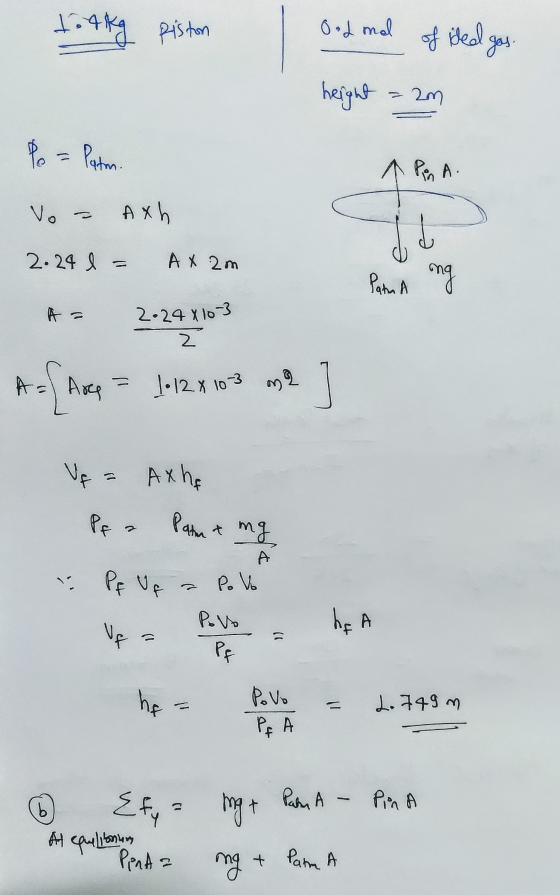
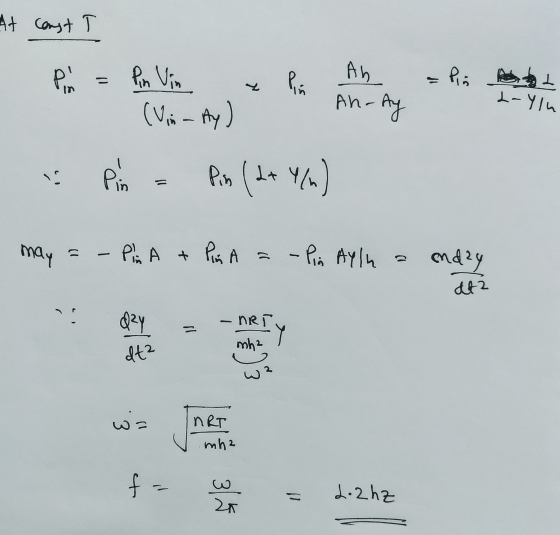
 1) A cylinder is filled with 0.10 mol of an ideal gas at
standard temperature and pressure, and a 1.4-kg piston seals the
gas in the cylinder (see figure) with a frictionless seal. The
trapped column of gas is 2.1-m high. The piston and cylinder are
surrounded by air, also at standard temperature and pressure. The
piston is released from rest and starts to fall. The motion of the
piston ceases after the oscillations stop with the piston and the...
1) A cylinder is filled with 0.10 mol of an ideal gas at
standard temperature and pressure, and a 1.4-kg piston seals the
gas in the cylinder (see figure) with a frictionless seal. The
trapped column of gas is 2.1-m high. The piston and cylinder are
surrounded by air, also at standard temperature and pressure. The
piston is released from rest and starts to fall. The motion of the
piston ceases after the oscillations stop with the piston and the...
A cylinder filled with ideal gas is sealed by a piston that is above the gas....
 A cylinder filled with ideal gas is sealed by a piston that is
above the gas. The piston is a cylindrical object, with a weight of
45.0 N, that can slide up or down in the cylinder without friction.
The area of the top (or the bottom) of the piston is 100
cm.
The top of the piston is exposed to the atmosphere, and the
atmospheric pressure is 100 kPa. As shown in the figure, the piston
is tied to...
A cylinder filled with ideal gas is sealed by a piston that is
above the gas. The piston is a cylindrical object, with a weight of
45.0 N, that can slide up or down in the cylinder without friction.
The area of the top (or the bottom) of the piston is 100
cm.
The top of the piston is exposed to the atmosphere, and the
atmospheric pressure is 100 kPa. As shown in the figure, the piston
is tied to...
ideal gas law questions Movable piston A cylinder contains an ideal gas that is at room...
 ideal gas law questions
Movable piston A cylinder contains an ideal gas that is at room temperature. The cylinder is sealed with a piston of mass M and cross-sectional area A that is free to move up or down without friction. No gas can enter or leave the cylinder. The piston is at rest. Atmospheric pressure (i.e. the pressure of the air surrounding the cylinder) is P. a. In the space provided, draw a free-body diagram for the piston. Ideal...
ideal gas law questions
Movable piston A cylinder contains an ideal gas that is at room temperature. The cylinder is sealed with a piston of mass M and cross-sectional area A that is free to move up or down without friction. No gas can enter or leave the cylinder. The piston is at rest. Atmospheric pressure (i.e. the pressure of the air surrounding the cylinder) is P. a. In the space provided, draw a free-body diagram for the piston. Ideal...
What is the gas pressure inside the cylinder?
A 20 cm--diameter vertical cylinder is sealed at the top by a frictionless 22 kg piston. The piston is 79 cm above the bottom when the gas temperature is 304 C.The air above the piston is at 1.00 atm pressure.a) What is the gas pressure inside the cylinder?b) What will the pressure be if the temperature is lowered to 20 C?c) What will the height of the piston be if the temperature is lowered to 20 C?
As shown in the figure, a sealed cylinder of ideal gas is divided into two parts...
 As shown in the figure, a sealed cylinder of ideal gas is
divided into two parts by a piston that can move up and down
without friction. There is ideal gas in both parts, but the gas
from one part is isolated from that in the other part by the
piston. The volume occupied by the gas in the lower part is twice
that occupied by the gas in the upper part, while the temperature
is the same in both...
As shown in the figure, a sealed cylinder of ideal gas is
divided into two parts by a piston that can move up and down
without friction. There is ideal gas in both parts, but the gas
from one part is isolated from that in the other part by the
piston. The volume occupied by the gas in the lower part is twice
that occupied by the gas in the upper part, while the temperature
is the same in both...
A cylinder that has a 43.5-cm radius and is 50.0 cm deep is filled with air...
A cylinder that has a 43.5-cm radius and is 50.0 cm deep is filled with air at 11.5°C and 1.00 atm shown in figure (a). A 16.0-kg piston is now lowered into the cylinder, compressing the air trapped inside as it takes equilibrium height hi as shown in figure (b). Finally, a 26.0-kg dog stands on the piston, further compressing the air, which remains at 11.5°C as shown in figure (c). (a) How far down (Δh) does the piston move...
An insulated piston-cylinder device contains 0.1m3 of air (ideal gas) at 400 kPa and 25℃. A...
An insulated piston-cylinder device contains 0.1m3 of air (ideal gas) at 400 kPa and 25℃. A paddle wheel within the cylinder is rotated until 15 kJ of work is done on the air while the pressure is held constant. Assuming the kinetic and potential energies are negligible and the gas constant and specific heat of air are ? = 0.287 kJ kg∙K and ?? = 1.005 kJ kg∙K . Tasks: ( a ) Determine the mass of air inside the...
A cylinder of monatomic ideal gas is sealed in a cylinder by a piston. Initially, the...
A cylinder of monatomic ideal gas is sealed in a cylinder by a piston. Initially, the gas occupies a volume of 2.50 L and the pressure is initially 125 kPa. The cylinder is placed in an oven that maintains the temperature at a constant value. 80.0 J of work is then done on the piston, compressing the gas (in other words, the gas does -80 J of work). The work is done very slowly so that the gas maintains a...
A movable piston traps 0.205 moles of an ideal gas in a vertical cylinder. As the...
A movable piston traps 0.205 moles of an ideal gas in a vertical cylinder. As the temperature of the gas is decreased from 511 ◦C to 24.0◦C, the piston slides without friction, reducing the volume of the gas so that its pressure remains constant. Find the work (J) done on the gas in the piston. Hint: Use the ideal gas law to change W = −P∆V to an expression using n and T. Be sure to include the sign of...
1. A rigid-sided flask contains an ideal gas at temperature 460o C and pressure 4.32 atm....
1. A rigid-sided flask contains an ideal gas at temperature 460o C and pressure 4.32 atm. If the flask is now heated to 801 oC, find the new pressure inside the flask, in atm. 2. In a certain heat engine: a fuel-air mixture is injected into a cylinder of volume 6.06 cc at pressure 7.08 atm and temperature 383o C. Now a piston comes down, compressing the gas to a volume 3.03 cc and pressure 64.2 atm. Find the Celsius...
 1) A cylinder is filled with 0.10 mol of an ideal gas at
standard temperature and pressure, and a 1.4-kg piston seals the
gas in the cylinder (see figure) with a frictionless seal. The
trapped column of gas is 2.1-m high. The piston and cylinder are
surrounded by air, also at standard temperature and pressure. The
piston is released from rest and starts to fall. The motion of the
piston ceases after the oscillations stop with the piston and the...
1) A cylinder is filled with 0.10 mol of an ideal gas at
standard temperature and pressure, and a 1.4-kg piston seals the
gas in the cylinder (see figure) with a frictionless seal. The
trapped column of gas is 2.1-m high. The piston and cylinder are
surrounded by air, also at standard temperature and pressure. The
piston is released from rest and starts to fall. The motion of the
piston ceases after the oscillations stop with the piston and the...
 A cylinder filled with ideal gas is sealed by a piston that is
above the gas. The piston is a cylindrical object, with a weight of
45.0 N, that can slide up or down in the cylinder without friction.
The area of the top (or the bottom) of the piston is 100
cm.
The top of the piston is exposed to the atmosphere, and the
atmospheric pressure is 100 kPa. As shown in the figure, the piston
is tied to...
A cylinder filled with ideal gas is sealed by a piston that is
above the gas. The piston is a cylindrical object, with a weight of
45.0 N, that can slide up or down in the cylinder without friction.
The area of the top (or the bottom) of the piston is 100
cm.
The top of the piston is exposed to the atmosphere, and the
atmospheric pressure is 100 kPa. As shown in the figure, the piston
is tied to...
 ideal gas law questions
Movable piston A cylinder contains an ideal gas that is at room temperature. The cylinder is sealed with a piston of mass M and cross-sectional area A that is free to move up or down without friction. No gas can enter or leave the cylinder. The piston is at rest. Atmospheric pressure (i.e. the pressure of the air surrounding the cylinder) is P. a. In the space provided, draw a free-body diagram for the piston. Ideal...
ideal gas law questions
Movable piston A cylinder contains an ideal gas that is at room temperature. The cylinder is sealed with a piston of mass M and cross-sectional area A that is free to move up or down without friction. No gas can enter or leave the cylinder. The piston is at rest. Atmospheric pressure (i.e. the pressure of the air surrounding the cylinder) is P. a. In the space provided, draw a free-body diagram for the piston. Ideal...
 As shown in the figure, a sealed cylinder of ideal gas is
divided into two parts by a piston that can move up and down
without friction. There is ideal gas in both parts, but the gas
from one part is isolated from that in the other part by the
piston. The volume occupied by the gas in the lower part is twice
that occupied by the gas in the upper part, while the temperature
is the same in both...
As shown in the figure, a sealed cylinder of ideal gas is
divided into two parts by a piston that can move up and down
without friction. There is ideal gas in both parts, but the gas
from one part is isolated from that in the other part by the
piston. The volume occupied by the gas in the lower part is twice
that occupied by the gas in the upper part, while the temperature
is the same in both...
Most questions answered within 3 hours.
-
Where is the error in this code sequence?
String s1 = "Hello";
String s2 = "ello";...
asked 11 months ago -
Financial data for Joel de Paris, Inc., for last year
follow:
Joel de Paris, Inc.
Balance...
asked 11 months ago -
Consider this reaction:
Al2(SO4)3 (aq)+ BaCl3
(aq) Al2Cl6 (aq)- +
3BaSO4(s) . What is the...
asked 11 months ago -
Suppose that Savneet is considering increasing her
recent random sample from 20 car rentals to 40...
asked 11 months ago -
Trucks arrive at an unloading terminal at an average rate of 120
per hour.
Trucks arrive...
asked 11 months ago -
Why are methanol and ethanol completely soluble in water while
octanol is not very little soluble....
asked 11 months ago -
A facilities manager at a university reads in a research report
that the mean amount of...
asked 11 months ago -
When the CuSO4 is rehydrated by adding water to the anhydrous
compound, is this an endothermic...
asked 11 months ago -
A ray of sunlight is passing from diamond into crown glass; the
angle of incidence is...
asked 11 months ago -
A block of mass 0.249 kg is placed on top of a light, vertical
spring of...
asked 11 months ago -
how do the kidneys compensate in the presences of acidosis
a) trigger hyperventilate
b) reserve acid...
asked 11 months ago -
Question 501 pts
The rental rate of capital to the firm increases. Which of the
following...
asked 11 months ago