
Homework Answers
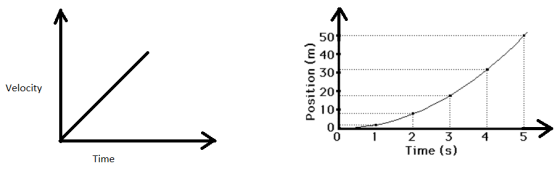
For the constant positive acceleration, The velocity -time graph is a straight line and position time graph becomes parabolla shape because the relatiom between the position and time is second order equation (S = ut + 0.5*a*t^2).
Dear student,
Please “LIKE” the solution If you have any doubt please ask me in the comment before rate I will clear your doubt as soon as possible by the comments.....
Your LIKES are very important for me so please LIKE….
Add Answer to:
explain in words please
Consider an object moving with a constant positive acceleration. What does a...
For an object is moving with constant positive acceleration, which of the following statements is true?...
For an object is moving with constant positive acceleration, which of the following statements is true? [Enter all correct answers eg. B or AC or ABC or ...] A) The position of the object must also be positive B) The velocity of the object must also be positive C) The velocity of the object must be zero D) The velocity of the object must be continually changing by the same amount each second E) None of the above Please explain.
(ii)(a) An object is moving with constant acceleration in 1D (along a straight line), what is...
 (ii)(a) An object is moving with constant acceleration in 1D (along a straight line), what is its position x(t) as a function of time, given its initial position xo, initial velocity vo and acceleration a? (b) How do you derive its velocity as a function of time from x(t)? (c) Why is the funciton of x(t) the key for predicting eclipses and hurricanes?
2. (a) Explain the difference between constant velocity and constant acceleration. (b) Are you more likely...
 2. (a) Explain the difference between constant velocity and constant acceleration. (b) Are you more likely to be able to walk at a constant velocity or at constant acceleration? (c) For the equation x = Xo + of + at, what does a graph of x versus t look like? (d) What does the graph look like if a -0? Please scetch graphs and give explanations. (7 pts) 2 3. For the following position versus time values, calculate the average...
. If the acceleration of an object is constant and we make a graph of the...
 . If the acceleration of an object is constant and we make a graph of the acceleration vs time, what function should fit the data? That is, if I write a ft), what is f(t)? 2. Velocity is the integral of acceleration. If the acceleration of an object is constant and we make a graph of the velocity vs time, what function should fit the data? 3. Position is the integral of velocity. If the acceleration of an object is...
4. 5. Moving with Constant Acceleration, PHYS 151 1. Take several objects of different masses, but...
 4. 5. Moving with Constant Acceleration, PHYS 151 1. Take several objects of different masses, but all relatively heavy, and drop them together. Do they all fall together, or do some objects fall significantly faster than others? 2. Drop a piece of paper. How is its behavior different from the others? 3 Why does the paper behave differently from the other objects? Get the timer tape (a long, skinny piece of paper with little dots on it). This was attached...
Part A: An object is moving with constant non-zero velocity in the +x axis. The position...
Part A: An object is moving with constant non-zero velocity in the +x axis. The position versus time graph of this object is Part B: An object is moving with constant non-zero acceleration in the +x axis. The position versus time graph of this object is Part C: An object is moving with constant non-zero velocity in the +x axis. The velocity versus time graph of this object is Part D: An object is moving with constant non-zero acceleration in...
An object is moving along a straight line in the positive x direction. The graph shows...
 An object is moving along a straight line in the positive x direction. The graph shows its position from the starting point as a function of time. Various segments of the graph are identified by the letters A, B, C, and D. a. Describe what the object is doing during each segment of the trip. Calculate all constant variables. b. What is the average velocity for the trip.
For an object undergoing constant positive acceleration, sketch the following curves: a) acceleration as a function...
For an object undergoing constant positive acceleration, sketch the following curves: a) acceleration as a function of time b) velocity as a function of time c) distance as a function of time.
1- What physical quantity is represented by the slope of a Position vs. Time plot? What...
1- What physical quantity is represented by the slope of a Position vs. Time plot? What are its dimensions? How did you know? Please explain. 2- What physical quantity is represented by the slope of a Velocity vs. Time plot? What are its dimensions? How did you figure it out? Please explain. 3- What would the Acceleration vs. Time plot look like for an object moving at constant velocity? Try drawing it and uploading a picture of your graph.
9) Assume that a moving object has constant acceleration a for all t>0 a) Determine a...
 9) Assume that a moving object has constant acceleration a for all t>0 a) Determine a function, v(t), for the velocity of the object. i. For you function, what is v(0)? ii. Is your v(t) the only possible function or are there other possibilities? iii. Describe all possible v(t) b) Determine a function s(t) for the position of the object. What is s(0)? i. ii. Describe all possible s(t) We know that acceleration due to gravity on earth is about...
 (ii)(a) An object is moving with constant acceleration in 1D (along a straight line), what is its position x(t) as a function of time, given its initial position xo, initial velocity vo and acceleration a? (b) How do you derive its velocity as a function of time from x(t)? (c) Why is the funciton of x(t) the key for predicting eclipses and hurricanes?
 2. (a) Explain the difference between constant velocity and constant acceleration. (b) Are you more likely to be able to walk at a constant velocity or at constant acceleration? (c) For the equation x = Xo + of + at, what does a graph of x versus t look like? (d) What does the graph look like if a -0? Please scetch graphs and give explanations. (7 pts) 2 3. For the following position versus time values, calculate the average...
 . If the acceleration of an object is constant and we make a graph of the acceleration vs time, what function should fit the data? That is, if I write a ft), what is f(t)? 2. Velocity is the integral of acceleration. If the acceleration of an object is constant and we make a graph of the velocity vs time, what function should fit the data? 3. Position is the integral of velocity. If the acceleration of an object is...
 4. 5. Moving with Constant Acceleration, PHYS 151 1. Take several objects of different masses, but all relatively heavy, and drop them together. Do they all fall together, or do some objects fall significantly faster than others? 2. Drop a piece of paper. How is its behavior different from the others? 3 Why does the paper behave differently from the other objects? Get the timer tape (a long, skinny piece of paper with little dots on it). This was attached...
 An object is moving along a straight line in the positive x direction. The graph shows its position from the starting point as a function of time. Various segments of the graph are identified by the letters A, B, C, and D. a. Describe what the object is doing during each segment of the trip. Calculate all constant variables. b. What is the average velocity for the trip.
 9) Assume that a moving object has constant acceleration a for all t>0 a) Determine a function, v(t), for the velocity of the object. i. For you function, what is v(0)? ii. Is your v(t) the only possible function or are there other possibilities? iii. Describe all possible v(t) b) Determine a function s(t) for the position of the object. What is s(0)? i. ii. Describe all possible s(t) We know that acceleration due to gravity on earth is about...
Most questions answered within 3 hours.
-
Where is the error in this code sequence?
String s1 = "Hello";
String s2 = "ello";...
asked 10 months ago -
Financial data for Joel de Paris, Inc., for last year
follow:
Joel de Paris, Inc.
Balance...
asked 10 months ago -
Consider this reaction:
Al2(SO4)3 (aq)+ BaCl3
(aq) Al2Cl6 (aq)- +
3BaSO4(s) . What is the...
asked 10 months ago -
Suppose that Savneet is considering increasing her
recent random sample from 20 car rentals to 40...
asked 10 months ago -
Trucks arrive at an unloading terminal at an average rate of 120
per hour.
Trucks arrive...
asked 10 months ago -
Why are methanol and ethanol completely soluble in water while
octanol is not very little soluble....
asked 10 months ago -
A facilities manager at a university reads in a research report
that the mean amount of...
asked 10 months ago -
When the CuSO4 is rehydrated by adding water to the anhydrous
compound, is this an endothermic...
asked 10 months ago -
A ray of sunlight is passing from diamond into crown glass; the
angle of incidence is...
asked 10 months ago -
A block of mass 0.249 kg is placed on top of a light, vertical
spring of...
asked 10 months ago -
how do the kidneys compensate in the presences of acidosis
a) trigger hyperventilate
b) reserve acid...
asked 10 months ago -
Question 501 pts
The rental rate of capital to the firm increases. Which of the
following...
asked 10 months ago