 A 2.0 kg block is sliding across a table
with an initial speed of 0.5 m/s. The table imparts a 20.0 N force
due to friction on the block. How much work in Joules will the
table do on the block?
A 2.0 kg block is sliding across a table
with an initial speed of 0.5 m/s. The table imparts a 20.0 N force
due to friction on the block. How much work in Joules will the
table do on the block?
Homework Answers
Add Answer to:
A 2.0 kg block is sliding across a table
with an initial speed of 0.5 m/s....
A 2.0 kg block is sliding across a table with an initial speed of 0.5 m/s....
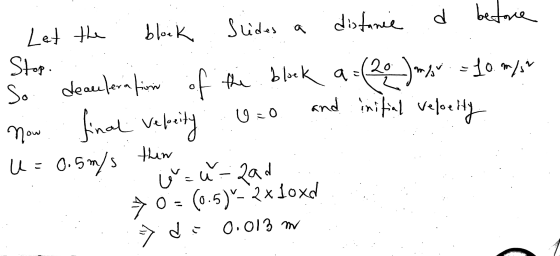
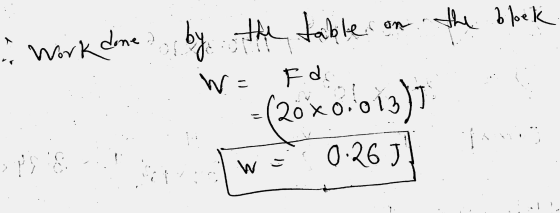
A 2.0 kg block is sliding across a table with an initial speed of 0.5 m/s. The table imparts a 20.0 N force due to friction on the block. How much work in Joules will the table do on the block?
A 2.0 kg block is sliding across a table with an initial speed of 0.5 m/s....
A 2.0 kg block is sliding across a table with an initial speed of 0.5 m/s. The table imparts a 20.0 N force due to friction on the block. How much work in Joules will the table do on the block?
A 2.0 kg block is sliding across a table with an initial speed of 0.5 m/s....
A 2.0 kg block is sliding across a table with an initial speed of 0.5 m/s. The table imparts a 20.0 N force due to friction on the block. How much work in Joules will the table do on the block?
Parts D and E only please A 5 kg block is sliding at an initial speed...
 Parts D and E only please
A 5 kg block is sliding at an initial speed of 9 m/s across a surface, encountering a constant friction force of 6 N. How much work is done on the block after it slides 22 cm? rrect, computer gets: -1.32 J int: Does the block gain or lose energy during this process? What sign does this imply for the work done on it? How fast is the block moving after sliding 22 cm?...
Parts D and E only please
A 5 kg block is sliding at an initial speed of 9 m/s across a surface, encountering a constant friction force of 6 N. How much work is done on the block after it slides 22 cm? rrect, computer gets: -1.32 J int: Does the block gain or lose energy during this process? What sign does this imply for the work done on it? How fast is the block moving after sliding 22 cm?...
A block with a mass of 4 kg is sliding across a horizontal surface with an...
A block with a mass of 4 kg is sliding across a horizontal surface with an initial speed of 5 m/s. Because of kinetic friction, the energy of this system will decrease linearly with the distance travelled by the block. a. What is the magnitude of the force of kinetic friction (in N) acting on the block if the block moves 4 m before coming to a stop? b. What is the average power (in W) supplied by the force...
A block of mass m = 2.0 kg is sitting stationary on a table. A horizontal...
A block of mass m = 2.0 kg is sitting stationary on a table. A horizontal force of magnitude F = 5.0 N is applied to the block, as shown. The coefficient of static friction is µS = 0.7, and the coefficient of kinetic friction is µK = 0.5. To the nearest 0.1 N, what is the magnitude of the force of friction between the block and the table?
A box of mass m starts sliding across a horizontal table with some initial speed. It...
A box of mass m starts sliding across a horizontal table with some initial speed. It slides distance d before coming to rest. The coefficient of kinetic friction between the table and the box is μk. Use Newton’s laws and kinematics equations to find the initial velocity of the box. Express your answer in terms of the given parameters. Solve the same problem using work and energy theorem. Do these two approaches give the same answer? What assumptions did you...
A 1.0 kg block is in motion up a ramp inclined at 40° to the horizontal with an initial speed of 4.0 m / s
A 1.0 kg block is in motion up a ramp inclined at 40° to the horizontal with an initial speed of 4.0 m / s. The block comes to rest after traveling d=0.84 mastraight along the ramp. (a) Determine the force of friction acting on the block. (b) What was the coefficient of kinetic friction between the block and ramp? (c) How much work was done by the normal force?
Question 5.2a: A 1350-kg car is traveling with an initial speed of 26.0 m/s. Determine the...
Question 5.2a: A 1350-kg car is traveling with an initial speed of 26.0 m/s. Determine the car's speed after ?2.15 ? 105 J of net work is done on the car. m/s Question 5.2b: A 11.6-kg box is sliding across a horizontal floor. It has an initial speed of 1.40 m/s and the only force acting on it is kinetic friction with magnitude fk = 3.00 N. Determine the distance the box will travel before coming to rest. m
A 5 kg block slides across a horizontal surface with an initial speed of 8.5 m/s....
A 5 kg block slides across a horizontal surface with an initial speed of 8.5 m/s. The coefficient of static friction between the block and the surface is 0.78. What is the increase in thermal energy of the block and its surroundings after it comes to rest?
 Parts D and E only please
A 5 kg block is sliding at an initial speed of 9 m/s across a surface, encountering a constant friction force of 6 N. How much work is done on the block after it slides 22 cm? rrect, computer gets: -1.32 J int: Does the block gain or lose energy during this process? What sign does this imply for the work done on it? How fast is the block moving after sliding 22 cm?...
Parts D and E only please
A 5 kg block is sliding at an initial speed of 9 m/s across a surface, encountering a constant friction force of 6 N. How much work is done on the block after it slides 22 cm? rrect, computer gets: -1.32 J int: Does the block gain or lose energy during this process? What sign does this imply for the work done on it? How fast is the block moving after sliding 22 cm?...
Most questions answered within 3 hours.
-
Where is the error in this code sequence?
String s1 = "Hello";
String s2 = "ello";...
asked 10 months ago -
Financial data for Joel de Paris, Inc., for last year
follow:
Joel de Paris, Inc.
Balance...
asked 10 months ago -
Consider this reaction:
Al2(SO4)3 (aq)+ BaCl3
(aq) Al2Cl6 (aq)- +
3BaSO4(s) . What is the...
asked 10 months ago -
Suppose that Savneet is considering increasing her
recent random sample from 20 car rentals to 40...
asked 10 months ago -
Trucks arrive at an unloading terminal at an average rate of 120
per hour.
Trucks arrive...
asked 10 months ago -
Why are methanol and ethanol completely soluble in water while
octanol is not very little soluble....
asked 10 months ago -
A facilities manager at a university reads in a research report
that the mean amount of...
asked 10 months ago -
When the CuSO4 is rehydrated by adding water to the anhydrous
compound, is this an endothermic...
asked 10 months ago -
A ray of sunlight is passing from diamond into crown glass; the
angle of incidence is...
asked 10 months ago -
A block of mass 0.249 kg is placed on top of a light, vertical
spring of...
asked 10 months ago -
how do the kidneys compensate in the presences of acidosis
a) trigger hyperventilate
b) reserve acid...
asked 10 months ago -
Question 501 pts
The rental rate of capital to the firm increases. Which of the
following...
asked 10 months ago