The figure below shows a top view of a bar that can slide on two frictionless...
The figure below shows a top view of a bar that can slide on two frictionless rails. The resistor is
R = 5.00 Ω,
and a 2.50-T magnetic field is directed perpendicularly downward, into the page. Let ℓ = 1.20 m.
A vertical bar and two parallel horizontal rails lie in the plane of the page, in a region of uniform magnetic field, vector Bin, pointing into the page. The parallel rails run from left to right, with one a distance ℓ above the other. The left ends of the rails are connected by a vertical wire containing a resistor R. The vertical bar lies across the rails to the right of the wire. Force vector Fapp points from the bar toward the right.
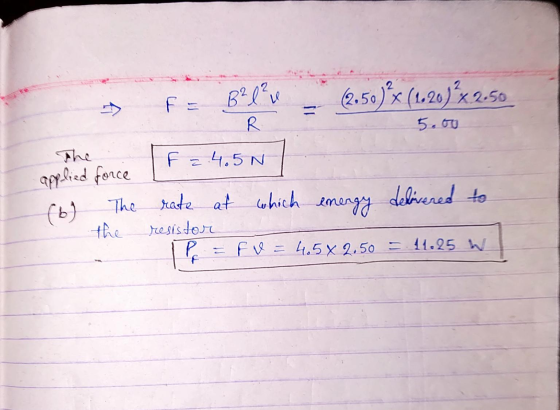
(a) Calculate the applied force required to move the bar to the
right at a constant speed of 2.50 m/s.
N (to the right)
(b) At what rate is energy delivered to the resistor?
W
Homework Answers
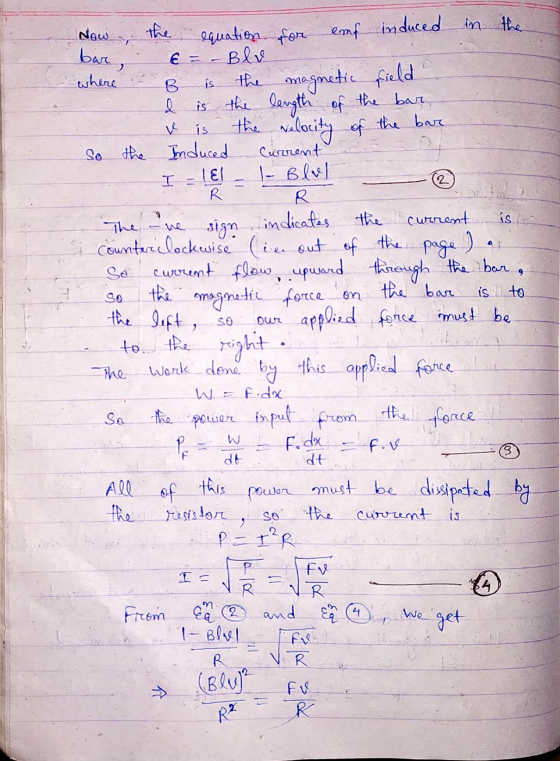
- The above problem is related to force on a current carrying wire because of magnetic field.
- All the steps are clearly mentioned and easy to understand.
- Hope the answer will help you. Thank you for your support.


Add Answer to:
The figure below shows a top view of a bar that can slide on two
frictionless...
In the figure below, a metal bar sitting on two parallel conducting rails, connected to each other by a resistor, is pulled to the right at a constant speed.
 A vertical bar and two parallel horizontal rails lie in the
plane of the page. The parallel rails run from left to right, with
one a distance ℓ above the other. The left ends of the rails are
connected by a vertical wire containing a resistor R. The
vertical bar lies across the rails to the right of the wire. Force
vector Fapp points from the bar toward
the right.In the figure below, a metal bar sitting on two parallel...
A vertical bar and two parallel horizontal rails lie in the
plane of the page. The parallel rails run from left to right, with
one a distance ℓ above the other. The left ends of the rails are
connected by a vertical wire containing a resistor R. The
vertical bar lies across the rails to the right of the wire. Force
vector Fapp points from the bar toward
the right.In the figure below, a metal bar sitting on two parallel...
The figure below shows a top view of a bar that can slide on two frictionless...
 The figure below shows a top view of a bar that can slide on two frictionless rails. The resistor is R - 6.80 O, and a 2.50-T magnetic field is directed perpendicularly downward, into the page. Let ! - 1.20 m. XX XX R (a) Calculate the applied force required to move the bar to the right at a constant speed of 1.90 m/s. N (to the right) (6) At what rate is energy delivered to the resistor? w
The figure below shows a top view of a bar that can slide on two frictionless...
 The figure below shows a top view of a bar that can slide on two frictionless rails. The resistor is R = 6.40 s, and a 2.50-T magnetic field is directed perpendicularly downward, into the page. Let l = 1.20 m. X X X X X X Bin X X X X X x X x X X X R X X X X X X *F app X X X X X X X X X (a) Calculate the...
4. -/10 points My Notes Ask Your Teacher The figure below shows a top view of a bar that can slide on two frictionl...
 4. -/10 points My Notes Ask Your Teacher The figure below shows a top view of a bar that can slide on two frictionless rails. The resistor is R -6,40 0, and a 2.50-T magnetic field is directed perpendicularly downward, into the page. Let l = 1.20 m. XXX Bin x x xxx (a) Calculate the applied force required to move the bar to the right at a constant speed of 1.50 m/s. N (to the right) C (b) At...
The adjacent figure shows a top view of a bar that can slide on two frictionless...
 The adjacent figure shows a top view of a bar that can slide on two frictionless rails. The resistance is R = 6.2. A 2.5 T magnetic field is directed perpendicularly downward into the paper. Let l = 1.2 m. (a) Calculate the applied force required to move the bar to the right at a constant speed of 2 m/s. X xx xx x x Bin (b) At what rate is energy delivered to the resistor? app
QUESTION 12 2, and a 2.50-T magnetic field is directed perpendicularly downward, The figure below shows...
 QUESTION 12 2, and a 2.50-T magnetic field is directed perpendicularly downward, The figure below shows a top view of a bar that can slide on two frictionless rails. The resistor is R = 6.20 into the page. Let l = 1.20 m. x * X * * * BAM * * * * * * * * X X X * * * * * * X X X * * * * * R . * * X...
please help me!! will comment and rate Thank you!! The figure below shows a top view...
 please help me!! will comment and rate Thank you!!
The figure below shows a top view of a bar that can slide on two frictionless rails. The resistor is R 7.000, and a 2.50-T magnetic field is directed perpendicularly downward, into the page. Let l = 1.20 m. X X X X X X X X XXXIX X X X X RZ x xxxxx X X X X P X X X X X X X X (a) Calculate the...
please help me!! will comment and rate Thank you!!
The figure below shows a top view of a bar that can slide on two frictionless rails. The resistor is R 7.000, and a 2.50-T magnetic field is directed perpendicularly downward, into the page. Let l = 1.20 m. X X X X X X X X XXXIX X X X X RZ x xxxxx X X X X P X X X X X X X X (a) Calculate the...
The figure below shows a bar of mass m = 0.280 kg that can slide without...
The figure below shows a bar of mass m = 0.280 kg that can slide without friction on a pair of rails separated by a distance ℓ = 1.20 m and located on an inclined plane that makes an angle θ = 29.5° with respect to the ground. The resistance of the resistor is R = 2.20 Ω, and a uniform magnetic field of magnitude B = 0.500 T is directed downward, perpendicular to the ground, over the entire region...
6. In the figure below, a metal wire of mass m = 24.1 mg can slide...
 6. In the figure below, a metal wire of mass m = 24.1 mg can slide with negligible friction on two horizontal parallel rails separated by distance d = 2.56 cm. The track lies in a vertical uniform magnetic field of magnitude B = 56.3 mT. At time t= 0, device G is connected to the rails, producing a constant current i = 9.13 mA in the wire and rails (even as the wire moves). At t = 61.1 ms,...
5. The conducting bar illustrated in the figure moves on two frictionless, parallel rails in the...
 5. The conducting bar illustrated in the figure moves on two frictionless, parallel rails in the presence of a uniform magnetic field directed into the page. The bar has mass m, and its length is t. The bar is given an initial velocity vi to the right and is released at t = 0. Using Newton's law find the speed of the bar as a function of time after it is released. X X X * Bin x x X...
 A vertical bar and two parallel horizontal rails lie in the
plane of the page. The parallel rails run from left to right, with
one a distance ℓ above the other. The left ends of the rails are
connected by a vertical wire containing a resistor R. The
vertical bar lies across the rails to the right of the wire. Force
vector Fapp points from the bar toward
the right.In the figure below, a metal bar sitting on two parallel...
A vertical bar and two parallel horizontal rails lie in the
plane of the page. The parallel rails run from left to right, with
one a distance ℓ above the other. The left ends of the rails are
connected by a vertical wire containing a resistor R. The
vertical bar lies across the rails to the right of the wire. Force
vector Fapp points from the bar toward
the right.In the figure below, a metal bar sitting on two parallel...
 The figure below shows a top view of a bar that can slide on two frictionless rails. The resistor is R - 6.80 O, and a 2.50-T magnetic field is directed perpendicularly downward, into the page. Let ! - 1.20 m. XX XX R (a) Calculate the applied force required to move the bar to the right at a constant speed of 1.90 m/s. N (to the right) (6) At what rate is energy delivered to the resistor? w
 The figure below shows a top view of a bar that can slide on two frictionless rails. The resistor is R = 6.40 s, and a 2.50-T magnetic field is directed perpendicularly downward, into the page. Let l = 1.20 m. X X X X X X Bin X X X X X x X x X X X R X X X X X X *F app X X X X X X X X X (a) Calculate the...
 4. -/10 points My Notes Ask Your Teacher The figure below shows a top view of a bar that can slide on two frictionless rails. The resistor is R -6,40 0, and a 2.50-T magnetic field is directed perpendicularly downward, into the page. Let l = 1.20 m. XXX Bin x x xxx (a) Calculate the applied force required to move the bar to the right at a constant speed of 1.50 m/s. N (to the right) C (b) At...
 The adjacent figure shows a top view of a bar that can slide on two frictionless rails. The resistance is R = 6.2. A 2.5 T magnetic field is directed perpendicularly downward into the paper. Let l = 1.2 m. (a) Calculate the applied force required to move the bar to the right at a constant speed of 2 m/s. X xx xx x x Bin (b) At what rate is energy delivered to the resistor? app
 QUESTION 12 2, and a 2.50-T magnetic field is directed perpendicularly downward, The figure below shows a top view of a bar that can slide on two frictionless rails. The resistor is R = 6.20 into the page. Let l = 1.20 m. x * X * * * BAM * * * * * * * * X X X * * * * * * X X X * * * * * R . * * X...
 please help me!! will comment and rate Thank you!!
The figure below shows a top view of a bar that can slide on two frictionless rails. The resistor is R 7.000, and a 2.50-T magnetic field is directed perpendicularly downward, into the page. Let l = 1.20 m. X X X X X X X X XXXIX X X X X RZ x xxxxx X X X X P X X X X X X X X (a) Calculate the...
please help me!! will comment and rate Thank you!!
The figure below shows a top view of a bar that can slide on two frictionless rails. The resistor is R 7.000, and a 2.50-T magnetic field is directed perpendicularly downward, into the page. Let l = 1.20 m. X X X X X X X X XXXIX X X X X RZ x xxxxx X X X X P X X X X X X X X (a) Calculate the...
 6. In the figure below, a metal wire of mass m = 24.1 mg can slide with negligible friction on two horizontal parallel rails separated by distance d = 2.56 cm. The track lies in a vertical uniform magnetic field of magnitude B = 56.3 mT. At time t= 0, device G is connected to the rails, producing a constant current i = 9.13 mA in the wire and rails (even as the wire moves). At t = 61.1 ms,...
 5. The conducting bar illustrated in the figure moves on two frictionless, parallel rails in the presence of a uniform magnetic field directed into the page. The bar has mass m, and its length is t. The bar is given an initial velocity vi to the right and is released at t = 0. Using Newton's law find the speed of the bar as a function of time after it is released. X X X * Bin x x X...
Most questions answered within 3 hours.
-
Where is the error in this code sequence?
String s1 = "Hello";
String s2 = "ello";...
asked 11 months ago -
Financial data for Joel de Paris, Inc., for last year
follow:
Joel de Paris, Inc.
Balance...
asked 11 months ago -
Consider this reaction:
Al2(SO4)3 (aq)+ BaCl3
(aq) Al2Cl6 (aq)- +
3BaSO4(s) . What is the...
asked 11 months ago -
Suppose that Savneet is considering increasing her
recent random sample from 20 car rentals to 40...
asked 11 months ago -
Trucks arrive at an unloading terminal at an average rate of 120
per hour.
Trucks arrive...
asked 11 months ago -
Why are methanol and ethanol completely soluble in water while
octanol is not very little soluble....
asked 11 months ago -
A facilities manager at a university reads in a research report
that the mean amount of...
asked 11 months ago -
When the CuSO4 is rehydrated by adding water to the anhydrous
compound, is this an endothermic...
asked 11 months ago -
A ray of sunlight is passing from diamond into crown glass; the
angle of incidence is...
asked 11 months ago -
A block of mass 0.249 kg is placed on top of a light, vertical
spring of...
asked 11 months ago -
how do the kidneys compensate in the presences of acidosis
a) trigger hyperventilate
b) reserve acid...
asked 11 months ago -
Question 501 pts
The rental rate of capital to the firm increases. Which of the
following...
asked 11 months ago