
Homework Answers
![For the reaction A - Product a general first order reaction, kinetic given by; in CA.] t = 2-303 к log CA] calculate constant](http://img.homeworklib.com/questions/5eb764c0-d9fb-11ea-98f8-17eaa4fc5e3d.png?x-oss-process=image/resize,w_560)
![G. K = 0.03 hr-1 3 So rate constant 50i03 hral = 0.03 hrd Now in se cond case, 85% of A in reacted. Su amount of A left CA] =](http://img.homeworklib.com/questions/5f6dbab0-d9fb-11ea-924e-759f2c0e7f07.png?x-oss-process=image/resize,w_560)
Add Answer to:
For a general first order reaction, A+ products, 35.0% of A has reacted after 14.2 hours....
For a general first order reaction, A+ products, 35.0% of A has reacted after 14.2 hours....
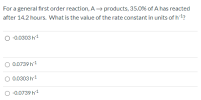 For a general first order reaction, A+ products, 35.0% of A has reacted after 14.2 hours. What is the value of the rate constant in units of h-1? 0 -0.0303 h 1 0.0739 h 1 0.0303 h 1 -0.0739h-1
The reactant concentration in a first-order reaction was 7.60×10⁻² M after 35.0 s and 5.50×10⁻³ M...
The reactant concentration in a first-order reaction was 7.60×10⁻² M after 35.0 s and 5.50×10⁻³ M after 85.0 s . What is the rate constant for this reaction? Express your answer with the appropriate units. Indicate the multiplication of units, as necessary, explicitly either with a multiplication dot or a dash. View Available Hint(s) k1st k1stk_1st =
The first order reaction SO2Cl2 → SO2 + Cl2, has a half-life of 8.75 hours at...
The first order reaction SO2Cl2 → SO2 + Cl2, has a half-life of 8.75 hours at 593 K. How long will it take for the reaction to be 37% complete? Express your answer to three significant figures
The reaction, aA products, is a first order reaction with a rate constant of 1.248...
The reaction, aA products, is a first order reaction with a rate constant of 1.248 x 10⁻⁴ s-1 . a. How long (in seconds) does it take for the initial amount of A to decrease by 30%? b. What fraction of reactant remains after 30 minutes? c. What is the half-life for the reaction? d. How long does it take for the initial amount of reactant to decrease by 87.5%?
The first order reaction, SO2Cl2 --> SO2 + Cl2, has a half life of 8.75 hours...
The first order reaction, SO2Cl2 --> SO2 + Cl2, has a half life of 8.75 hours at 593 K.? How long will it take for the concentration of SO2CL2 to fall to 12.5% of its initial value? Steps must be shown.
What statement is true? For the first-order reaction, A → products, 12.5% of initial amount of...
What statement is true? For the first-order reaction, A → products, 12.5% of initial amount of A is left after two half-lives. For the first-order reaction, A → products, if half of the initial concentration of A reacts in 20 min, then the remaining half will completely react in the next 20 min. For the first-order reaction, A → products, 25% of initial amount of A is left after two half-lives. For the first-order reaction, A → products, 75% of...
Back to main menu Exercise 1 The reaction N O4(g) 2NO2(g) has first-order kinetics and a...
 Back to main menu Exercise 1 The reaction N O4(g) 2NO2(g) has first-order kinetics and a rate law constant of 1.06x10⁻⁵ l/s at 298 K. (a) If the initial concentration of N20 is 3.40x10⁻⁵M and no NO2 is present at the beginning of the reaction, what is the concentration of NO2 after 1000s? (b) How long will it take for 90% of N2O, to react away? Express the time in days, hours and minutes. Rark to main menu
Given the first order reaction, X → Products, where X has half-life of 12.6 seconds, how...
Given the first order reaction, X → Products, where X has half-life of 12.6 seconds, how long will it take for 87.5% of the initial concentration of X to be consumed?
Referen The initial concentration of the reactant in a first-order reaction A → products is 0.528...
 Referen The initial concentration of the reactant in a first-order reaction A → products is 0.528 mol/L and the half-life is 27.0 s. (a) Calculate the concentration of the reactant (in mol/L) 54.0 s after initiation of the reaction. moll (b) How long (in s) would it take for the concentration of the reactant to drop to one eighth its initial value? (e) How long (ins) would it take for the concentration of the reactant to drop to 0.0330 mol/L?...
The reactant concentration in a first-order reaction was 8.60×10⁻² M after 35.0 s and 6.90×10⁻³ M...
The reactant concentration in a first-order reaction was 8.60×10⁻² M after 35.0 s and 6.90×10⁻³ M after 100 s . What is the rate constant for this reaction?
 For a general first order reaction, A+ products, 35.0% of A has reacted after 14.2 hours. What is the value of the rate constant in units of h-1? 0 -0.0303 h 1 0.0739 h 1 0.0303 h 1 -0.0739h-1
 Back to main menu Exercise 1 The reaction N O4(g) 2NO2(g) has first-order kinetics and a rate law constant of 1.06x10⁻⁵ l/s at 298 K. (a) If the initial concentration of N20 is 3.40x10⁻⁵M and no NO2 is present at the beginning of the reaction, what is the concentration of NO2 after 1000s? (b) How long will it take for 90% of N2O, to react away? Express the time in days, hours and minutes. Rark to main menu
 Referen The initial concentration of the reactant in a first-order reaction A → products is 0.528 mol/L and the half-life is 27.0 s. (a) Calculate the concentration of the reactant (in mol/L) 54.0 s after initiation of the reaction. moll (b) How long (in s) would it take for the concentration of the reactant to drop to one eighth its initial value? (e) How long (ins) would it take for the concentration of the reactant to drop to 0.0330 mol/L?...
Most questions answered within 3 hours.
-
Where is the error in this code sequence?
String s1 = "Hello";
String s2 = "ello";...
asked 10 months ago -
Financial data for Joel de Paris, Inc., for last year
follow:
Joel de Paris, Inc.
Balance...
asked 10 months ago -
Consider this reaction:
Al2(SO4)3 (aq)+ BaCl3
(aq) Al2Cl6 (aq)- +
3BaSO4(s) . What is the...
asked 10 months ago -
Suppose that Savneet is considering increasing her
recent random sample from 20 car rentals to 40...
asked 10 months ago -
Trucks arrive at an unloading terminal at an average rate of 120
per hour.
Trucks arrive...
asked 10 months ago -
Why are methanol and ethanol completely soluble in water while
octanol is not very little soluble....
asked 10 months ago -
A facilities manager at a university reads in a research report
that the mean amount of...
asked 10 months ago -
When the CuSO4 is rehydrated by adding water to the anhydrous
compound, is this an endothermic...
asked 10 months ago -
A ray of sunlight is passing from diamond into crown glass; the
angle of incidence is...
asked 10 months ago -
A block of mass 0.249 kg is placed on top of a light, vertical
spring of...
asked 10 months ago -
how do the kidneys compensate in the presences of acidosis
a) trigger hyperventilate
b) reserve acid...
asked 10 months ago -
Question 501 pts
The rental rate of capital to the firm increases. Which of the
following...
asked 10 months ago