
Homework Answers
Add Answer to:
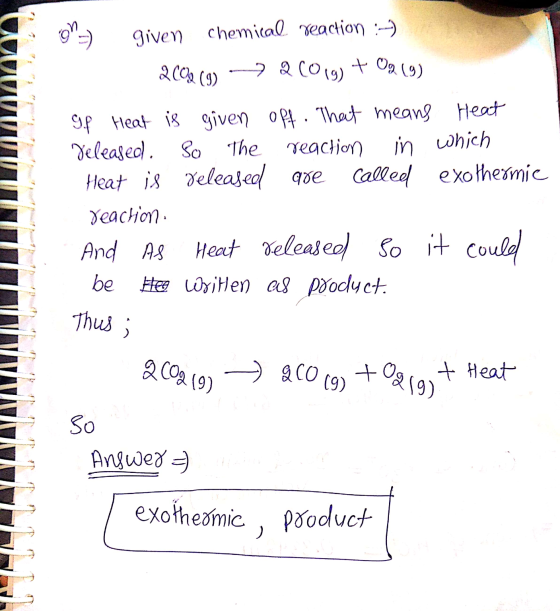
For the reaction of carbon dioxide to form carbon monoxide and oxygen, heat is given off....
Carbon dioxide reacts to form carbon monoxide and oxygen by the following equation: 2CO2 -> 2CO...
Carbon dioxide reacts to form carbon monoxide and oxygen by the following equation: 2CO2 -> 2CO + O2; K= 2.00 x 10⁻⁶ mol/L If 3.00 mmol CO2 is initially placed into a 5.00 L chamber, calculate the equilibrium concentration of all three species. Use the equilibrium ICE table and the 5% rule.
Carbon monoxide reacts with oxygen gas to form CO2, as shown by the balanced equation below....
Carbon monoxide reacts with oxygen gas to form CO2, as shown by the balanced equation below. 2CO (g) + O2 (g) ----------> 2CO2 (g) A reaction vessel contains 3.000 g of CO and 3.000 g of O2. What is the maximum number of moles of CO2 recovered, based on the number of moles of the given reactants?
What volumes (in liters) of carbon monoxide and oxygen gas must react according to the equation...
What volumes (in liters) of carbon monoxide and oxygen gas must react according to the equation 2CO(g) + O2(g) → 2CO2(g) to form 2.41 L of carbon dioxide? What is the volume of CO? what is the volume of the O2?
The direct reaction of methane (CH) with oxygen to give carbon monoxide is hard to accomplish without also producin...
 The direct reaction of methane (CH) with oxygen to give carbon monoxide is hard to accomplish without also producing carbon dioxide. However, we can use a Hess's law calculation to calculate AH,anyway. Calculate AH in kJ for the following reaction from the thermochemical equations given. 35. 2CO(g) + 4H2O() 2CH&(g) +302(g) Use the following thermochemical equations: AH-221.08 kJ 2CO(g) (1) 2C(s)+O2(g) AH=-890.4 kJ CH&g)+202(g) CO2(g)+ 2H20() (2) AH -393.51 kJ CO2(g) C(s)+O2(g) (3)
14) In an exothermic reaction, heat can be considered a A) reactant B) product C) rate...
 14) In an exothermic reaction, heat can be considered a A) reactant B) product C) rate D) catalyst E) determinant 15) Any reaction that absorbs 150 kcal of energy can be classified as A) endothermic B) exothermic C) activated D) reduction E) oxidation 16) The is the energy difference between reactants and products in a chemical reaction. A) transition energy B) activation energy C) product energy D) overall energy E) heat of reaction 17) For the reaction of carbon with...
--xal Yield and Percent Yield combusts with oxygen to form carbon dioxide and water by the...
 --xal Yield and Percent Yield combusts with oxygen to form carbon dioxide and water by the following reaction: pentane combud CsHız(l) + 8 O2(g) → 5 CO2(g) + 6 H2O(g) a. If 8.00 g of pentane is mixed with 10.0 g of oxygen, which is the limiting reactant? (Hint: compare it to either of the products). b. What is the theoretical yield (in grams) of carbon dioxide and water for this reaction? Hydrogen reacts with nitrogen to form ammonia by...
Part II : Volume - Volume 1. Carbon monoxide burns in oxygen to form carbon dioxide....
 Part II : Volume - Volume 1. Carbon monoxide burns in oxygen to form carbon dioxide. What volume of oxygen at 25°C and 760. mm Hg is required to react with 15.0 L of carbon monoxide (at STP)? 2. What volume of hydrogen and nitrogen are required to produce 20.0 L of ammonia (all gases at STP)? 3. Acetylene ( CH) burns in oxygen to form carbon dioxide and water. How many liters of oxygen (at STP) are needed to...
Ethane is burned in air (oxygen) to form carbon dioxide and water by the following reaction....
Ethane is burned in air (oxygen) to form carbon dioxide and water by the following reaction. Determine the maximum grams of carbon dioxide that can be formed if 57.9 g of ethane are reacted with 57.9 g of oxygen. 2 C2H6 + 7 O2 = 4 CO2 + 6H2O.
Question 5 (1 point) If (4.544x10^1) g of oxygen react with (4.81x10^1) g of carbon monoxide to form carbon dioxide...
 Question 5 (1 point) If (4.544x10^1) g of oxygen react with (4.81x10^1) g of carbon monoxide to form carbon dioxide. What mass of carbon dioxide forms? Note: Your answer is assumed to be reduced to the highest power possible. Your Answer: X10 Answer
Acetone reacts with oxygen to form carbon dioxide and water according to the following reaction: C3H6O(l,...
Acetone reacts with oxygen to form carbon dioxide and water according to the following reaction: C3H6O(l, acetone) + 4 O2 (g) → 3 CO2 (g) + 3 H2O(g) If we start with 27.3 g of acetone and 28.0 g of oxygen, how many grams of carbon dioxide do we make? Answer in 3 sig. figures please?
 The direct reaction of methane (CH) with oxygen to give carbon monoxide is hard to accomplish without also producing carbon dioxide. However, we can use a Hess's law calculation to calculate AH,anyway. Calculate AH in kJ for the following reaction from the thermochemical equations given. 35. 2CO(g) + 4H2O() 2CH&(g) +302(g) Use the following thermochemical equations: AH-221.08 kJ 2CO(g) (1) 2C(s)+O2(g) AH=-890.4 kJ CH&g)+202(g) CO2(g)+ 2H20() (2) AH -393.51 kJ CO2(g) C(s)+O2(g) (3)
 14) In an exothermic reaction, heat can be considered a A) reactant B) product C) rate D) catalyst E) determinant 15) Any reaction that absorbs 150 kcal of energy can be classified as A) endothermic B) exothermic C) activated D) reduction E) oxidation 16) The is the energy difference between reactants and products in a chemical reaction. A) transition energy B) activation energy C) product energy D) overall energy E) heat of reaction 17) For the reaction of carbon with...
 --xal Yield and Percent Yield combusts with oxygen to form carbon dioxide and water by the following reaction: pentane combud CsHız(l) + 8 O2(g) → 5 CO2(g) + 6 H2O(g) a. If 8.00 g of pentane is mixed with 10.0 g of oxygen, which is the limiting reactant? (Hint: compare it to either of the products). b. What is the theoretical yield (in grams) of carbon dioxide and water for this reaction? Hydrogen reacts with nitrogen to form ammonia by...
 Part II : Volume - Volume 1. Carbon monoxide burns in oxygen to form carbon dioxide. What volume of oxygen at 25°C and 760. mm Hg is required to react with 15.0 L of carbon monoxide (at STP)? 2. What volume of hydrogen and nitrogen are required to produce 20.0 L of ammonia (all gases at STP)? 3. Acetylene ( CH) burns in oxygen to form carbon dioxide and water. How many liters of oxygen (at STP) are needed to...
 Question 5 (1 point) If (4.544x10^1) g of oxygen react with (4.81x10^1) g of carbon monoxide to form carbon dioxide. What mass of carbon dioxide forms? Note: Your answer is assumed to be reduced to the highest power possible. Your Answer: X10 Answer
Most questions answered within 3 hours.
-
Where is the error in this code sequence?
String s1 = "Hello";
String s2 = "ello";...
asked 11 months ago -
Financial data for Joel de Paris, Inc., for last year
follow:
Joel de Paris, Inc.
Balance...
asked 11 months ago -
Consider this reaction:
Al2(SO4)3 (aq)+ BaCl3
(aq) Al2Cl6 (aq)- +
3BaSO4(s) . What is the...
asked 11 months ago -
Suppose that Savneet is considering increasing her
recent random sample from 20 car rentals to 40...
asked 11 months ago -
Trucks arrive at an unloading terminal at an average rate of 120
per hour.
Trucks arrive...
asked 11 months ago -
Why are methanol and ethanol completely soluble in water while
octanol is not very little soluble....
asked 11 months ago -
A facilities manager at a university reads in a research report
that the mean amount of...
asked 11 months ago -
When the CuSO4 is rehydrated by adding water to the anhydrous
compound, is this an endothermic...
asked 11 months ago -
A ray of sunlight is passing from diamond into crown glass; the
angle of incidence is...
asked 11 months ago -
A block of mass 0.249 kg is placed on top of a light, vertical
spring of...
asked 11 months ago -
how do the kidneys compensate in the presences of acidosis
a) trigger hyperventilate
b) reserve acid...
asked 11 months ago -
Question 501 pts
The rental rate of capital to the firm increases. Which of the
following...
asked 11 months ago